BigBlueButton
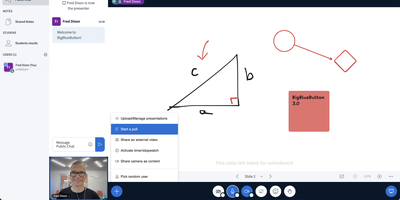
Used daily by millions of educators and learners in over 65 languages and embedded as the default virtual classroom in Moodle Cloud, Canvas, Sakai, D2L, Jenzabar, and Schoology — together comprising more than 75% of the worldwide learning management system market — BigBlueButton has been the leading open-source web conferencing platform for education since its creation at Carleton University in 2007. The platform delivers WebRTC-based real-time audio, video, and screen sharing with a tldraw v2-powered multi-user whiteboard featuring infinite canvas support, allowing multiple participants to annotate slides and draw simultaneously. Breakout rooms support up to eight concurrent groups with collaborative whiteboards enabled by default, and polling with customizable response types lets instructors assess understanding in real time. The built-in Learning Analytics Dashboard answers three questions at a glance: who is attending, who is participating, and who is learning based on poll responses, providing actionable engagement metrics without requiring webcam surveillance. Session recording captures audio, video, slides, chat, and whiteboard annotations for asynchronous playback on any device. The plugin architecture introduced in version 3.0 enables custom extensions, while IMS LTI 1.0 compliance allows integration with Blackboard, Desire2Learn, Pearson Learning Studio, and any conformant platform without custom code. The REST API enables programmatic session management, user authentication, and recording access for custom frontends like the included Greenlight application. Version 4.0 introduces LiveKit-based media and a redesigned interface. Running on a dedicated VPS on RepoCloud with guaranteed CPU, RAM, and SSD, full root SSH access, and a browser serial console. LGPL-3.0 licensed.
LiveKit
With over 20,000 GitHub stars and adoption by companies building everything from telehealth platforms to AI voice agents, LiveKit is the most widely deployed open-source real-time communication server available. The Go-based Selective Forwarding Unit handles hundreds of concurrent participants per node with adaptive bitrate streaming, simulcast layers, SVC codec support for VP9 and AV1, and end-to-end encryption. Client SDKs span JavaScript, Swift, Kotlin, Flutter, React Native, Rust, Python, Unity, and ESP32 embedded devices, while server-side APIs cover Node.js, Go, Ruby, Java, Python, Rust, PHP, and .NET. The Agents framework enables building AI-powered voice and video applications — real-time speech-to-text, LLM-driven conversations, and computer vision pipelines — running as server-side participants in any room. Egress records sessions to S3-compatible storage or streams to RTMP endpoints, while Ingress pulls external feeds from OBS via RTMP, WHIP, or SRT into LiveKit rooms. The SIP bridge connects traditional telephony to WebRTC rooms for hybrid conferencing. JWT-based authentication, webhook notifications, room-level moderation APIs, and selective subscription give operators granular control. Deploy as a single binary for development, Docker Compose for production single-node, or Kubernetes with the official Helm chart for distributed multi-region clusters using Redis for state coordination. Running on a dedicated VPS on RepoCloud with guaranteed CPU, RAM, and SSD, full root SSH access, and a browser serial console. Apache 2.0 licensed.
Jitsi Meet
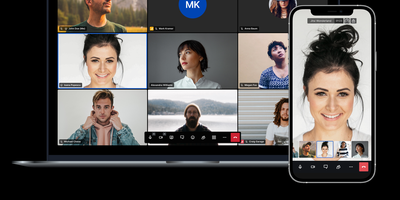
Backed by nearly 30,000 GitHub stars and powering millions of meetings through meet.jit.si, Jitsi Meet is the open-source video conferencing platform that runs entirely in the browser with no plugins or downloads required. The WebRTC-based architecture delivers HD audio and video through the Jitsi Videobridge selective forwarding unit, while Prosody handles XMPP signaling and Jicofo manages conference focus and orechestration. End-to-end encryption uses AES-GCM 128-bit keys exchanged via the Olm protocol, protecting audio, video, and screen sharing through the Insertable Streams API in Chromium-based browsers. Moderators can split participants into breakout rooms with individual password protection, enable lobby waiting rooms for admission control, set meeting passwords, and track speaker statistics with per-participant talk time metrics. Virtual backgrounds leverage TensorFlow.js body segmentation with WebGPU and WebGL acceleration, automatically adapting quality through device tier detection. Server-side recording and YouTube live streaming run through Jibri, while Jigasi provides a SIP gateway for PSTN dial-in and speech-to-text transcription. The platform includes in-meeting chat with private conversations, polls, raise-hand functionality, emoji reactions, and tile and speaker view layouts. Mobile applications for iOS and Android complement the web client, and both web and native SDKs enable embedding video conferences into custom applications. Running on a dedicated VPS on RepoCloud with guaranteed CPU, RAM, and SSD, full root SSH access, and a browser serial console. Apache-2.0 licensed.
Tailchat
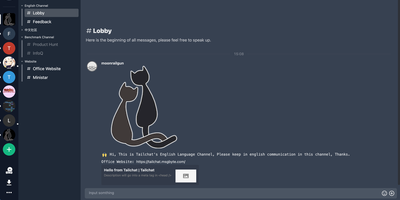
Think of it as a team messaging platform where every feature beyond core chat is a plugin you can install or remove, inspired by VS Code's extension model but applied to real-time communication. The Moleculer microservice backend scales horizontally across nodes while Socket.io delivers instant message synchronization with text, images, files, mentions, reactions, and rich Markdown formatting. Available plugins provide LiveKit video conferencing, collaborative drawing boards, task management panels, end-to-end encryption, custom themes, and third-party push notification reception without touching core code. Groups use a two-level space system with customizable panel layouts arranged through drag-and-drop, while role-based access control enforces fine-grained permissions across the organization. The Open Platform exposes OAuth for single sign-on across connected applications and a Bot API enabling bidirectional message processing between Tailchat and external services via HTTP requests. Multi-platform clients cover web, Electron desktop with screenshot capabilities, and mobile apps with native push. Docker Compose deployment bundles MongoDB for persistence, Redis for caching and transport, and MinIO for S3-compatible file storage. Deploy on RepoCloud with a dedicated VPS for persistent team infrastructure under the Apache 2.0 license.