
MLflow
Trusted by thousands of organizations with over 30 million monthly downloads and 20,000+ GitHub stars, MLflow is the largest open-source AI engineering platform providing end-to-end lifecycle management for traditional ML models, LLMs, and AI agents. The OpenTelemetry-based tracing system captures complete request flows through any LLM provider or agent framework — including OpenAI, LangChain, DSPy, Vercel AI, PydanticAI, and smolagents — with one-line auto-instrumentation that tracks inputs, outputs, token usage, and costs at every intermediate step. MLflow's evaluation engine offers 50+ built-in metrics and LLM judges for systematic quality assessment, detecting issues across correctness, latency, adherence, relevance, and safety dimensions before code reaches production. The Prompt Registry versions, tests, and deploys prompts with full lineage tracking while automated optimization algorithms improve prompt performance using evaluation feedback. The AI Gateway provides a unified API endpoint for all LLM providers, enforcing rate limits, cost controls, and access policies across the organization. MLflow 3.0 introduces the LoggedModel abstraction linking traces, metrics, and prompts to specific model versions across Python, TypeScript, Java, and R SDKs. The model registry manages deployment workflows with automated quality gates, while experiment tracking records parameters, metrics, and artifacts across training runs. Running on a dedicated VPS on RepoCloud with guaranteed CPU, RAM, and SSD, full root SSH access, and a browser serial console. Apache License 2.0 licensed.
Netron
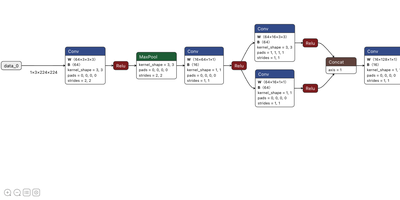
Hand Netron an ONNX, TensorFlow Lite, PyTorch, Core ML, or Keras file and the whole network appears as a zoomable graph, with no training framework or inference runtime required to read it. The same viewer opens TorchScript, torch.export, ExecuTorch, TensorFlow, OpenVINO, Caffe, Darknet, Safetensors, and NumPy files, with experimental support for MLIR, JAX, GGUF, RKNN, ncnn, MNN, PaddlePaddle, and scikit-learn. Click a layer to read its type, attributes, inputs, and outputs; click a weight to see its shape, data type, minimum, maximum, mean, standard deviation, and sparsity. Find searches nodes, connections, and weights by name and centers the graph on the match you pick. Toggle attributes, names, and weights on the canvas, flip between vertical and horizontal layouts, and watch light and dark themes follow the system setting. Model and graph panels list the format, producer, imports, graph inputs and outputs, and parameter counts. Any view exports as a PNG or SVG image for documentation, pull requests, and papers. Install with pip, then run netron model.onnx with a host and port, or call netron.start from Python, and the built-in HTTP server delivers the graph to any browser that can reach it. Teams point reviewers at one shared address to check exported models and conversion results. Running on a dedicated VPS on RepoCloud with guaranteed CPU, RAM, and SSD, full root SSH access, and a browser serial console. MIT licensed.