UltraRAG
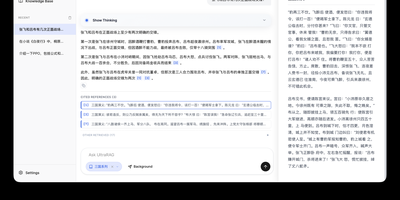
Every step, loop, and branch of a retrieval-augmented generation pipeline appears as a node on UltraRAG's visual canvas, with the YAML behind it kept in sync. Edit nodes on the canvas or in the synchronized YAML editor, press Build, read the console, set model endpoints and credentials on the Parameters page, and manage Jinja prompt templates. Corpus parses and chunks documents, Retriever embeds and indexes them in FAISS or Milvus, Generation calls vLLM, Hugging Face, or OpenAI, and each runs as its own MCP server you can swap or extend. Pipelines run in sequence, loop, or branch on a condition, and bundled examples cover Search-o1, VisRAG, IRCoT, and deep-research workflows. The Knowledge Base page creates Milvus collections and uploads documents, and Chat runs a built pipeline against a chosen collection and shows the sources behind each answer. The AI Assistant inspects your workspace, validates proposed YAML, and waits for you to apply or reject each change. Evaluation scores retrieval with MRR, NDCG, MAP, and Recall and generation with EM, F1, and ROUGE, and a built-in permutation test checks whether one retriever truly beats another. A Case Study viewer steps through each stage's inputs and outputs for every question, so you can see exactly where a pipeline went wrong. Running on a dedicated VPS on RepoCloud with guaranteed CPU, RAM, and SSD, full root SSH access, and a browser serial console. Apache-2.0 licensed.
RAGFlow
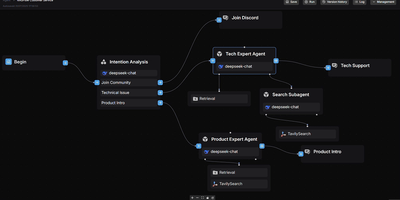
RAGFlow has established itself as one of the most widely adopted open-source RAG engines available, powering production AI systems that demand traceable, hallucination-free answers from complex enterprise data. The platform processes PDF, DOCX, Excel, and PPT files through vision-based deep document understanding with layout analysis and OCR, extracting structured knowledge from tables, charts, and images that simpler parsers miss entirely. RAGFlow's hybrid retrieval pipeline combines vector search with BM25 keyword matching and multi-stage reranking across configurable document stores including Elasticsearch, InfiniFlow's Infinity engine, OpenSearch, and OceanBase. Developers connect any combination of LLM providers — OpenAI, DeepSeek, Anthropic Claude, Google Gemini, and locally-hosted models via Ollama — through a unified configuration layer. The visual agent workflow system enables multi-step reasoning chains with persistent memory, tool calling, and pre-built templates for common enterprise scenarios. RAGFlow synchronizes data from Confluence, S3, Notion, and Google Drive, and delivers answers through chat integrations with Feishu, Discord, Telegram, and Line. The Python SDK and RESTful API on port 9380 provide programmatic access to knowledge base management, document parsing, and conversational retrieval. The full stack deploys via Docker Compose with MySQL for metadata, Redis for task orchestration, and MinIO for object storage. Running on a dedicated VPS on RepoCloud with guaranteed CPU, RAM, and SSD, full root SSH access, and a browser serial console. Apache 2.0 licensed.