ClassroomIO
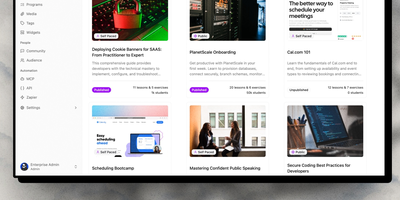
Turn company knowledge into structured courses in minutes: ClassroomIO's AI course builder takes your documents, policies, or topic outlines and generates complete lessons with exercises using Gemini, GPT-4o, or Claude — then an in-lesson AI tutor helps employees study the material at their own pace. The SvelteKit 5 and Hono API architecture backs a platform purpose-built for employee compliance training, customer education, and partner certification programs. Programs group courses into cohorts with team management, progress tracking, and goal setting. Live Kahoot-style quizzes drive real-time engagement during training sessions with automatic scoring and leaderboards. Exercises support multiple question types with automatic grading for multiple choice and AI-assisted evaluation for open-ended responses — teachers review and override all AI decisions. Branded certificates with custom IDs reward course completion. Custom domain mapping through Cloudflare lets organizations serve their learning portal under their own brand. MinIO provides S3-compatible storage for documents and video uploads. The REST API and signed webhooks enable programmatic enrollment and completion tracking, while an MCP server on npm supports AI-native authoring workflows. An embeddable widget drops the course catalog onto any website. Better Auth handles sessions and OAuth with optional SSO. Running on a dedicated VPS on RepoCloud with guaranteed CPU, RAM, and SSD, full root SSH access, and a browser serial console. AGPL-3.0 licensed.
Invio
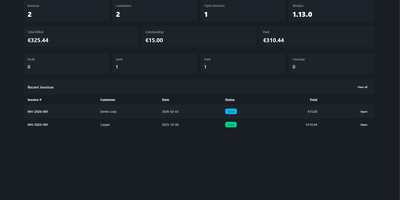
Create an invoice, share a secure link, get paid — that's the entire workflow, no client portals or account registrations required. Invio distills billing into its absolute minimum viable surface while still producing legally compliant EU electronic invoices in Factur-X/ZUGFeRD 2.2 BASIC, UBL 2.1, and Italian FatturaPA formats, all embedded as XML attachments inside WeasyPrint-rendered PDFs. The Deno 2 backend uses Hono v4 for HTTP routing with SQLite persistence, while the SvelteKit 2 frontend styled with Tailwind CSS v4 and DaisyUI v5 delivers a responsive interface that stays out of your way. The team access system includes a permission matrix, TOTP-based two-factor authentication, and OIDC integration with configurable auto-provisioning — drop it into existing identity infrastructure without manual user management. Preset products let you build invoices from reusable catalog items. A change history log tracks every modification for audit purposes. Rate limiting protects the API behind reverse proxies. The entire stack ships as a single multi-stage Docker image containing Deno, Bun, Node, WeasyPrint, and all required font packages — zero external service dependencies beyond the container itself. Running on a dedicated VPS on RepoCloud with guaranteed CPU, RAM, and SSD, full root SSH access, and a browser serial console. Unlicense licensed.
SolidInvoice
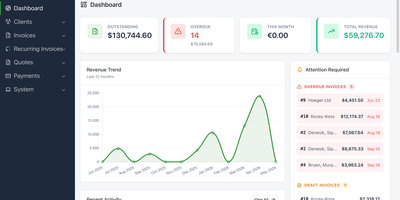
SolidInvoice ships a complete billing platform as a single FrankenPHP binary — no separate PHP installation, no web server configuration, just one executable that delivers quote-to-invoice conversion, automated recurring billing, Stripe and PayPal payment processing, multi-currency precision arithmetic, and eight render-ready PDF templates out of the box. Maintained since 2012 across 63 releases with 30 contributors, the Symfony 7 and PHP 8.4 backend provides quote creation with one-click conversion to invoices, recurring billing with configurable frequency schedules, and online payment processing through Payum supporting Stripe, PayPal, and additional gateways. Multi-currency support uses real Money objects for precision arithmetic, while multi-tax support handles invoice-level and line-item tax rates with automatic calculation. Client management stores contacts, multiple addresses with map integration, credit balances, and complete quote and invoice history per client. The redesigned Tabler-based UI features a dashboard with hero statistics, ChartJS revenue trend visualization, attention-required alerts for overdue and draft invoices, quick actions, and a recent activity timeline. A RESTful API enables integrations with external systems. Multi-channel notifications deliver alerts via email, SMS, and webhooks. Google OAuth and two-factor authentication secure access. Grid export and full company data export support backup and migration. Deploy using Docker, Homebrew, the standalone FrankenPHP binary, or from source. Running on a dedicated VPS on RepoCloud with guaranteed CPU, RAM, and SSD, full root SSH access, and a browser serial console. MIT licensed.
Invoicerr
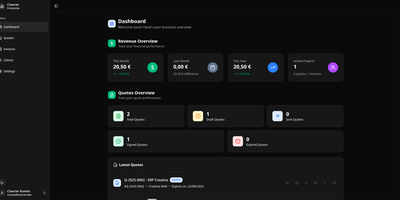
Invoicerr nails the exact billing sequence freelancers actually use: draft a quote, send it to the client, collect a legally-binding electronic signature via a secure browser link, convert the approved quote into an invoice, and generate a branded PDF — no DocuSign account, no external signing service, no enterprise complexity. The React frontend with NestJS backend uses Prisma ORM with your choice of SQLite for instant local setup or PostgreSQL for production workloads. Quotes and invoices are first-class objects with independent status tracking — unread, sent, viewed, signed for quotes; paid for invoices — not a single form with a label swap. The e-signature system generates secure-token signing links that clients open in their browser to review and sign documents without needing any account or external service. PDF generation renders quotes, invoices, and receipts with your company logo, name, VAT number, colors, and custom email templates so documents reflect your brand identity rather than the software's defaults. Authentication supports JWT tokens or OIDC providers stored in cookies. The REST API backend enables future integrations with mobile and desktop clients. A plugin system with community-made features and outgoing webhooks extends functionality without forking core code. International-friendly with customizable currencies. Deploy with Docker Compose using the prebuilt image from GitHub Container Registry. Running on a dedicated VPS on RepoCloud with guaranteed CPU, RAM, and SSD, full root SSH access, and a browser serial console. AGPL-3.0 licensed.
InvoicePlane
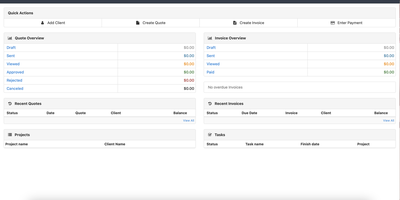
InvoicePlane manages the complete freelance and small-business billing cycle — draft quotes, convert them to invoices, automate recurring charges, collect payments through Stripe and PayPal, and generate EU-compliant eInvoice XML for automated processing by accounting systems. Deployed over 100,000 times across 193 countries, the PHP 8.2+ application on CodeIgniter 3 with MySQL or MariaDB handles everything from first estimate to final receipt. EU-compliant eInvoice generation creates machine-readable XML invoices meeting European Union standards since version 1.6.2. Recurring invoices automate periodic billing with configurable controls that pause generation when previous invoices remain unpaid. Online payment integration lets clients pay directly through Stripe, PayPal with Advanced Credit Cards, and Venmo support. The CRM-like client management module stores contact details, notes, custom fields, and complete transaction history per client. Product and task management modules let you build line-item invoices from reusable product catalogs and project tasks. Customizable PDF templates powered by mPDF support branded invoice layouts with QR codes, while email delivery via PHPMailer handles automated sending with configurable SMTP. A guest portal gives clients read-only access to view and pay their outstanding invoices and quotes. Financial reporting tracks revenue, outstanding balances, and payment history. The multi-language interface supports community translations, and multi-currency handles international invoicing. Deploy via Docker Compose with automatic database migrations. Running on a dedicated VPS on RepoCloud with guaranteed CPU, RAM, and SSD, full root SSH access, and a browser serial console. MIT licensed.
GoRaven
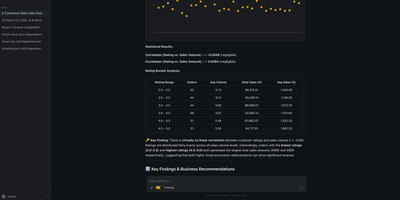
GoRaven transforms AI chat from a question-answer window into a full engineering workstation where agents read files, write code, run shell commands, query databases via MCP tools, and deliver structured results — orchestrating across OpenAI, Claude, DeepSeek, Gemini, Qwen, GLM, and Ollama with task-based routing that allocates the right model for each job based on cost and capability. Built on a Go backend using the Freedom framework with Iris HTTP and a React/TypeScript frontend powered by Vite and Tailwind CSS, each user operates in an isolated workspace with team-shared project areas and centrally managed model quotas. The skill marketplace packages prompts, scripts, and workflows as reusable installable units with automatic dependency resolution and centralized versioning. MCP toolchain integration connects agents to internal APIs, databases, private services, and CLI tools so they query data, invoke services, and trigger actions directly. RAG-powered knowledge bases ingest policies, documentation, and business data for real-time retrieval during planning, coding, and Q&A with source attribution. Long-running task support decomposes complex work through a main agent coordinating sub-agents that execute in parallel across sessions. Plugin hooks inject custom logic at conversation start and end, tool calls, and SSE event streams without forking core code. The operations dashboard tracks usage metrics, model consumption, and team activity. Supports SQLite, MySQL, or PostgreSQL with Redis or local memory caching. Deploy with a single Docker command. Running on a dedicated VPS on RepoCloud with guaranteed CPU, RAM, and SSD, full root SSH access, and a browser serial console. Apache 2.0 licensed.
Krayin CRM
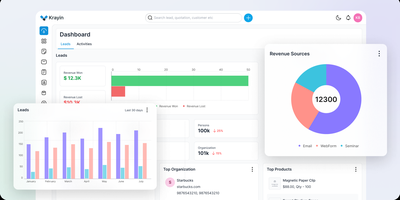
Krayin CRM gives sales teams a visual Kanban pipeline where leads flow through configurable stages — new, contacted, qualified, proposal, won, lost — with deal values tracked per stage, drag-and-drop transitions, and AI-powered document import that extracts contact details from uploaded PDFs, DOCs, and images without manual data entry. Built on Laravel 12 with a Vue.js frontend and MySQL database, the platform delivers complete customer lifecycle management through a two-stage contact model separating unqualified Leads from qualified Persons linked to Organizations, with a unified timeline displaying associated activities, notes, emails, and deals. The activity module schedules calls, meetings, and tasks on a drag-and-drop calendar with reminders and team assignment. A built-in product catalog supports line-item quoting with pricing and quantities. Email integration connects via SMTP, IMAP, and SendGrid parsing, linked to leads and contacts automatically. Workflow automation triggers actions on conditions and pushes events to external systems via webhooks. The dashboard visualizes pipeline performance, top customers, top products, and email engagement with pie charts and trend widgets. Custom attributes add text, number, date, boolean, and dropdown fields to any entity. Role-based ACLs manage team permissions per module. Extensions add multi-tenant SaaS, WhatsApp lead generation, and VoIP calling. Deploy via Docker Compose. Running on a dedicated VPS on RepoCloud with guaranteed CPU, RAM, and SSD, full root SSH access, and a browser serial console. MIT licensed.
GoatCounter
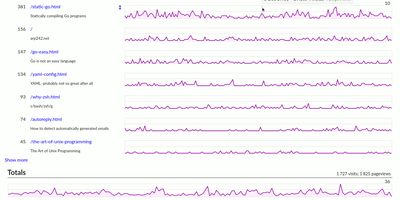
GoatCounter delivers meaningful web traffic insights — pageviews, referrers, browsers, screen sizes, country-level geolocation — without setting a single cookie, without collecting personal data, and without forcing GDPR consent banners on your visitors. Written entirely in Go and distributed as a single compiled binary consuming roughly 25MB of RAM, it adds just 3.5KB to your pages via the tracking script, with a JavaScript-free tracking pixel alternative for sites that avoid scripts entirely, plus backend middleware integration and log file import for server-side collection. The dashboard displays pageview counts per path with hourly resolution, referrer sources grouped by domain with full URL on hover, browser and OS version breakdowns, screen size distributions, and country-level location data derived from IP addresses that are immediately discarded after geolocation. Campaign tracking supports UTM parameters and custom data attributes. A public stats option exposes your dashboard at a shareable URL for build-in-public transparency. SQLite serves as the default database requiring zero administration, while PostgreSQL handles higher-traffic deployments with multi-site setups. Built-in ACME and TLS certificate management eliminates reverse proxy requirements for HTTPS — no Nginx or Caddy needed. The REST API provides programmatic access to all analytics data. Deploy as a single binary, via Docker with the official arp242/goatcounter image, or through native packages. Running on a dedicated VPS on RepoCloud with guaranteed CPU, RAM, and SSD, full root SSH access, and a browser serial console. EUPL-1.2 licensed.
pgAdmin
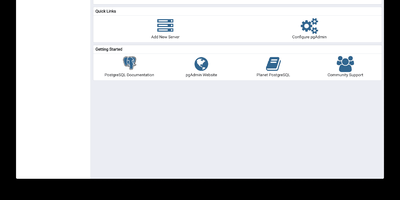
pgAdmin 4 is the reference administration GUI for PostgreSQL, bundled by virtually every Linux distribution and supporting versions 14 through 18 including EDB Advanced Server — browse schemas in a hierarchical tree, write and optimize queries with AI assistance, design entity-relationship diagrams visually, monitor live sessions, and run backup/restore operations entirely from the browser. Built on Python Flask with a ReactJS frontend, version 9.17 delivers a comprehensive web-based platform accessible from any device. The Query Tool provides syntax highlighting, auto-completion, query history, an EXPLAIN plan visualizer with graphical node representation, AI-powered SQL generation from natural language prompts, and AI Insights for execution plan analysis that identifies performance bottlenecks. The Graph Visualiser renders query results as line charts, bar charts, stacked charts, and pie charts directly in the interface. The ERD Tool auto-generates entity-relationship diagrams from existing schemas for visual database design. The Schema Browser presents databases, schemas, tables, views, functions, sequences, roles, and extensions in a navigable hierarchy. Server monitoring dashboards display real-time active sessions, locks, transaction throughput, and vacuum status. GUI-driven backup and restore wraps pg_dump and pg_restore with format and compression options. Authentication supports internal, LDAP, Kerberos, OAuth2/OIDC, and webserver modes. The Helm chart includes an HTTPRoute template for Kubernetes Gateway API deployments. Bundled pg_dump, pg_restore, and psql utilities version 18.4. Deploy via Docker with the official dpage/pgadmin4 image. Running on a dedicated VPS on RepoCloud with guaranteed CPU, RAM, and SSD, full root SSH access, and a browser serial console. PostgreSQL License.
Shelf
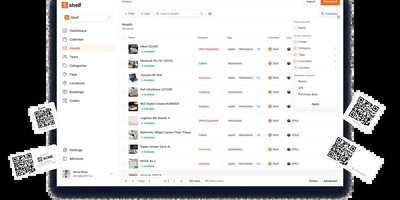
Shelf answers the three questions every equipment manager dreads — who has it, where is it, and when is it coming back — using QR-code-first tracking where every asset gets a unique scannable label, every handover is logged with timestamps and e-signed custody agreements, and every scan captures GPS coordinates displayed on a map. Built on React Router 7 with React 19, TypeScript 5, Prisma 6 ORM, and Tailwind CSS 3 with Radix UI components, the platform generates QR codes and barcodes (Code128, Code39, Datamatrix) printable on DYMO, Brother, and Zebra label printers. The custody system records every handover with user details and generates PDF custody agreements with e-signatures for high-value items, while a complete audit trail tracks responsibility from check-out to return. The visual booking calendar prevents double-bookings automatically, supports partial check-outs and returns with segmented lifecycle bars, and handles quantity-tracked consumables alongside individually serialized equipment. Asset Models enable bulk creation of identical items with shared defaults while maintaining individual QR codes and custody histories. Location tracking displays last-scanned GPS coordinates on MapTiler maps. Supabase Auth provides email and SSO authentication, pg-boss handles background job queuing, and Nodemailer delivers SMTP email. The Shelf Companion app on iOS and Android enables field scanning and bookings. Export Asset Inventory, Asset Distribution, and Custody Snapshot reports for compliance. Deploy via Docker with PostgreSQL and Supabase. Running on a dedicated VPS on RepoCloud with guaranteed CPU, RAM, and SSD, full root SSH access, and a browser serial console. AGPL v3.0 licensed.
Mixpost
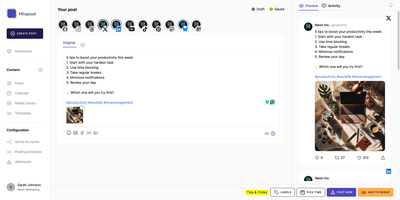
Mixpost puts Facebook, Instagram, X, LinkedIn, YouTube, TikTok, Pinterest, Threads, Bluesky, Mastodon, Pixelfed, and Google Business under a single scheduling dashboard — plan content visually on a drag-and-drop calendar, queue posts for optimal engagement windows, and track audience growth per platform without juggling twelve separate apps or paying per-seat SaaS fees. Built on Laravel with a Vue.js 3 and Inertia.js frontend styled with Tailwind CSS, the Lite edition provides unified content management where each post supports platform-specific customization with individual captions, media attachments, hashtag groups, and first-comment scheduling. Posting queues automate publishing at configurable time slots throughout the day. The media library provides a centralized asset manager with drag-and-drop uploads, stock photo integration via Unsplash, and Tenor GIF search. AI-powered content assistance generates and optimizes post copy. Per-platform analytics dashboards display audience growth, engagement metrics, reach, and impressions with exportable reports. Team workspaces support role-based permissions for collaborative content management across departments. External integrations connect through the REST API, webhooks, n8n, Zapier, and RSS feeds, plus an MCP server for AI assistant publishing. Deploy via Docker Compose with MySQL and Redis. Running on a dedicated VPS on RepoCloud with guaranteed CPU, RAM, and SSD, full root SSH access, and a browser serial console. MIT licensed.
SurveyKing
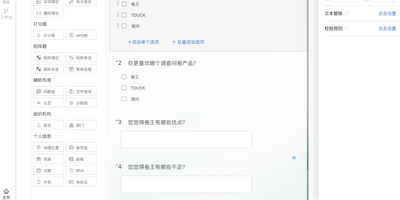
SurveyKing combines survey creation and online examination in a single platform — generate complete questionnaires from plain English via built-in LLM integration, administer timed exams with anti-cheating proctoring, and collect structured data through 20+ question types including matrix questions, cascading selectors, file uploads, and electronic signatures. Built on Spring Boot 3 with a React and TypeScript frontend using the UMI framework and Ant Design components, version 1.12 delivers each question type with independent validation rules, data type controls, and formula calculations. The AI engine connects to mainstream LLMs for survey generation from natural language prompts and provides real-time answer explanations during practice sessions. Exam mode features item banks with Word and Excel bulk import, fixed and randomized question selection, composite paper assembly, live proctoring dashboards with anti-cheating controls, automatic and manual grading with per-question scoring, and PDF score report archiving. The visual logic designer and DSL expression engine handle show/hide conditions, required rules, skip branching, quota controls, randomization, and cross-tabulation analysis with SPSS export. Role-based access controls support multi-user collaboration with department and permission management via Spring Security and JWT authentication. Redis handles caching and queuing while MyBatis Plus manages database operations. Deploy via a single Docker command with embedded H2 for trials or Docker Compose with MySQL for production. Running on a dedicated VPS on RepoCloud with guaranteed CPU, RAM, and SSD, full root SSH access, and a browser serial console. MIT licensed.
AzuraCast
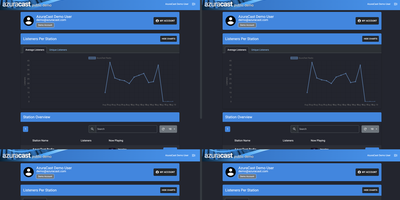
AzuraCast is a solution for running internet radio stations, packaging the entire broadcast stack into a single Docker installation that gets you on air in minutes. Built on PHP with a Vue.js frontend, it uses Liquidsoap as the AutoDJ engine to compile media from playlists, live DJ inputs, and scheduled programming into composited output streams, then broadcasts via Icecast-KH, SHOUTcast 2 DNAS, or Rocket Streaming Audio Server to thousands of concurrent listeners. The media library supports drag-and-drop uploads with automatic metadata extraction, while playlist management handles sequential, random, weighted, and time-scheduled rotations. Live DJ accounts let remote broadcasters connect via BUTT, Mixxx, or any Icecast-compatible software, with automatic crossfade transitions between AutoDJ and live input. The built-in Web DJ tool enables broadcasting directly from the browser without additional software. Each station includes public-facing player pages with now-playing metadata, album art, song history, and embeddable widgets for external websites. The listener request system lets audiences queue songs through the public interface. Multi-station administration hosts unlimited stations on a single server with individual user accounts and granular role-based permissions. Comprehensive analytics track listener counts, geographic distribution, unique listeners, and listening duration with exportable reports. HLS streaming delivers adaptive bitrate broadcasts for mobile compatibility. LADSPA audio plugins enable professional equalization and processing in the stream pipeline. Running on a dedicated VPS on RepoCloud with guaranteed CPU, RAM, and SSD, full root SSH access, and a browser serial console. AGPL-3.0 licensed.

Wealthfolio
Wealthfolio is a portfolio tracker offering a complete wealth management platform where financial data never leaves your infrastructure. Built on Rust with an Axum HTTP server, Diesel ORM, and SQLite storage, paired with a React 19 and Vite frontend, version 3.6 tracks stocks, ETFs, mutual funds, crypto, and cash savings across unlimited accounts with unified holdings. The performance engine calculates time-weighted returns (TWR), internal rate of return (IRR), volatility, maximum drawdown, and benchmark comparisons against the S&P 500 and custom indices, scoped per-account or across the entire portfolio. Net worth tracking monitors assets including real estate, vehicles, collectibles, and precious metals alongside liabilities, with stale-valuation warnings for items not updated in 90+ days. The spending module categorizes transactions automatically, supports multi-currency credit cards, builds budgets with monthly targets and rollovers, and generates narrative insights. A built-in AI assistant answers portfolio questions, suggests asset classifications, and imports transactions conversationally — bring your own API key from OpenAI, Anthropic, or use local LLMs. The addon system provides sandboxed extensions with granular permission declarations across 16 capability domains. CSV import maps broker exports with per-broker recipes for Interactive Brokers, Schwab, Fidelity, and dozens more. Market data streams from Yahoo Finance with automatic currency conversion. Running on a dedicated VPS on RepoCloud with guaranteed CPU, RAM, and SSD, full root SSH access, and a browser serial console. AGPL-3.0 licensed.

Bagisto
Bagisto is an eCommerce framework for businesses demanding full ownership and zero recurring platform fees. Built on Laravel 12 and Vue.js, version 2.4 supports seven product types — simple, configurable, virtual, downloadable, grouped, bundle, and booking — with multi-channel inventory management across unlimited warehouses and sales channels. The multi-vendor marketplace module transforms a single store into a full marketplace with vendor dashboards, commission management, automated approval workflows, and seller-managed product catalogs supporting 10M+ SKUs through Elasticsearch and OpenSearch indexing. Payment processing handles Stripe, Razorpay, PayU, PhonePe, and PayPal v2 with secure checkout sessions and IPN processing. The headless commerce architecture exposes a GraphQL API via Laravel Lighthouse, enabling decoupled storefronts built with Next.js or any frontend framework, while the PWA module delivers mobile-optimized shopping experiences. AI integration through the Laravel AI SDK connects GPT-5, Gemini, Mistral, and other LLMs for automated product descriptions, chatbot support, and AI-powered image search with TensorFlow.js fallback. Enterprise security features include admin two-factor authentication, Google reCAPTCHA Enterprise, and EU-compliant online contract withdrawal per Directive 2023/673. Built-in SEO tools handle meta titles, descriptions, keywords, and channel-wise sitemap generation. Redis caching, Laravel queues for async operations, and horizontal scaling support containerized deployments across multiple application and database servers. Running on a dedicated VPS on RepoCloud with guaranteed CPU, RAM, and SSD, full root SSH access, and a browser serial console. MIT licensed.
Snipe-IT
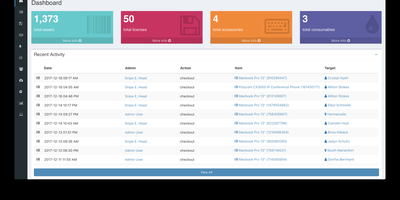
Trusted by thousands of organizations worldwide with over 14,700 GitHub stars, Snipe-IT has been the gold standard in open-source IT asset management since 2013. Built on Laravel 12 with PHP 8.2+, it provides a comprehensive web-based platform for tracking every physical and digital asset in your organization — from laptops and servers to software licenses, accessories, consumables, and components. The check-in/check-out system assigns assets to users with full audit trails, digital signature acceptance, and automated email notifications for checkouts, approaching deadlines, expiring warranties, and low inventory. License management handles multi-seat software with seat-by-seat tracking, compliance monitoring, and expiration alerts. Custom fields let you capture organization-specific metadata, while the advanced search engine supports logical operators including and/or conditions, exact matching with is:value, fuzzy exclusions with not:value, and null checks. SCIM 2.0 integration synchronizes users, groups, locations, companies, and managers from identity providers like Azure Entra ID and Okta. Enterprise authentication supports LDAP, Active Directory, Google Secure LDAP, and SAML 2.0 single sign-on. The reporting dashboard generates custom asset reports with saved templates, depreciation schedules, and audit logs. QR code labels enable instant mobile asset lookup via barcode scanners. The full-featured JSON REST API powers custom integrations, with community-built SDKs, MCP servers, and third-party mobile apps including SnipeMate and Snipe-Scan. Deploy via Docker Compose with MariaDB 11 in minutes. Running on a dedicated VPS on RepoCloud with guaranteed CPU, RAM, and SSD, full root SSH access, and a browser serial console. AGPL-3.0 licensed.
Kotaemon
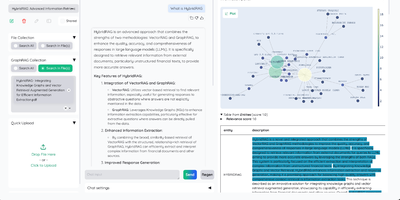
Kotaemon is a document QA platform that combines advanced RAG techniques with a clean Gradio-based web interface for chatting with your documents. Built by Cinnamon, the Python backend supports any LLM provider including OpenAI, Azure OpenAI, Cohere, Groq, and local models via Ollama and llama-cpp-python, with a model management panel for configuring LLM and embedding providers from the UI. The default hybrid RAG pipeline combines full-text keyword retrieval with vector similarity search and applies re-ranking to ensure optimal result quality, while multi-modal document parsing extracts content from tables and figures alongside text. Advanced citations link every answer to specific source passages with relevance scores, viewable directly in the built-in PDF viewer with highlighted text spans. GraphRAG indexing via NanoGraphRAG, LightRAG, or Microsoft GraphRAG builds knowledge graphs from document collections for relationship-aware retrieval. Agent-based reasoning supports question decomposition for multi-hop queries using ReAct and ReWOO strategies. Multi-user authentication organizes documents into private and public collections with sharing and collaboration features. The platform supports Docker deployment in lite, full, and Ollama-bundled variants, runs on port 7860, and stores application data in a persistent volume. MCP tool integration enables external system connections for extended retrieval capabilities. On RepoCloud, deploy Kotaemon on a dedicated VPS with Docker, root SSH access, and complete control over your document AI infrastructure, all under the Apache 2.0 license.
Keep
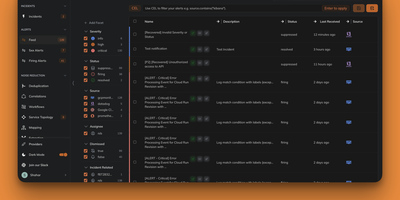
Keep is an open-source AIOps and alert management platform built with Python FastAPI and Next.js. It provides a single pane of glass for monitoring alerts from 110+ integrations, alert deduplication, correlation, enrichment, and filtering, YAML-based workflow automation similar to GitHub Actions, AI-powered correlation and summarization, and customizable dashboards for incident management. With 12,100+ GitHub stars, Y Combinator backing, and an Elastic partnership, Keep is the open-source AIOps platform that centralizes alert management across your entire monitoring stack into a single customizable dashboard. Alert deduplication identifies duplicate notifications across providers, correlation groups related alerts into incidents based on rules or AI-powered semantic analysis using pluggable LLM backends supporting OpenAI, Anthropic, and local models via Ollama, and enrichment adds context from external sources like CMDBs and databases. Workflow automation follows a GitHub Actions paradigm with declarative YAML files defining triggers, conditions, and actions that can query MySQL, update Jira tickets, send Slack messages, execute Python scripts, or call REST APIs. Authentication supports no-auth, database, Auth0, Keycloak, OAuth2 Proxy, Okta, and OneLogin. The Common Expression Language enables advanced alert querying, slicing, and rule-based grouping to reduce noise. On RepoCloud, deploy Keep on a dedicated VPS with Docker Compose, root SSH access, and complete control over your alert infrastructure, all under the MIT license.