Apache SeaTunnel
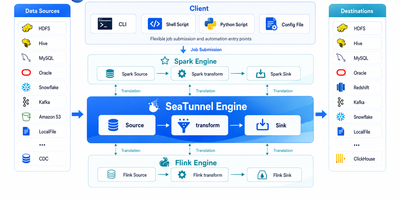
Apache SeaTunnel is a distributed integration platform that runs batch, streaming, and change-data-capture pipelines between databases, message queues, data lakes, lakehouses, and SaaS applications without hand-rolled scripts. Pipelines are declared once in a configuration file and executed on your choice of the native Zeta engine, Apache Flink, or Apache Spark, so the same job definition travels across engines without connector rewrites. Real-time CDC captures row changes from major databases with a snapshot-first handoff that never locks the source, while checkpoint-backed recovery restarts jobs from the last completed checkpoint with exactly-once semantics. When an upstream table gains a column, schema evolution propagates the change downstream automatically instead of pausing the pipeline for manual surgery. Roughly two hundred connectors cover relational databases, Kafka, object storage, search indexes, vector stores, and business apps, and the multi-table routing keeps every record on the right destination path. Engineers can dry-run configurations against sampled data before a full launch, isolate failures per table, and route bad records to dead-letter queues. Release 3.0.0 adds AI-assisted configuration generation from natural language, Python sources and transforms, and document parsing with text chunking for RAG preparation. Running on a dedicated VPS on RepoCloud with guaranteed CPU, RAM, and SSD, full root SSH access, and a browser serial console. Apache-2.0 licensed.
Apache EventMesh
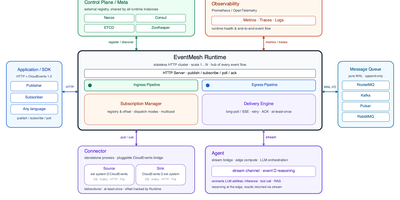
Applications publish an event once and stop caring who needs it next: Apache EventMesh receives CloudEvents over plain HTTP, stores them durably, and delivers each one to every subscription that matches. Producers call publish, consumers call subscribe or unsubscribe, and the runtime owns the registry, offsets, acknowledgements, and redelivery that messaging clients usually force you to build yourself. Subscribers choose load-balanced delivery for competing workers, broadcast delivery for every listener, or multicast for selected groups, and they receive events by HTTP long polling, Server-Sent Events, or WebSocket push. Filters drop irrelevant events before they leave the mesh, while transformers reshape payloads so a producer and consumer can disagree about format without either one changing code. Kafka and RocketMQ act as pluggable write-ahead storage, with an in-memory backend for development, and stateless runtime instances scale horizontally without consumer-group rebalancing. Twenty-three connectors move events into and out of RabbitMQ, Pulsar, MongoDB, MySQL change data capture, Redis, S3, Prometheus, Slack, DingTalk, Lark, WeChat, and AI services, each checkpointing offsets so failures replay instead of silently losing data. Agent-to-Agent protocol support and MCP connectors let AI agents exchange asynchronous events alongside synchronous tool calls, and event-triggered agents can publish decisions back into the mesh for downstream delivery. Running on a dedicated VPS on RepoCloud with guaranteed CPU, RAM, and SSD, full root SSH access, and a browser serial console. Apache-2.0 licensed.
Apache RocketMQ
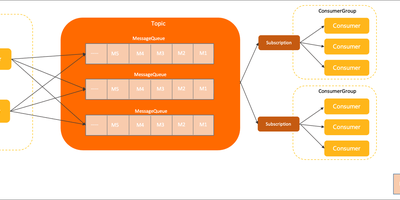
When your services need to talk without waiting on each other, Apache RocketMQ carries the conversation: a distributed messaging platform where producers publish to topics and consumers process at their own pace, with delivery guarantees you can build money movement on. Send ordinary messages for fire-and-forget events, transactional messages that commit or roll back with your local database transaction, ordered and FIFO messages for sequences that must not shuffle, and delayed messages that arrive seconds or days later on schedule. Consumers pull with long polling, filter by tag or SQL expression at the broker, and retry failures through built-in retry queues and dead letter queues instead of losing work. Clusters scale by adding brokers, while Controller mode elects broker replicas automatically so a failed node stops being a page. The Proxy component speaks gRPC with modern multi-language clients and adds POP consumption, where messages become invisible while processed and reappear if the consumer never acknowledges. Tiered storage offloads cold messages to cheaper object storage while hot data stays on local disk, and RocketMQ Streams, Connect, and an MQTT bridge extend the same cluster into stream processing, data integration, and device messaging. Lite Mode trims subscription overhead for AI workloads, and the separate RocketMQ Dashboard gives operators a web console for topics, consumers, and message tracing. Running on a dedicated VPS on RepoCloud with guaranteed CPU, RAM, and SSD, full root SSH access, and a browser serial console. Apache-2.0 licensed.
Eclipse Ditto
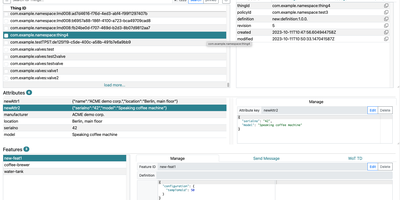
Every physical device on your network gets a living digital counterpart in Eclipse Ditto: a Thing whose Features hold its current state, desired state, and properties, readable and writable through APIs even while the device itself is offline. Your application talks to the twin over a REST-like HTTP API for CRUD and search, over WebSocket for real-time bidirectional streams, or over Server-Sent Events for change notifications, and Ditto routes commands down the live channel to the actual device when it is connected. Devices and backends connect through managed Connections to MQTT, AMQP 1.0 and 0.9.1, Apache Kafka, and HTTP endpoints, with payload mapping that translates between device formats and Ditto Protocol JSON. Fine-grained Policies decide per subject and resource who may read a temperature, change a setpoint, or receive an event, including namespace-scoped entries and partial change notifications that only reveal fields a subscriber may see. Search across millions of twins uses an RQL query language with custom MongoDB indexes, and Web of Things integration generates Thing Descriptions scoped to each requester's permissions. The bundled Explorer UI lets operators browse Things, inspect Features, and time-travel a twin's state to any past revision or timestamp to see exactly what changed and when. OpenID Connect and basic authentication protect the gateway, and Prometheus metrics expose live entity counts per namespace. Running on a dedicated VPS on RepoCloud with guaranteed CPU, RAM, and SSD, full root SSH access, and a browser serial console. EPL-2.0 licensed.
Apache ShenYu
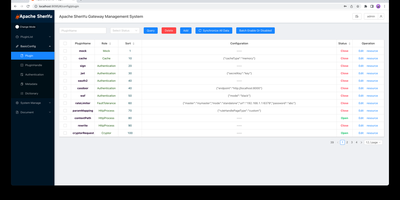
Put one governed doorway in front of every service you run: Apache ShenYu is an API gateway that proxies, secures, and manages traffic for HTTP, Dubbo, gRPC, WebSocket, and MQTT backends from a single entry point. Every request flows through an ordered, hot-pluggable plugin chain, so you compose exactly the behavior each route needs instead of accepting a fixed gateway feature set. Selectors give you coarse, service-level routing and rules refine it down to individual methods, matched against headers, paths, and parameters. Authentication and edge security come from JWT, OAuth 2.0, request-signing, and WAF plugins, while rate limiting, circuit breaking, and load balancing protect fragile upstreams from traffic spikes. You reshape calls in flight with request, response, and parameter mapping, and convert protocols so a gRPC or Dubbo service answers ordinary HTTP clients. Newer releases add AI gateway plugins that proxy LLM calls with prompt processing, token limits, and sensitive-word filtering, plus an MCP server plugin for exposing tools to AI agents. The ShenYu Admin console on its own port manages plugins, selectors, rules, users, and permissions, then pushes changes live to every gateway replica over WebSocket, ZooKeeper, Nacos, etcd, or HTTP long polling. Metrics, tracing, and logging plugins stream operational data to Kafka or Elasticsearch, and client SDKs for Java, Go, Python, and .NET let services register themselves automatically. Running on a dedicated VPS on RepoCloud with guaranteed CPU, RAM, and SSD, full root SSH access, and a browser serial console. Apache-2.0 licensed.
JupyterHub
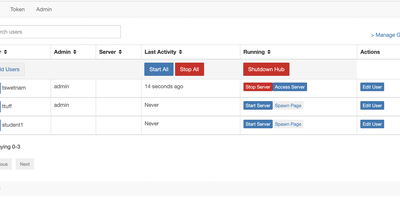
One server, a login for everyone, and a private JupyterLab in every browser tab: that is the whole pitch, and for classrooms and research teams it is transformative. JupyterHub authenticates each user against your existing identity system (campus OAuth, GitHub, Google, LDAP, or local accounts), then spawns a dedicated single-user server just for them, with their files, their kernels, and their compute allocation. Users open notebooks, terminals, and extensions in JupyterLab without installing anything, and their environment is identical whether they log in from a lab workstation or a laptop at home. The Spawner decides where those servers live: plain processes on one machine for a small class, Docker containers for isolation, or Kubernetes pods that scale across a cluster for a whole university. Administrators manage users, groups, and named servers from the admin panel, grant precise permissions through roles and scopes, and watch start times and profiles for every running server. External services plug into the Hub API, so dashboards, autograders, and portals can authenticate through the same OAuth machinery. When a user disappears for the semester break, culling stops their idle server and frees the resources. Running on a dedicated VPS on RepoCloud with guaranteed CPU, RAM, and SSD, full root SSH access, and a browser serial console. BSD-3-Clause licensed.
StackStorm
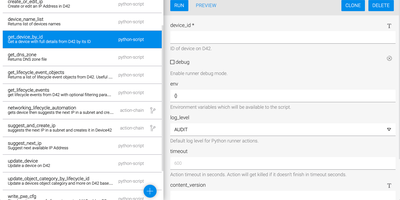
Sensors watch your infrastructure so your engineers do not have to watch it at 3 a.m. StackStorm is event-driven automation: Python sensors poll or listen to external systems (monitoring alerts, ticket updates, chat messages, webhooks, timers) and inject each event as a trigger. Rules match triggers against criteria you define and fire the response automatically, mapping the event payload straight into action parameters. Actions do the work: SSH commands, REST calls, and integrations for AWS, Docker, OpenStack, Puppet, Jira, Slack, and hundreds more from community packs, or your own scripts wrapped with a few lines of metadata. Multi-step responses become workflows that sequence actions with conditions, branching, and data passed between tasks, handling everything from disk-full remediation to full deployment pipelines. Everything bundles into packs, the shareable units that group sensors, rules, actions, and workflows per product or per automation, installable from the StackStorm Exchange or your own Git repositories. The web UI runs actions, explores workflow executions down to individual task results in real time, manages rules, and installs packs, while every execution, manual or automated, lands in an audit trail with its triggering context. ChatOps aliases even let the team trigger approved automations from chat. Running on a dedicated VPS on RepoCloud with guaranteed CPU, RAM, and SSD, full root SSH access, and a browser serial console. Apache-2.0 licensed.
Pinpoint
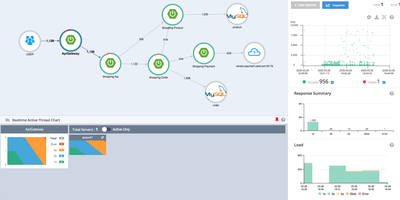
When checkout slows to a crawl somewhere across forty services, Pinpoint draws you the map of what is actually talking to what and where the time went. The ServerMap renders your whole topology live: services, databases, message queues, and external APIs as nodes whose edges carry transaction counts and error rates, so the unhealthy dependency announces itself visually. Click a node and the scatter chart plots every request against its response time; drag across the suspicious cluster and the CallStack opens those exact transactions at code level, method by method, SQL statement by SQL statement, until the bottleneck has nowhere to hide. The Inspector watches each application's CPU, memory, garbage collection, TPS, and JVM arguments, while realtime active-thread charts show stuck work as it happens. Agents attach to Java, PHP, and Python applications without changing a line of code, and applications already instrumented with OpenTelemetry send their traces straight in over OTLP. Group applications into services so each team sees its own Service Map, then arm alarm templates for slow counts, error rates, and thread saturation before users notice. Error Analysis gathers exceptions and error logs grouped by route, and URI metrics rank your hottest endpoints by cost. Running on a dedicated VPS on RepoCloud with guaranteed CPU, RAM, and SSD, full root SSH access, and a browser serial console. Apache-2.0 licensed.
Apache StreamPipes
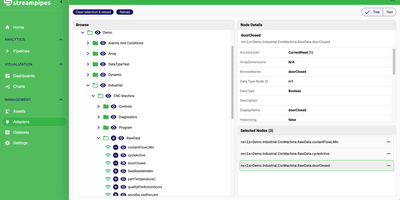
On the factory floor, the data already exists; it is just locked inside machines, PLCs, and protocols nobody on the analytics team speaks. StreamPipes unlocks it with guided adapters for OPC UA (including a web-based node browser), MQTT, Kafka, Pulsar, REST services, and industrial controllers, turning each source into a live stream in minutes. Domain experts then drag those streams into the pipeline editor, chain processors and sinks on a canvas, and watch connection validation check schema compatibility as they build, with live preview showing real values before anything is saved. Pipelines filter, enrich, aggregate, and route machine data, raise alerts, and write results to the built-in time-series data lake, where the data explorer charts history and spots trends. Finished pipelines run under an overview that starts, stops, and bulk-manages them, while detail views expose logs, metrics, status, and the pipeline as code. Live dashboards carry the same data to shop-floor screens and operations centers, organized around assets so a line, a cell, or a single machine becomes the navigation unit. Developers extend everything with custom adapters, processors, and sinks built on the Java SDK and deployed as microservices, or drive the platform from Python, Go, and Java clients. Running on a dedicated VPS on RepoCloud with guaranteed CPU, RAM, and SSD, full root SSH access, and a browser serial console. Apache-2.0 licensed.
GitBucket
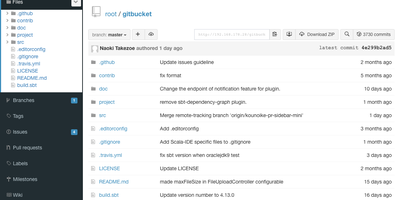
One downloadable WAR file gives your team a complete GitHub-style home for its code, with no per-seat bill and no repositories living on someone else's terms. You create public or private repositories and reach them over HTTP, HTTPS, or SSH, with Git LFS handling large binary assets alongside ordinary commits. The repository viewer includes an online file editor, so quick fixes and documentation tweaks happen in the browser without a local clone. Every repository carries its own issue tracker, pull request workflow, and wiki, keeping discussion, review, and project documentation next to the code they describe. Activity timelines and email notifications keep collaborators aware of new issues, comments, and merges as they happen. Administrators manage users and groups directly, connect account management to LDAP, and protect the instance with fine-grained repository visibility. A plug-in system extends the platform, and official plug-ins add gists, emoji, static Pages hosting, and richer notifications, while community plug-ins widen the menu further. Tools that already speak the GitHub API can point at your GitBucket instead, because its web API deliberately mirrors GitHub's. Upgrades stay simple: stop the process, replace the WAR, and restart with the same data directory. Running on a dedicated VPS on RepoCloud with guaranteed CPU, RAM, and SSD, full root SSH access, and a browser serial console. Apache-2.0 licensed.
Magistrala
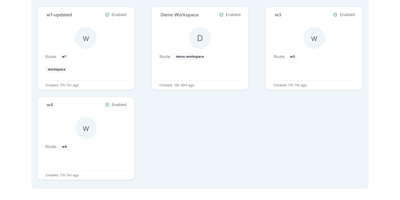
Thousands of devices speaking four different protocols is where IoT projects usually dissolve into glue code; Magistrala replaces that tangle with one platform where MQTT, HTTP, WebSocket, and CoAP clients share a single identity, provisioning, and messaging model. You organise work into domains, register clients for devices and applications, and connect them to channels that control who publishes and who subscribes, with fine-grained policies deciding which client may touch which channel. Protocol adapters bridge the transports, so a sensor publishing over MQTT and a dashboard reading over WebSocket meet in the same channel without translators in between. Telemetry lands in TimescaleDB through dedicated writer services and comes back out through reader APIs, while the bundled three-node FluxMQ cluster carries the messaging load with mutual TLS on device connections. The rules engine reacts to incoming messages with conditions and actions, alarms flag the readings that breach them, and reports package fleet data for the people who never open a terminal. A Community web UI covers domains, clients, channels, messages, and rules for day-to-day operation, and everything deploys as one Docker Compose stack with Prometheus metrics and Jaeger tracing already wired in. Running on a dedicated VPS on RepoCloud with guaranteed CPU, RAM, and SSD, full root SSH access, and a browser serial console. Apache-2.0 licensed.
Dolt
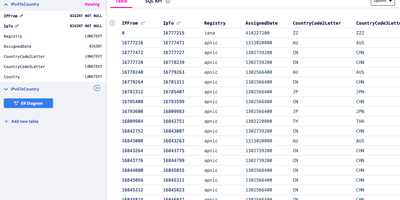
Dolt is a SQL database that versions your tables the way Git versions files, so every row carries a history you can branch, diff, merge, and roll back. The command line mirrors Git command for command: dolt init, add, commit, checkout, log, and blame operate on tables instead of files, and merges happen cell by cell, with conflicting cells landing in dolt_conflicts tables you resolve by choosing ours or theirs. Run dolt sql-server and the same database answers on the MySQL wire protocol, so the mysql client, TablePlus, DataGrip, and your existing application drivers connect unchanged, while stored procedures like DOLT_CHECKOUT and DOLT_MERGE and system tables like dolt_diff and dolt_log put version control inside SQL itself. Teams push and pull databases through remotes on DoltHub, S3, GCS, or a filesystem, fork a database to test a risky migration, and cherry-pick the good commits back. AI agents get their own branches to write into, and a human reviews the row-level diff before anything merges to main. Data publishers ship corrections as commits subscribers can pull, and analysts query any historical snapshot with AS OF instead of restoring backups. Running on a dedicated VPS on RepoCloud with guaranteed CPU, RAM, and SSD, full root SSH access, and a browser serial console. Apache-2.0 licensed.
Nuclio
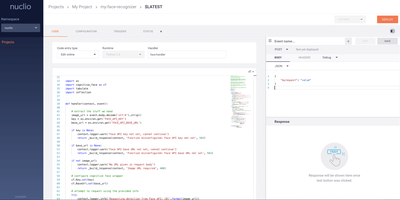
Serverless platforms promise to run your code only when it is needed; Nuclio adds the part they usually skip, raw throughput for data-heavy work, with a single function instance able to process hundreds of thousands of HTTP requests or records per second. You write functions in Python, Go, Node.js, Java, .NET, or plain Shell, and deploy them from the dashboard on port 8070, from the nuctl command line, or from Jupyter through the Nuclio SDK. Events reach your code through HTTP calls, cron schedules, Kafka and Kinesis streams, MQTT and NATS messages, RabbitMQ queues, or Azure Event Hubs, so the same function model covers APIs, stream processors, and scheduled jobs. Each function ships as its own container, built securely with Kaniko, and scales on plain Docker for a single server or on Kubernetes when the workload outgrows one machine, with GPU support for inference and media pipelines. Projects organise functions with shared configuration, secrets, and API gateways, and the dashboard shows invocations, logs, and metrics while templates for common jobs get a first function running in minutes. Data science teams plug Nuclio into MLRun and Kubeflow Pipelines to serve models and automate ML workflows without a separate serving tier. Running on a dedicated VPS on RepoCloud with guaranteed CPU, RAM, and SSD, full root SSH access, and a browser serial console. Apache-2.0 licensed.
ejabberd
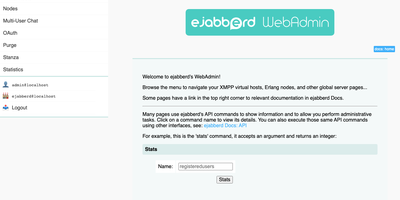
A single ejabberd node carries chat, device telemetry, voice calls, and federated messaging at once, because the same Erlang server speaks XMPP, MQTT, SIP, and Matrix over one authentication, storage, and clustering layer. Users get standards-based instant messaging with group chats, message archives, publish-subscribe, message carbons, push notifications, and OMEMO encryption, and your server federates with the global XMPP network out of the box. Devices publish and subscribe through the built-in MQTT broker on TCP or WebSocket transports, sharing accounts and access rules with your chat users instead of needing a second broker. Voice and video calls route through the integrated SIP gateway and STUN/TURN support, so WebRTC clients get signalling and media relay from the same deployment. Matrix support bridges federated rooms into the same infrastructure, letting two decentralised ecosystems interoperate without a separate bridge stack to babysit. Clustering with consistent hashing scales a deployment across nodes, and a single node is rated at two million concurrent sessions for very large communities. Operators manage everything from the web admin and command line, with SQL or Mnesia storage, LDAP authentication, and virtual hosting for multiple domains on one server. Running on a dedicated VPS on RepoCloud with guaranteed CPU, RAM, and SSD, full root SSH access, and a browser serial console. GPL-2.0 licensed.
phpBB
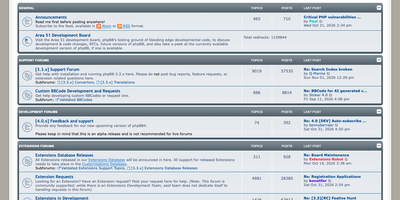
No per-seat fees, no landlord, no shutdown notice: phpBB gives your community the complete bulletin board package on a server you own. Organize discussion into categories holding unlimited forums and subforums, each with its own rules, password, style, or redirect, and let members post in flat topics with quoting, BBCode formatting, file attachments, polls, smilies, and emoji. Members register through configurable anti-spam checks, subscribe to forums and topics, keep bookmarks, exchange private messages with folders and drafts, and get notified about replies and mentions in their notification center. Moderators work from their own control panel with approval queues, reported-post handling, warnings, topic tools, pruning, and bans by username, email, or IP range, while the famous permission system assigns forum, moderator, and admin roles per user or group and can trace exactly why any member can or cannot do something. Administrators run everything from the ACP: styles built on the responsive prosilver theme, extensions installed from the validated catalog, language packs for a global audience, search and cache backends, scheduled tasks, and database backups. Whether it is a support board, a hobbyist community, or a company knowledge commons, the conversation stays on infrastructure you own. Running on a dedicated VPS on RepoCloud with guaranteed CPU, RAM, and SSD, full root SSH access, and a browser serial console. GPL-2.0 licensed.
Foreman
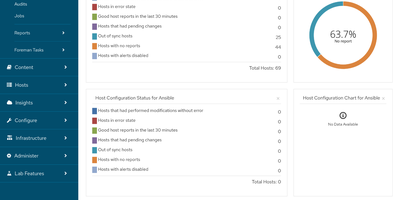
Foreman is the control room for a server fleet, taking machines from blank hardware or an empty VM to configured, monitored hosts through one web interface. Create a host entry and it network-boots by PXE or UEFI HTTP, or starts from a discovery image that phones home its hardware inventory so unknown machines can be claimed and built by rule. Installation runs from templates for Kickstart, Preseed, AutoYaST, Agama, and cloud-init, while host groups bundle the operating system, partition layout, and parameters that make every build of a role identical. The same console provisions onto bare metal, libvirt, VMware, oVirt, Amazon EC2, Google Compute Engine, and OpenStack, because each provider plugs in as a compute resource with its own images and networks. After installation, Puppet classes and parameters, Ansible roles with recurring runs, or Salt states keep configuration enforced, and the reports and facts those tools send back fill dashboards showing which hosts are current, which drifted, and which are erroring. Smart Proxy services carry DHCP, DNS, TFTP, and configuration enforcement into each subnet or datacenter segment, remote execution runs jobs across the fleet, and the Katello plugin adds content and patch management on top. Hammer gives the whole API a command-line face, and role-based access with LDAP or FreeIPA sign-in keeps large teams in their lanes. Running on a dedicated VPS on RepoCloud with guaranteed CPU, RAM, and SSD, full root SSH access, and a browser serial console. GPL-3.0 licensed.
zrok
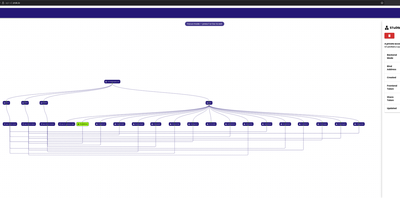
zrok puts services that live behind NAT and firewalls onto the public internet with a shareable URL, without opening a single inbound port. The machine being shared dials out to an OpenZiti overlay network, so a web app on your desk, a Raspberry Pi at home, or a staging box inside a corporate network becomes reachable through your instance while its firewall stays closed. One command shares an HTTP service publicly; add a name from one of your namespaces and the URL stays stable even when you move the backend to a different machine, and an ephemeral name can be promoted to a reserved one when a quick demo turns into a keeper. Private shares skip the public internet entirely and reach only the users you grant, including raw TCP and UDP services, while web and drive backend modes publish static sites or whole folders, with OAuth, password auth, and an interstitial warning page available on public shares. The long-running agent keeps every share and access under one process, restarts the named ones after a reboot, and offers a localhost console for point-and-click sharing; the account-wide web console maps your environments, shares, and accesses as a navigable graph or a sortable table with live activity. Operators get invite-based accounts, InfluxDB-backed usage metrics, and configurable limits that warn or cut off accounts that exceed their quotas. Running on a dedicated VPS on RepoCloud with guaranteed CPU, RAM, and SSD, full root SSH access, and a browser serial console. Apache-2.0 licensed.
Argilla
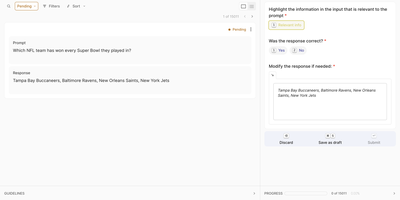
Before a language model learns from your data, someone has to label it well; Argilla gives AI engineers and domain experts a shared workspace to label, review, and refine the datasets that fine-tune language models and train NLP pipelines. You build each dataset from the Python SDK, mixing text, chat, and image fields with the exact questions your task needs: single-label classification for intent detection, span questions for named entities, ratings for response quality, rankings for preference tuning, or free text for corrections. Annotators then work through records in a focused labeling interface where model predictions already sit attached as suggestions, turning most reviews into a fast confirm-or-correct decision instead of a blank-page exercise. Full-text search, metadata filters, and status filters slice a hundred thousand records down to the ones needing attention, while vector-based semantic search finds lookalike examples, near-duplicates, and the disagreement hotspots where guidelines need sharpening. Dataset owners watch completion progress, manage who has responded to what, and split work across workspaces with owner, admin, and annotator roles for each team or client. Finished datasets export with responses, suggestions, and metadata intact, locally or straight to the Hugging Face Hub, ready for fine-tuning and evaluation runs. Running on a dedicated VPS on RepoCloud with guaranteed CPU, RAM, and SSD, full root SSH access, and a browser serial console. Apache-2.0 licensed.