Codever
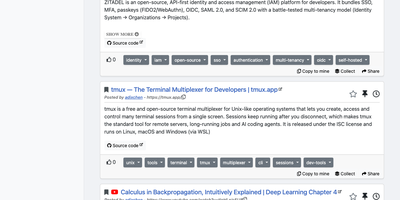
Every developer has a graveyard of browser tabs, chat messages, and stray text files holding links and code worth keeping; Codever replaces the graveyard with a bookmarks, notes, and snippets manager designed for developer workflows. Save a page in two clicks from Chrome or Firefox, drop selected text in as a snippet or note, or use the bookmarklet in any other browser, with title, description, and tags prefilled for you. From IntelliJ IDEA and Visual Studio Code you can push code straight into your library and pull it back without switching to the browser. Bookmarks carry descriptions and tags, and Pinned and Read Later lists sit beside your history so rediscovery takes seconds. Notes are written in Markdown and render with math, tables, and inline code, while snippets keep reusable code one search away with its context attached. Full text search spans bookmarks, notes, and snippets at once, with Brave, Google, Stack Overflow, and Bing one click away when the library comes up empty. Entries can be public, copied into your own collection, or gathered into curated sets for a team or topic. Accounts sign in through Keycloak with GitHub, Google, GitLab, or Stack Overflow, so a self-hosted instance fits the identity setup your team already uses. Running on a dedicated VPS on RepoCloud with guaranteed CPU, RAM, and SSD, full root SSH access, and a browser serial console. MIT licensed.
Urlaubsverwaltung
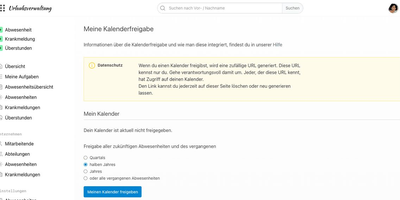
One calendar answers who is away next week: Urlaubsverwaltung is a self-hosted leave and absence manager where employees request vacation, managers approve it, and sick notes and overtime balances live beside the requests. A request moves through waiting, provisionally approved, finally approved, rejected, or cancelled states, so employees and approvers always see where a decision stands. Department heads decide for their own teams, a second stage authority can add the final approval, the boss sees every request company wide, and office staff manage people, settings, and sick notes for others. Administrators configure which absence types exist, from annual and special leave to parental leave, sabbatical, training, and working from home, each with its own color and rules. Sick notes are recorded as full day, morning, or afternoon, including child sick notes, and a note can later be converted into vacation when plans change. Overtime gets the same care: staff log hours and minutes for any period, choose to add or reduce their balance, and attach a comment for the record. Personal, department, and company calendars collect every absence, secret iCal links feed external calendar apps, and optional Google Calendar synchronization pushes new and changed entries. Email notifications for submissions, upcoming absences, substitute duties, and overtime entries can be switched on per person, and a token protected REST API exposes persons, absences, sick notes, and workdays. Running on a dedicated VPS on RepoCloud with guaranteed CPU, RAM, and SSD, full root SSH access, and a browser serial console. Apache-2.0 licensed.
FeedCraft
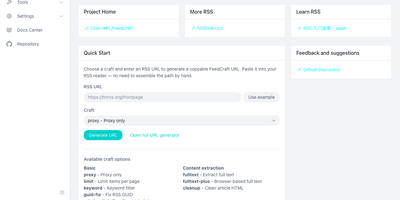
Excerpt-only feeds, truncated teasers, and articles in languages you do not read make RSS feel broken; FeedCraft sits between the source and your reader and fixes the feed itself. Pick from more than twenty single-step crafts: extract the full article text, even from JavaScript-rendered pages through a headless browser, translate titles or whole articles, add AI introductions and summaries, strip ads and clutter, or filter items by keyword, embedding similarity, or a natural-language prompt to your own LLM. Chain crafts into FlowCraft pipelines, so one pass can limit a feed to ten items, fetch every full text, drop the advertorials, and summarize what survives. Save the result as a recipe and FeedCraft hands you a permanent crafted feed URL that drops straight into the reader you already use, while portable mode transforms any feed on the fly from a single crafted URL prefix. When a site has no feed at all, the visual generators build one from a webpage with CSS selectors, from a JSON API with curl import, or straight from search results. Running on a dedicated VPS on RepoCloud with guaranteed CPU, RAM, and SSD, full root SSH access, and a browser serial console. GPL-3.0 licensed.
Mosparo
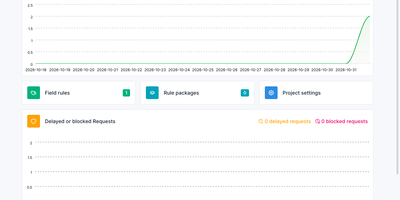
CAPTCHAs make every visitor solve a puzzle to prove they are human; Mosparo takes the opposite route and checks the submitted content itself, no challenges, no image grids, and no tracking cookies. Drop the customizable checkbox widget into any form and Mosparo inspects each field separately, scoring the entry against your rules the way an email spam filter scores a message. Build field rules for banned words, domains, email addresses, IP addresses and subnets, providers, Unicode blocks, user agents, and websites, each with its own rating weight, or subscribe to shared rule packages that refresh themselves automatically. Every submission lands in an admin inbox with its spam rating, IP address, and verification status, and dashboard charts show valid versus spam traffic plus delayed or blocked requests over time. Legitimate users notice nothing but a plain checkbox, which stays fully usable with assistive technology, while everything Mosparo stores is encrypted and automatically deleted after 14 days. Run one instance for many sites with separate projects, project groups, and member roles, and connect your forms over the documented API from any stack that can send an HTTP request. Running on a dedicated VPS on RepoCloud with guaranteed CPU, RAM, and SSD, full root SSH access, and a browser serial console. MIT licensed.
Meerkat CRM
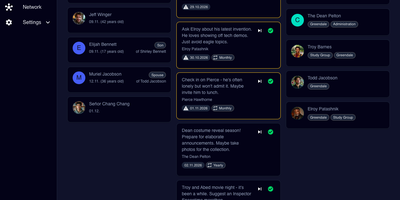
Friends drift away when nobody remembers to call; Meerkat CRM is a self-hosted personal CRM that keeps your relationships warm with birthday and stay in touch reminders, contact notes, and a living map of who knows whom. Organize every contact into circles like family, friends, or work, store spouses and children as linked relationships, and see the whole crowd on an interactive network graph that shows how people connect. Sync the same address book two ways: Meerkat runs its own CardDAV server for your phone and can also act as a CardDAV client against an external server you already use. Against each person you can keep the details that matter, dietary habits, kids names, the last conversation, plus a social style timeline of activities you have shared, from dinners to group projects. Reminders nudge you by email when it has been too long, with upcoming birthdays surfaced on the dashboard, so catching up becomes a habit instead of an afterthought. Move data in and out freely: import CSV, VCF, and even a Monica export, export back to CSV and VCF, connect external calendars, and fire webhooks into your own automations. Use it in English, German, Italian, Spanish, or French with light and dark modes, and SSO for whoever shares the house. Running on a dedicated VPS on RepoCloud with guaranteed CPU, RAM, and SSD, full root SSH access, and a browser serial console. MIT licensed.

Clu Comics
Comic Library Utilities (CLU) is a self-hosted comic library manager that converts, repairs, tags, downloads, and reads your entire comic collection from one web interface. Convert whole folders or libraries from CBR to CBZ in bulk, turn PDFs into CBZ with JPEG or WebP output, and rename thousands of files to one consistent pattern without touching a terminal. Open any CBZ in the browser editor to reorder pages, add or delete images, crop covers, split merged multi issue archives, and adjust contrast and brightness issue by issue. Write ComicInfo.xml from Metron, ComicVine, Grand Comics Database, AniList, MangaDex, MangaUpdates, or Bedetheque, then bulk apply tags across a directory with review before saving and a history log that can revert any change. Browse your library by publisher, series, or folder, read page by page in the built in reader that remembers your place, and follow weekly release calendars with a pull list and Wanted tracker for issues you do not own yet. Download new issues from Direct Download sources, Usenet through Newznab indexers with SABnzbd or NZBGet, and DC++, while folder monitoring unpacks, converts, renames, and files new arrivals automatically. Add Reader, Clerk, and Store Owner accounts with per folder permissions, publish OPDS feeds for reader apps, and sync reading history with Komga. Running on a dedicated VPS on RepoCloud with guaranteed CPU, RAM, and SSD, full root SSH access, and a browser serial console. GPL-3.0 licensed.
CHMonitor
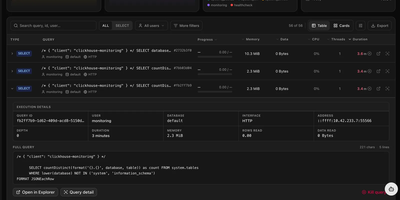
When a ClickHouse cluster slows down, the answers are buried in system tables nobody wants to query by hand; CHMonitor turns those tables into an operations dashboard that explains what the cluster is doing and what to fix next. Live views cover running queries with elapsed time, memory, and a kill action, while history, failed, slowest, and most-expensive pages rank finished work by CPU, duration, and rows read, each with the full statement and one-click EXPLAIN. Thread-level analysis shows how a single query parallelized, and per-user summaries reveal which analyst or service is eating the cluster. Beyond queries, you get a merge and part-lifecycle timeline, replication queue and Keeper health, a live topology map of shards and replicas, storage breakdowns by database, table, and part, and a query activity heatmap spanning a year. An AI advisor reviews the workload and recommends skip indexes, projections, PREWHERE clauses, and TTL changes ranked by impact, with an MCP interface and built-in agent for asking questions in plain English; it recommends only and never applies DDL. Threshold-based health checks alert to Slack, Discord, PagerDuty, or Opsgenie, multiple ClickHouse hosts are watched from one dashboard, and a companion terminal UI covers quick checks from the shell. Running on a dedicated VPS on RepoCloud with guaranteed CPU, RAM, and SSD, full root SSH access, and a browser serial console. GPL-3.0 licensed.
Cupdate
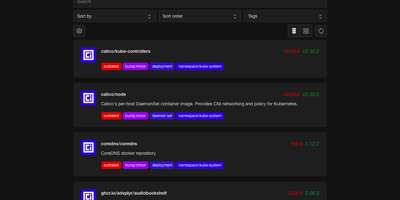
Cupdate keeps a watchful eye on every container image you run, reporting which ones are outdated or vulnerable while deliberately never touching the update button itself. Point it at a Kubernetes cluster, a Docker socket, or Podman hosts (local or remote, one or several) and it inventories every image in use with no configuration to write. Each image is matched against its registry to find the newest available version, and the dashboard shows the gap between what you deployed and what you could be running, with release notes inline so the decision to upgrade takes seconds instead of a changelog hunt. Vulnerability data is layered on top from four sources: Docker Scout for Docker Hub images, Clair for participating Quay images, GitHub Advisories for images tied to repositories, and osv.dev correlation for images shipping SBOMs. A dependency graph explains why each image exists in your stack by showing which workloads pull it, which ends the "can I delete this?" guessing game. Subscribe to the RSS feed to hear about new releases passively, query the REST API to drive scripts that update compose files or kustomizations, or surface outdated and vulnerable counts in a Homepage dashboard widget. Prometheus metrics and traces are available when you want the watcher itself watched. Running on a dedicated VPS on RepoCloud with guaranteed CPU, RAM, and SSD, full root SSH access, and a browser serial console. MIT licensed.
BorgWarehouse
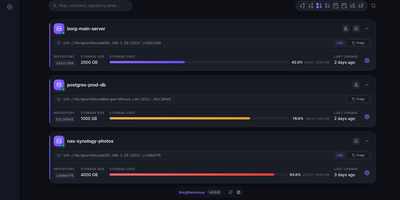
Centralizing BorgBackup usually means hand-creating Unix users, wiring SSH keys, and remembering which machine stopped backing up three weeks ago; BorgWarehouse replaces that terminal work with a dashboard built for exactly this job. Add a repository and it provisions the dedicated user, authorized key, and storage quota for you, then hands back ready-to-paste client commands so a new machine is backing up in minutes. Every repository carries a freshness threshold: when no modification lands within the window you set, its status dot turns red and an alert goes out by SMTP email, through Apprise to Discord, Telegram, Slack, Gotify, or ntfy, or as a signed webhook POST to tools like n8n and Uptime Kuma, rate-limited to one alert per repository per day. Append-only mode is enforced on the server, so even a fully compromised client can add archives but never destroy existing ones, which is the property that keeps ransomware from eating your backup history. The monitoring view tracks storage consumption against each quota, a setup wizard walks new clients through onboarding (with a LAN variant for local transfers), and sign-in can delegate to GitHub, Google, Microsoft, GitLab, or any OIDC provider. A versioned REST API automates provisioning, and your passphrase never reaches the server: backups stay end-to-end encrypted on the clients. Running on a dedicated VPS on RepoCloud with guaranteed CPU, RAM, and SSD, full root SSH access, and a browser serial console. AGPL-3.0 licensed.

Afilmory
Afilmory turns a storage bucket full of originals into a polished photography portfolio, complete with EXIF panels, a GPS map, and a GPU-accelerated viewer that makes full-resolution images feel instant. Point the builder at Amazon S3, Cloudflare R2, MinIO, Backblaze B2, a GitHub repository, an Eagle library, or a plain local folder, and it syncs your photos, converts HEIC and TIFF files for the web, generates multi-size thumbnails with ThumbHash placeholders, and extracts complete metadata into a manifest the gallery reads at runtime. Visitors browse a responsive masonry grid that loads progressively, open any shot in a WebGPU viewer (WebGL fallback included) with smooth zoom and pan, and inspect camera body, lens, focal length, aperture, ISO, and GPS coordinates for every frame. Geotagged work appears on an interactive MapLibre map, iPhone Live Photos play back as motion, HDR gain-map images render properly on HDR displays, and Fujifilm shooters get their film simulation recipes displayed alongside the shot. Photographers can organize by the folders they already keep, since directory structure becomes tags automatically, and backend-powered galleries add visitor comments and reactions. Deploy it as a static site on any CDN or as a server-rendered Node.js application with per-photo Open Graph previews for sharing. Running on a dedicated VPS on RepoCloud with guaranteed CPU, RAM, and SSD, full root SSH access, and a browser serial console. AGPL-3.0 licensed.
Reclip
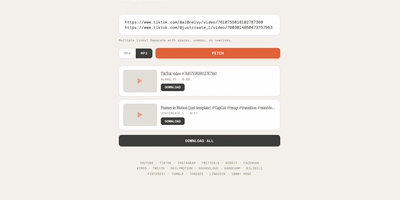
Reclip is a self-hosted web downloader that turns links from YouTube, TikTok, Instagram, and more than a thousand other video sites into MP4 or MP3 files saved on your own server. Paste one link or a whole batch of URLs, and Reclip fetches each video's title, thumbnail, duration, and uploader before you commit to anything. A quality picker lists every available resolution, so a lecture can be grabbed at 360p for a phone while a concert film comes down at full height with the best audio stream merged in. MP3 mode strips the picture away entirely, which makes it painless to archive podcasts, DJ sets, and spoken-word clips as plain audio files. Playlists expand into their individual videos automatically, repeated URLs are deduplicated before any bandwidth is spent, and a Download All button works through the whole queue without babysitting. Each job runs in a background thread with live status in the interface, so the page stays responsive while ffmpeg finishes merging streams behind the scenes. Everything lives behind one clean page with no accounts, no uploads to third-party converters, and no expiring download links, and finished files land in a downloads folder you control. Running on a dedicated VPS on RepoCloud with guaranteed CPU, RAM, and SSD, full root SSH access, and a browser serial console. MIT licensed.
DashBeam
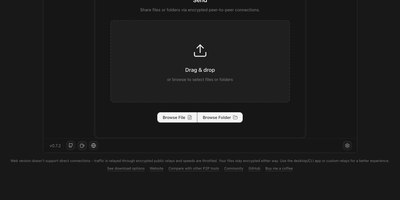
DashBeam sends files and folders of any size straight from one device to another, end to end encrypted, with no cloud account, no size limits, and nothing parked on a third party server in between. Drop in a file and share it through a short code, a link, or a QR scan; whoever receives it needs no account and can collect it in a plain browser tab with nothing installed. On the same network, nearby machines appear on their own, so pairing two devices and sending between them takes a couple of clicks instead of a cable or a memory stick. Pair a device once and it stays reachable by its identity, so your machines can exchange files from anywhere without swapping fresh tickets every time. Interrupted transfers resume where they stopped, and hopping from Wi-Fi to cellular mid-send does not drop the connection. One share can fan out to several receivers at once, and devices you mark as trusted can accept files automatically, which suits pushing builds, media libraries, or backups around a small fleet. You can preview what is arriving before downloading it, and a local history records every completed transfer. The repository also ships Docker Compose stacks for your own relay and discovery server, so even the encrypted fallback path can run entirely on machines you own. Running on a dedicated VPS on RepoCloud with guaranteed CPU, RAM, and SSD, full root SSH access, and a browser serial console. AGPL-3.0 licensed.
Kanidm
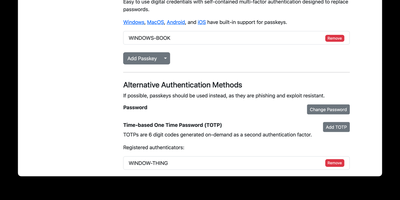
Every service you self-host wants its own account database, and Kanidm exists so they can all share one: one identity server where people sign in with passkeys and every application trusts the same login. Users register YubiKeys, Touch ID, Windows Hello, or TPM backed authenticators, and attested passkey policies let administrators restrict sign-in to specific authenticator models in high security environments. Applications connect as OAuth2 or OpenID Connect clients with authorization code, client credentials, PKCE, token exchange, and revocation supported, so your wiki, Git forge, and file sync all delegate sign-in instead of storing passwords. The application portal gives each person one page of tiles for every service they may open, and role based access control decides which groups see which applications and scopes. Older systems that only speak LDAP bind to the read-only LDAPS gateway, while Wi-Fi and VPN gear authenticates through the built-in RADIUS server with MS-CHAPv2 and EAP-TLS. Linux machines join through the Unix client for PAM and NSS authentication, cached offline credentials protected by the machine TPM, and SSH keys distributed from the server to every host. A second server replicates the whole database with strong eventual consistency, every node accepting writes without elections or quorums, so a failed machine never locks your users out of sign-in. Running on a dedicated VPS on RepoCloud with guaranteed CPU, RAM, and SSD, full root SSH access, and a browser serial console. MPL-2.0 licensed.
Zigbee2MQTT
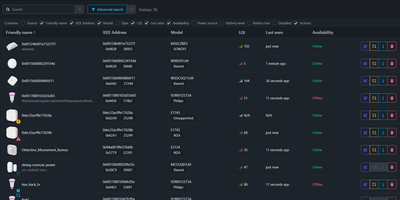
Zigbee2MQTT bridges a Zigbee smart home network to MQTT so bulbs, switches, sensors, and locks from hundreds of vendors work with your own automation server instead of each manufacturer's cloud bridge. It supports 5,798 devices from 608 vendors, so a Philips Hue bulb, an IKEA TRÅDFRI switch, an Aqara sensor, and a Tuya plug can all join one coordinator and speak one protocol. The built-in frontend on port 8080 shows every paired device with its link quality, battery level, and live state, and lets you rename, reconfigure, bind, or remove devices without editing YAML. A network map view charts which routers carry traffic for which end devices, making weak spots and dead zones visible before automations start failing. Groups collect devices that should act together, scenes capture lighting states for a room, and bindings let a switch talk directly to a bulb even when the server is briefly offline. Firmware stays current through over the air updates you can trigger or schedule per device from MQTT topics or the frontend, including downgrades when a new release misbehaves. Home Assistant picks everything up automatically through MQTT discovery, while openHAB, Domoticz, and Node-RED flows subscribe to the same plain JSON topics. The coordinator plugs into the host by USB or joins over the local network, while the bridge, frontend, and broker traffic run headlessly beside Mosquitto or EMQX. Running on a dedicated VPS on RepoCloud with guaranteed CPU, RAM, and SSD, full root SSH access, and a browser serial console. GPL-3.0 licensed.

BookWyrm
Instead of handing your reading history to a retail platform and letting an algorithm decide what you read next, BookWyrm lets a self-hosted community of readers make the recommendations. Shelve every book as to-read, currently reading, stopped, or finished, record start and finish dates with progress updates along the way, and set an annual reading goal to keep the habit honest. Rate and review finished books, drop a comment while you are mid-chapter, or save a quotation worth keeping, and all of it can appear on the book page alongside reviews aggregated from other connected instances. Follow friends to see their shelves fill up, join a group to build a shared reading list, or create your own list and choose whether it stays closed, accepts suggestions for approval, opens to everyone, or belongs to the group. Posts, shelves, and lists each carry their own privacy level, public, unlisted, followers-only, or private, and you can approve followers by hand before they see anything. Because instances federate over ActivityPub, your readers can follow you from another BookWyrm community or straight from Mastodon, and book metadata is shared between servers so small instances do not catalog alone. Running on a dedicated VPS on RepoCloud with guaranteed CPU, RAM, and SSD, full root SSH access, and a browser serial console. Anti-Capitalist Software License licensed.
Chat UI
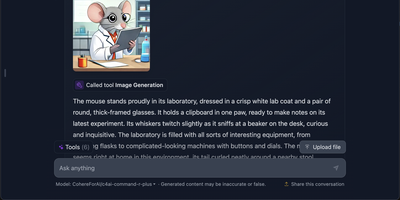
Self-hosting a language model is only half the job; people still need somewhere pleasant to talk to it, and Chat UI is that window, the same interface that powers HuggingChat. Point it at any OpenAI-compatible endpoint, your own Ollama or llama.cpp server, the Hugging Face router, or a hosted gateway like OpenRouter, and the models it serves appear in the picker automatically, with no per-model configuration. Conversations are saved to your database and stay browsable in the sidebar, so a thread from last week can be reopened, continued, and compared against a fresh answer from another model. Multimodal models accept image uploads right in the composer, and models that support it can call MCP tools mid-conversation to fetch data or run actions. For a shared team deployment, OpenID Connect sign-in keeps individual histories and settings separate, and per-user defaults travel with each account. Everything a consumer chatbot would keep on someone else's servers, prompts, uploaded files, and usage history, stays in the MongoDB you control on the same machine. Running on a dedicated VPS on RepoCloud with guaranteed CPU, RAM, and SSD, full root SSH access, and a browser serial console. Apache-2.0 licensed.
Dobase
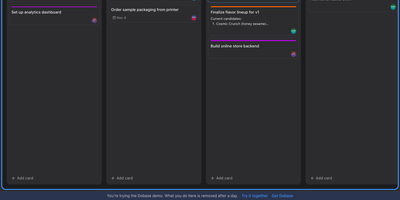
Dobase replaces the scattered pile of team subscriptions with one self-hosted workspace where mail, kanban boards, documents, chat, to-do lists, files, a calendar, and video rooms live side by side. Install only the tools your team needs, and share each one with exactly the collaborators you choose; a board for the whole company and a private todo list can sit in the same window. Several people can type in the same document at once, watching each other's colored cursors while the text merges cleanly, and presence faces in the sidebar show who is inside every tool right now. Open tools arrange themselves as tiles in a wide window, so chat can sit next to the board it discusses and the calendar under the mail you are answering. Pressing Cmd+K searches cards, todos, documents, files, chat, events, and mail in one motion, and nearly everything also works from the keyboard alone. Mail threads conversations and lets you accept calendar invites from the message, files get public links guarded by a password and an expiry, and the calendar syncs with CalDAV services or runs on its own. Video rooms with screen sharing join the same workspace, mentions and notifications follow you, and an email digest catches up anyone who was away. Running on a dedicated VPS on RepoCloud with guaranteed CPU, RAM, and SSD, full root SSH access, and a browser serial console. MIT licensed.
MicroBin
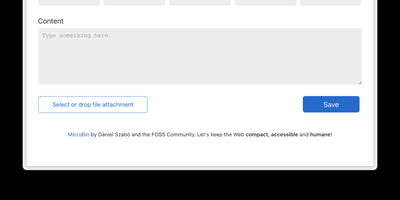
A video too large for Discord, a secret that should not live in a chat log, or a config file a headless server needs to fetch: MicroBin turns each into a short link with an animal name, served from your own machine. Paste text or code and it comes back with syntax highlighting, inline image and video embedding, and a QR code for moving it to a phone. Attach one file or several, then decide exactly who can see them: uploads can be public or private, editable or locked, set to expire on a schedule or to never expire. For sensitive material, server-side encryption and client-side end-to-end encryption keep contents unreadable without the password. Raw serving hands the plain bytes to curl, a browser, or another program, which makes the same box a tiny file endpoint for scripts and test rigs. A postbox mode lets people send you files and texts they cannot browse or delete afterwards, and a read-only mode with an uploader password turns the instance into a drop point with exactly one trusted sender. The admin console lists uploads and storage, and everything runs as one small binary backed by SQLite or a JSON file, comfortable in a few megabytes of memory. Running on a dedicated VPS on RepoCloud with guaranteed CPU, RAM, and SSD, full root SSH access, and a browser serial console. BSD-3-Clause licensed.