AxonHub
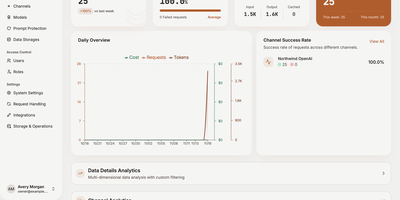
AxonHub is an open-source AI gateway that lets any OpenAI, Anthropic, or Gemini SDK reach more than 100 models through a single address. Point Claude Code, Codex, OpenCode, or your own scripts at one base URL, and the gateway translates each request for whichever provider sits behind the model name, so changing vendors means editing a string instead of rewriting code. Channels hold provider keys, model lists, weights, and health history, and load balancing with automatic failover sends traffic to the healthiest route. Chat, image generation, embeddings, and reranking all travel through the same endpoint. Every call lands in request logs with token counts, first-token latency, and cost, and traces group related calls into threads with a timeline of spans. A built-in playground tests one channel or the full gateway, prompt protection rules filter sensitive text before it leaves your network, and API keys can be limited by project, owner, or IP range. Roles and per-user usage tables keep teams apart. Running on a dedicated VPS on RepoCloud with guaranteed CPU, RAM, and SSD, full root SSH access, and a browser serial console. Apache-2.0 licensed.
ccLoad
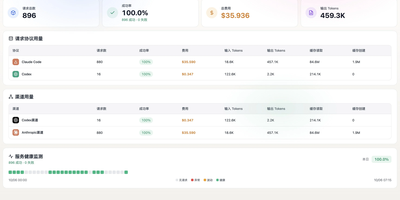
An upstream dies mid-stream. The session does not have to. ccLoad is a self-hosted AI gateway that stands between your coding agents and every key, relay, and subscription you own, retrying the next source before the first byte reaches your client. Claude Code, Codex, Gemini, and OpenAI-compatible tools all point at one address and present one ccLoad token. Behind it, each source becomes a channel with a model list, a priority, and health-based ordering. Requests are matched by the model name the client asked for. Protocol differences disappear in transit, with Anthropic, OpenAI, Codex Responses, and Gemini converted in either direction, streamed responses included. Failure gets a narrow blast radius. A revoked key cools down alone, a failing model cools down alone, and a dead URL cools down alone, each with exponential backoff that respects upstream reset times. Errors disguised as successful responses still trigger failover. Subscription accounts work as channels beside API keys, tokens refresh on their own, and quota use is tracked against each provider's reset window. Every request lands in the logs with its cost, priced with cache reads, cache writes, and long-context tiers included. Tokens carry model restrictions, budgets, and concurrency caps. Channels carry daily spend limits. Sensitive text can be masked on the way out and restored on the way back. Running on a dedicated VPS on RepoCloud with guaranteed CPU, RAM, and SSD, full root SSH access, and a browser serial console. MIT licensed.
Nyro
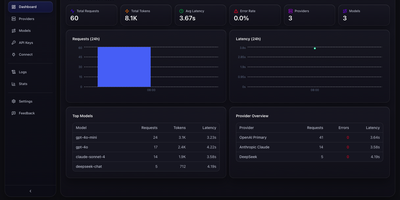
Point Claude Code, Codex CLI, Gemini CLI, or any OpenAI, Anthropic, or Gemini SDK at one address and Nyro routes every request to whichever model provider you choose. The gateway translates protocols on the fly, including streaming, reasoning blocks, and tool calls, so a tool built for one API can run on a model from another. Define virtual model names, bind each to one or more providers, and pick weighted load balancing or priority failover; unhealthy targets are skipped and recover automatically. Issue API keys with limits on requests and tokens per minute and per day, and bind each key only to the models it may call. Exact and semantic caching return repeated answers instantly. A request log records provider, model, token counts, latency, and streaming speed, and usage charts break traffic down by model and provider. The Connect page generates ready-to-paste samples in Python, TypeScript, and cURL, plus one-click configuration for popular coding CLIs. Choose an embedded database for a single host or an external PostgreSQL or MySQL server for production, and run the gateway, the admin UI, or both as separate processes. Running on a dedicated VPS on RepoCloud with guaranteed CPU, RAM, and SSD, full root SSH access, and a browser serial console. Apache-2.0 licensed.
OrcaRouter Lite
Every prompt your application sends is a small buying decision, and OrcaRouter Lite makes it a smart one instead of a habit. Point your app at one OpenAI-compatible endpoint on your server, and each request is shopped across the providers whose keys you hold: OpenAI, Anthropic, Google, xAI, DeepSeek, and dozens more. Send model set to auto and the router picks the cheapest model that can actually do the job, checking whether the request needs tools, vision, or JSON mode before it commits your money. Prefer a different tradeoff and you can switch the whole gateway between balanced, cheapest, fastest, and quality strategies, with quality picks driven by real benchmark scores rather than vibes. Clients that speak Anthropic's or Gemini's native protocols connect directly too, so Claude Code, the OpenAI SDK, and google-genai all land on the same routing pipeline. Streaming responses flow through untouched, and every answer reports which model really served it. The built-in dashboard shows recent requests, spend, latency percentiles, unreachable providers, and a savings tile that tells you what your traffic would have cost if you had blindly used a flagship model for everything. Your provider keys stay encrypted on your own box, your analytics never leave it, and if every local provider has a bad day, the hosted OrcaRouter can step in as a failover safety net. Running on a dedicated VPS on RepoCloud with guaranteed CPU, RAM, and SSD, full root SSH access, and a browser serial console. MIT licensed.
CLIProxyAPI
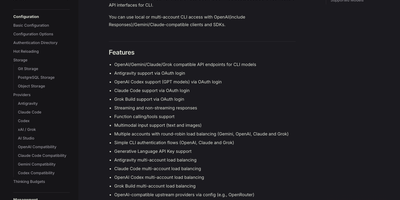
CLIProxyAPI turns AI coding subscriptions you already hold into one standard API endpoint that any OpenAI, Gemini, or Claude compatible client can call. Connect Codex, Claude Code, Grok Build, and Gemini accounts through simple OAuth sign in flows, then point your editor, agent, or script at a single base URL instead of juggling separate tools. Add several accounts per provider and the proxy spreads requests across them with round robin load balancing, so a busy team can pool capacity instead of pressing against one account's limits. Streaming, non streaming, and WebSocket responses are supported where the provider allows them, which keeps interactive coding sessions responsive. Function calling and tool use pass through, so agents can still run commands, edit files, and call external tools through the unified endpoint. Multimodal requests combine text and images, covering screenshot driven debugging and visual questions. Gemini API keys, AI Studio accounts, and hosted Gemini access sit alongside subscription accounts, and OpenAI compatible upstreams such as OpenRouter can be added in configuration. A management API exposes control endpoints for companion dashboards, while a reusable Go SDK lets developers embed the proxy inside their own services. Running on a dedicated VPS on RepoCloud with guaranteed CPU, RAM, and SSD, full root SSH access, and a browser serial console. MIT licensed.
Manifest LLM Gateway
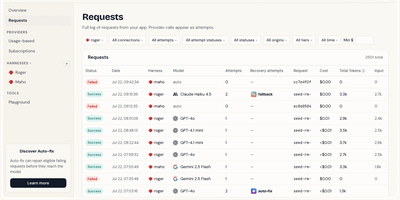
Manifest LLM Gateway is a self-hosted gateway that puts every model you pay for behind one OpenAI- and Anthropic-compatible endpoint. Connect provider API keys, reuse subscriptions like ChatGPT Plus or Claude Max, or point it at Ollama and LM Studio on your own hardware. Send a request with the model set to auto and your routing rules choose the target by model, header, complexity, or task type, with fallbacks that take over the instant a model fails. Each agent or app gets its own harness, a named connection with a private key, spending limits, and notifications when usage climbs. The Requests view logs every call and every retry attempt, with status, cost, tokens, and the full request and response body readable as a conversation. Autofix repairs a malformed request, for example one using a renamed parameter, and resends it before your app ever sees an error. A Playground tests models from the dashboard, a command line tool and MCP server handle setup from a terminal or an AI assistant, and an n8n node plugs it into automations. Over 35 provider connections cover more than 300 models. Running on a dedicated VPS on RepoCloud with guaranteed CPU, RAM, and SSD, full root SSH access, and a browser serial console. MIT licensed.
Oh My CPA
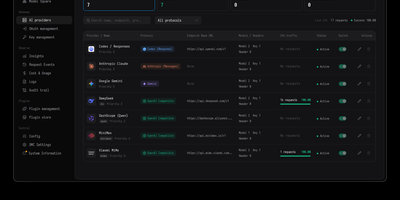
Oh My CPA gives a CLIProxyAPI gateway a proper control room, where providers, OAuth credentials, client keys, model routing, and the cost of every request are managed and watched from one self-hosted console. You add providers such as Codex, Claude, Gemini, xAI, DeepSeek, Vertex AI, and OpenAI-compatible services, each with credentials, retry and error policies, priority, weight, and an enable switch the gateway actually enforces. OAuth accounts are signed in from the console, with quota window readings, refresh schedules, and per-credential model aliases kept next to the keys they belong to. Client keys can be created, named, and revoked, and those names follow the traffic into request records and filters so you always know which key spent what. The dashboard follows request volume, token throughput, cache hit rate, and cost from the last fifteen minutes out to ninety days, with a year-long token heatmap for the long view. Insights compare keys, models, providers, and credentials against the previous period, while the live routing view shows which credential each request travelled to and whether it was rerouted. Every request stays searchable, with duration, time to first token, token breakdown, and the raw log in a detail drawer. A playground tests any routed model with text and images before your users do. Running on a dedicated VPS on RepoCloud with guaranteed CPU, RAM, and SSD, full root SSH access, and a browser serial console. MIT licensed.
TokenHub
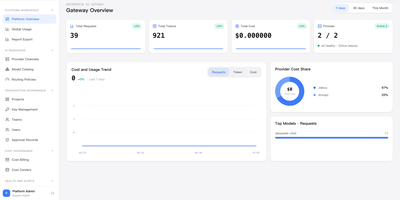
Give every team, project, and application one governed door to AI models instead of scattering raw provider keys across codebases. TokenHub is an OpenAI-compatible gateway that serves chat completions, responses, embeddings, reranking, and image generation, plus Anthropic Messages endpoints, in front of OpenAI, Azure OpenAI, Anthropic, Gemini, DeepSeek, Qwen, Codex subscriptions, local models, and more than 150 provider templates. Administrators publish a model catalog and write routing policies with priority, weight, failover order, and cost or quality preferences, so a provider outage never reaches client code. Users create project-scoped API keys with quotas and concurrency limits, team leaders manage project spaces and members, and each role gets a workspace that matches its job. Usage analytics and request logs attribute every call to a user, project, team, model, and cost center, and provider reconciliation compares internal usage with upstream bills. Sign in through OAuth or OIDC, control access with RBAC, and keep an audit trail of administrative changes. The console switches between English, Chinese, Japanese, and Russian, and includes an API documentation workspace for developers. Running on a dedicated VPS on RepoCloud with guaranteed CPU, RAM, and SSD, full root SSH access, and a browser serial console. Apache-2.0 licensed.
Apache APISIX
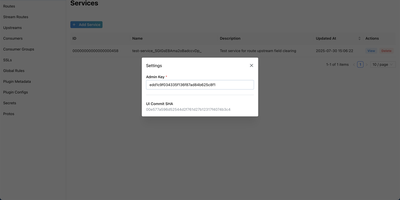
With 17,000 GitHub stars, 460+ contributors, and deployments across telecommunications, automotive, and financial services running on over 10,000 CPU cores at the largest known installations, Apache APISIX delivers a fully dynamic API gateway achieving 140,000 QPS on eight cores with sub-millisecond latency through NGINX's event-driven architecture and LuaJIT-compiled plugin execution. The 100+ open-source plugins cover authentication (JWT, OAuth 2.0, OIDC, Keycloak, LDAP), observability (Prometheus, Datadog, SkyWalking, OpenTelemetry), traffic management (rate limiting, circuit breaking, canary releases, traffic splitting), and security (CORS, IP restriction, CSRF protection) — all hot-reloadable without process restarts via etcd-based real-time configuration synchronization. Multi-protocol support handles HTTP, gRPC, MQTT, TCP, UDP, and WebSocket traffic for both north-south API access and east-west service mesh communication. AI gateway capabilities proxy requests to 20+ LLM providers with semantic caching, token-aware rate limiting, provider failover routing, and content moderation. Custom plugins extend the gateway in Lua, Go, Java, Python, or WebAssembly. Radixtree route matching handles 100,000+ routes without performance degradation. Functions as a Kubernetes ingress controller with native service discovery for Consul, Nacos, and Eureka. Deploy via Docker or Helm charts with horizontal scaling through etcd cluster coordination. Running on a dedicated VPS on RepoCloud with guaranteed CPU, RAM, and SSD, full root SSH access, and a browser serial console. Apache 2.0 licensed.
Unla
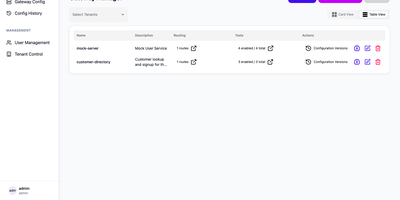
Unla puts a friendly front door on every API you already run, so AI clients can call it as an MCP server without anyone writing a line of glue code. Describe an endpoint in YAML or the form editor, name its arguments, choose where each one goes in the request, and the gateway exposes it as a tool over SSE or streamable HTTP. Import an OpenAPI file to generate a whole server at once, or proxy a third-party MCP server and route it under a prefix of your choice. The Gateway Manager shows every server as a card or table row with its routes, enabled tools, and tool counts. Every save creates a numbered config version with its author and timestamp, so changes are easy to audit and roll back. Tenants keep teams separate, user accounts carry roles, and CORS settings sit next to each route. Configuration hot reloads, syncs across replicas, and persists to disk, SQLite, PostgreSQL, or MySQL. Running on a dedicated VPS on RepoCloud with guaranteed CPU, RAM, and SSD, full root SSH access, and a browser serial console. MIT licensed.
Higress
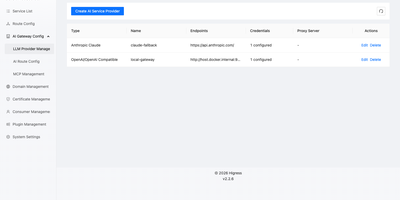
Send every AI request through one gateway that holds your model providers, API keys, and access rules. The web console starts with a first-run admin setup, then an LLM Provider page where OpenAI-compatible endpoints, Anthropic Claude, Azure OpenAI, Tongyi Qianwen, Moonshot, Zhipu, and other services are added with their tokens. AI Route Config maps path prefixes and model match rules to weighted target services, with token failover and first-packet timeouts to keep traffic moving when a key fails. Consumer Management issues key, OAuth2, and JWT credentials, and each route can limit access to named consumers. Plugin Management lists ready-made AI plugins for caching, context limits, data masking, prompt templates, prompt decorators, load balancing, and intent checks, plus traffic and security plugins that can be configured per route. MCP Management hosts MCP servers behind the same authentication and rate limits so agents call tools through one governed address. Service Sources import backends from Nacos, Zookeeper, Consul, Eureka, static addresses, or domains, and domain and certificate pages handle HTTPS, including free automatic certificates from Let's Encrypt. An LLM proxy for a product team, a shared model endpoint for several agents, or a replacement for an ingress controller all fit this console. Running on a dedicated VPS on RepoCloud with guaranteed CPU, RAM, and SSD, full root SSH access, and a browser serial console. Apache-2.0 licensed.
CPA Manager Plus
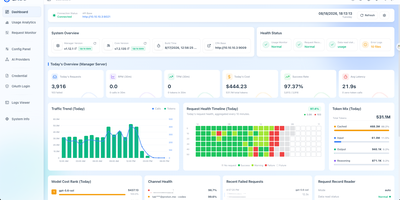
CPA Manager Plus is a self-hosted observability dashboard and management panel that tracks every AI request flowing through your CLI Proxy API gateway, breaking down failures, costs, and account health across providers like OpenAI, Anthropic, xAI, and Codex in one interface. When a request fails, drill into the persistent history to see status codes, affected models, latency, and redacted failure evidence without exposing raw response bodies. The cost analytics engine breaks down token consumption and estimated spend by model, provider, account, API key, project, channel, and time range while tracking input, output, reasoning, cache, and service-tier pricing semantics separately. Model prices sync automatically from models.dev with LiteLLM and OpenRouter fallbacks, and you can add local overrides for aliases or internal models. For teams running Codex or xAI accounts, the health inspector reads quota windows, reset evidence, credential state, and workspace status on a configurable schedule, routing credential failures into an action queue for review rather than letting them silently degrade throughput. Deploy the Lightweight Panel to replace your existing CPA management UI without adding another service, or run Full Mode as a single Docker container that adds the Manager Server with persistent SQLite storage for request history, historical analytics, and automated account inspections. Export or import request history as JSONL for external analysis, and back up the SQLite files alongside your encrypted management keys. Running on a dedicated VPS on RepoCloud with guaranteed CPU, RAM, and SSD, full root SSH access, and a browser serial console. MIT licensed.
KeiRouter
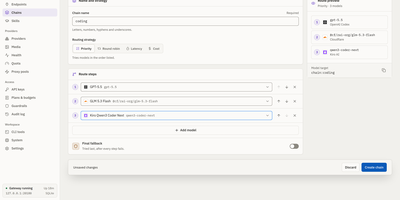
One endpoint, 130+ models from 90+ providers: KeiRouter is a self-hosted AI gateway, so apps, coding tools, and agents connect once and stop juggling provider keys. Your code speaks OpenAI Chat, OpenAI Responses, Anthropic Messages, or native Gemini, and KeiRouter translates to whichever upstream you want, including AWS Bedrock, Azure AI Foundry, Vertex, Snowflake Cortex, and self-hosted runtimes like Ollama and vLLM. Fallback chains keep requests moving when a provider goes down or hits a rate limit, using priority, round-robin, latency, or cost ordering, so coding sessions do not stop mid-task. Five token savers compress prompts on the way in and trim responses on the way out, with a live dashboard showing savings recovered. A response cache answers repeated prompts instantly for zero marginal cost, with optional semantic matching. Per-key budgets and rate plans set USD, token, RPM, and concurrency limits with auto-cutoff, stopping surprise bills. Guardrails scan for PII, prompt injection, toxicity, and banned topics at global, provider, model, chain, and key scopes, with a monitor showing what got blocked and what it cost. The dashboard tracks usage by provider and model, latency, a live console tracing each request through its fallbacks, and provider health. You can import from 9router or OmniRoute, white-label the portal for your team, and run replicas on Postgres and Redis for high availability. Running on a dedicated VPS on RepoCloud with guaranteed CPU, RAM, and SSD, full root SSH access, and a browser serial console. MIT licensed.
Tingly Box
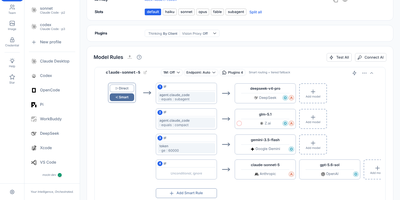
Give every agent your team runs the same front door, and the model chaos behind it becomes manageable. Tingly Box is a self-hosted gateway with a web console where providers, keys, routing rules, and team usage live in one place. Claude Code, OpenCode, Codex, Xcode, and other clients simply call the endpoint. A request arrives. The gateway reads your rules, weighs cost against speed against the policy you wrote, picks a model and a token, translates the protocol if the two ends disagree, and streams the answer back. Existing subscription quotas are spendable here, connected by OAuth beside ordinary API keys, and per-scenario profiles let quick edits and deep refactors land on different models by default. Team mode shares that endpoint properly. Model rules are managed centrally, each member receives a dedicated key, data stays isolated per user, and the usage dashboard shows exactly who consumed what. The gateway also speaks images, generating and editing through the same address with a playground for testing prompts before clients depend on them. Agents remain reachable after you leave the desk, driven through Telegram, DingTalk, Feishu, Lark, Weixin, or WeCom, with guardrails and an MCP gateway available as power-ups. Virtual models give new rules a safe target for testing and benchmarking before real traffic moves over. Running on a dedicated VPS on RepoCloud with guaranteed CPU, RAM, and SSD, full root SSH access, and a browser serial console. MPL-2.0 licensed.
CatGPT Gateway
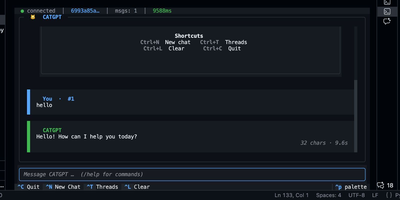
CatGPT Gateway turns the ChatGPT or Claude account a team already pays for into an OpenAI-compatible API that ordinary tools can call. Point the OpenAI Python SDK, LangChain, or a plain curl request at the gateway and choose the browser-backed model for Claude or ChatGPT; the service opens the provider web interface in a real Chromium session, enters the prompt, waits for completion, extracts the answer, and returns standard OpenAI JSON. Streaming responses arrive over SSE, persistent session headers keep multi-turn conversations on one browser tab to avoid reloads, and a browser page pool handles concurrent requests across several tabs. Tool calling round-trips through structured prompt injection, so LangChain agents can invoke local functions and receive parsed tool calls in the normal format. Vision inputs, PDF and document attachments, and ChatGPT image generation through DALL-E pass through the same endpoint shape that existing clients already speak. A live monitor at the preview route shows every active browser tab in a double-buffered grid, with tab switching and safe tab closure for the operator. One browser login through a noVNC page persists in a Docker volume, so the API keeps serving after restarts without storing provider API keys. Running on a dedicated VPS on RepoCloud with guaranteed CPU, RAM, and SSD, full root SSH access, and a browser serial console. MIT licensed.
OpenGateLLM
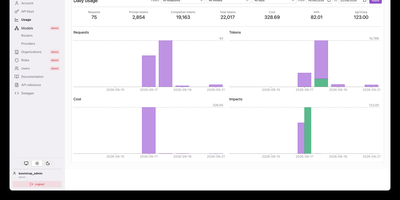
One endpoint, every model you run, and a government-grade paper trail for each request. OpenGateLLM sits in front of your AI infrastructure as the single door: applications call one OpenAI-compatible API, and the gateway decides which backend answers, a self-hosted vLLM cluster, an Ollama box in the corner, a Hugging Face TEI embeddings service, or a hosted provider when you allow one. You publish friendly model names as routers and attach real provider APIs behind them, then load-balance across those backends by shuffle or least-busy so a second GPU node starts earning its keep the moment you register it. Chat completions, embeddings, reranking, OCR, and audio transcription each get their standard endpoint, so existing OpenAI SDK code, LangChain, and LlamaIndex projects point at a new base URL and keep working. Governance is built in rather than bolted on: organizations, users, and roles control who may call which model, API keys authenticate every request, and rate limiting keeps one enthusiastic team from eating the whole cluster. Usage monitoring follows every inference, and carbon footprint estimates attach to models through their hosting zone and parameter counts. Retrieval-augmented generation against Elasticsearch or Qdrant plugs into the same surface. No chat history is stored, which is rather the point when the data is yours. Running on a dedicated VPS on RepoCloud with guaranteed CPU, RAM, and SSD, full root SSH access, and a browser serial console. MIT licensed.