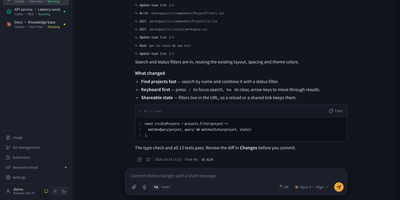
AgentBox
AgentBox is a self-hosted browser workspace that runs Claude Code and Codex CLI on a server you control, so a task goes from chat to reviewed code without leaving one place. Open a workspace from an empty project, an uploaded archive, or a Git clone, then talk to the agent in streaming web chat or drop into its original interactive terminal when you want the CLI itself. Files persist between sessions along with your home configuration and chat history, so a project picked up on a laptop continues on a phone exactly where it stopped. Review per-file diffs line by line before committing, pushing, or opening a pull request, and download the result when no Git connection is configured. Shared files, layered home templates, Claude skills, and MCP configuration carry your setup into every new workspace, with per-workspace overrides when a project differs. A trusted team shares central account pools with per-user scopes, while every model request is recorded with tokens, cache hit rate, cost, and latency, exportable to CSV and optionally capped by credits. An optional tunnel reaches allowlisted repositories and databases on private networks, and six interface styles with light and dark modes keep long sessions comfortable. Running on a dedicated VPS on RepoCloud with guaranteed CPU, RAM, and SSD, full root SSH access, and a browser serial console. Apache-2.0 licensed.
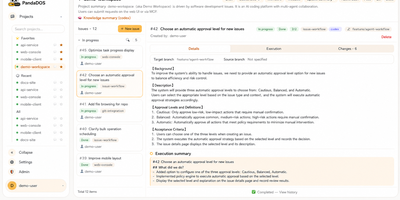
PandaDOS
PandaDOS is a self-hosted control plane that turns Claude Code and Codex into long-running coding agents you direct through an issue queue from any browser, instead of babysitting a terminal. You file an issue with the outcome and acceptance criteria, and PandaDOS clarifies missing requirements, plans the work, picks the agent, and drives implementation, verification, and delivery in stages. Three approval levels, cautious, balanced, and automatic, decide which actions proceed alone; safe reversible steps continue automatically while destructive, irreversible, production, or secret-related decisions always come back to you. The browser workspace shows the real agent conversation, a native terminal, project files, Git history and diffs, and an execution summary, so you can inspect or intervene at any moment from a phone or laptop. Agents run on local or SSH-connected executor machines inside tmux sessions, and work sharing one repository is serialized while independent projects proceed in parallel without conflicting edits. Modules keep one assigned agent and durable project knowledge, so context from finished issues carries into the next task instead of evaporating when a chat ends. Teams can sign in through Feishu, ask the project manager questions in chat, and receive subscription notifications and approval cards on their phones. Running on a dedicated VPS on RepoCloud with guaranteed CPU, RAM, and SSD, full root SSH access, and a browser serial console. Apache-2.0 licensed.
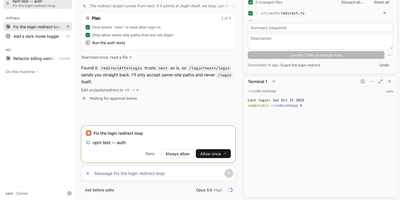
CodeRail
Close the laptop, walk away, and your coding agents keep working; CodeRail is the remote control that lets you supervise them from a browser or your phone without handing your machines to anyone's cloud. A small bridge on each computer connects outbound to your server, so there are no open ports and no VPN to babysit, and each machine keeps its own Claude Code and Codex logins because CodeRail never holds your AI keys. Chats show plans, tool calls, models, modes, and background tasks, and when an agent wants to run something sensitive, the approval lands with you wherever you are, including as a phone push notification. Real terminals outlive the browser tab, files can be viewed, edited, uploaded, and downloaded in place, and git work, pull requests included, sits beside the conversation that produced it. Each chat even gets a browser on the computer itself, shared live with everyone in the chat and drivable by the agent. Roles run Owner, Operator, or Viewer per computer, narrowed down to folders and agents, with every change audited, and sessions keep running with every browser closed while history stays readable offline. Running on a dedicated VPS on RepoCloud with guaranteed CPU, RAM, and SSD, full root SSH access, and a browser serial console. Apache-2.0 licensed.
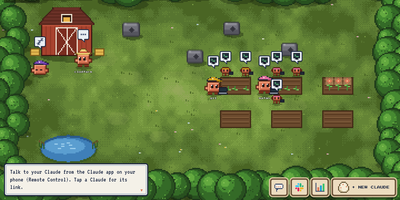
Clodfarm
While you sleep, a crew of Claude Code agents in a single Docker container keeps building: you plant a mission, the farm splits it into sub-agents on their own branches, and only work that passes your tests ever lands in the repo. Open the farm in your browser and every agent is a pixel Claude walking its plot, tending a task at a terminal or napping when the budget says stop, with the quest log, mission board, and a hatchery for new agents a click away. Each account is paced against its real five hour and weekly usage, measured live, always leaving you twenty percent and never paying overage, and teammates' agents message each other and hand jobs to whichever account still has room. Talk to any agent from the Claude app on your phone, post quests, set schedules like weekday issue triage at nine, and watch live dashboards the agents maintain themselves. Whiteboards let you sketch while an agent draws back full Mermaid architectures for the whole farm to see, the farm's logged-in browser does website work as you, and Slack mentions, Blender scenes, and other models from GPT to a local Ollama all plug into the same queue. Running on a dedicated VPS on RepoCloud with guaranteed CPU, RAM, and SSD, full root SSH access, and a browser serial console. MIT licensed.
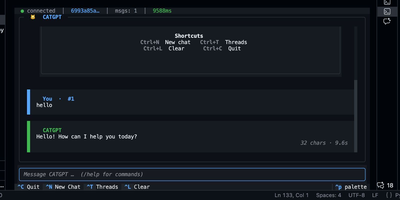
CatGPT Gateway
CatGPT Gateway turns the ChatGPT or Claude account a team already pays for into an OpenAI-compatible API that ordinary tools can call. Point the OpenAI Python SDK, LangChain, or a plain curl request at the gateway and choose the browser-backed model for Claude or ChatGPT; the service opens the provider web interface in a real Chromium session, enters the prompt, waits for completion, extracts the answer, and returns standard OpenAI JSON. Streaming responses arrive over SSE, persistent session headers keep multi-turn conversations on one browser tab to avoid reloads, and a browser page pool handles concurrent requests across several tabs. Tool calling round-trips through structured prompt injection, so LangChain agents can invoke local functions and receive parsed tool calls in the normal format. Vision inputs, PDF and document attachments, and ChatGPT image generation through DALL-E pass through the same endpoint shape that existing clients already speak. A live monitor at the preview route shows every active browser tab in a double-buffered grid, with tab switching and safe tab closure for the operator. One browser login through a noVNC page persists in a Docker volume, so the API keeps serving after restarts without storing provider API keys. Running on a dedicated VPS on RepoCloud with guaranteed CPU, RAM, and SSD, full root SSH access, and a browser serial console. MIT licensed.