CookCLI
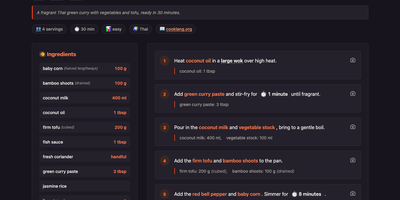
Plain-text recipes in, a phone-friendly recipe site out: CookCLI reads Cooklang files and serves them with scaling, search, shopping lists, meal plans, and pantry tracking. Write ingredients, cookware, and timers inline. Open any recipe from a phone or laptop on your network. Change the serving count and the quantities recalculate. Search by ingredient or by text. Plan a week in a .menu file and get one shopping list, merged across recipes, grouped by store aisle from your own aisle configuration, with pantry items already subtracted. The pantry file holds quantities, expiry dates, and low-stock thresholds. Ask which items are depleted or expiring, or which dishes you can cook right now, near matches included. In the terminal, print any recipe as Cooklang, JSON, or Markdown, run template-driven reports, and let a doctor command check your files. Import a recipe from a web page with an OpenAI API key. Switch on sign-in so everyone can browse but only signed-in users can edit recipes, the pantry, or the shopping list. A documented HTTP API feeds other tools. The whole collection also builds into a static website. Running on a dedicated VPS on RepoCloud with guaranteed CPU, RAM, and SSD, full root SSH access, and a browser serial console. MIT licensed.
asciinema Server
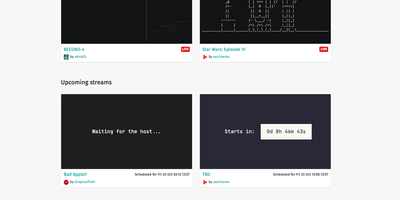
asciinema server gives terminal recordings and live streams a home on your own domain, stored as lightweight, searchable text instead of heavy video files. Demos, tutorials, and incident replays recorded with the asciinema CLI upload in the asciicast format and play back in an integrated web player with configurable terminal themes and font families. Live streams broadcast a running session to viewers in their browsers, which suits workshops, pair debugging, and open office hours. Search spans titles, descriptions, and the terminal output itself, so a command typed months ago is easy to find. Every recording or stream is private, unlisted, or public, secret links make sharing simple, and titles and Markdown descriptions stay editable after upload. Players embed in documentation pages, an SVG preview image links back to the recording, and transcripts download as plain .txt files. No tracking, no advertising. Sign-in uses emailed login links, which a single-user instance can read straight from the server log. An HTTP API creates, updates, and deletes recordings and streams, and an optional audio track can accompany either one. Running on a dedicated VPS on RepoCloud with guaranteed CPU, RAM, and SSD, full root SSH access, and a browser serial console. Apache-2.0 licensed.