Apache Kafka
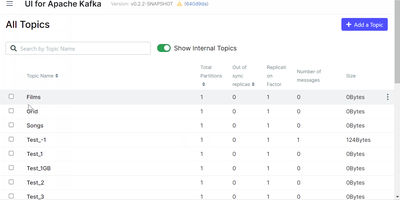
Used by over 80% of Fortune 100 companies including LinkedIn, Netflix, Uber, and Goldman Sachs, Apache Kafka processes trillions of messages per day as the world's most widely deployed distributed event streaming platform. Since version 4.0 released in March 2025, Kafka operates exclusively with KRaft consensus, replacing Apache ZooKeeper entirely with an internal Raft-based metadata quorum managed by controller nodes, reducing operational complexity and eliminating external coordination dependencies. Topics are organized as append-only partitioned commit logs with configurable replication factors across brokers, delivering network-limited throughput with end-to-end latencies as low as 2 milliseconds. Kafka Streams provides a client library for building stateful stream processing applications with exactly-once semantics, windowed aggregations, joins across streams and tables, and interactive queries against local state stores. Kafka Connect integrates with hundreds of systems including PostgreSQL, MySQL, Elasticsearch, Amazon S3, MongoDB, HDFS, and JMS through a standardized connector framework with distributed worker mode and automatic offset management. Share Groups introduced in version 4.2 deliver queue-style consumption semantics alongside traditional consumer groups, enabling Kafka to serve both pub-sub and point-to-point messaging patterns natively. The Schema Registry enforces Avro, Protobuf, and JSON Schema compatibility rules across producers and consumers, preventing schema evolution from breaking downstream applications. Tiered Storage offloads older log segments to object storage like S3 while maintaining transparent consumer access, dramatically reducing local broker storage costs for long-retention topics. Running on a dedicated VPS on RepoCloud with guaranteed CPU, RAM, and SSD, full root SSH access, and a browser serial console. Apache 2.0 licensed.
RisingWave
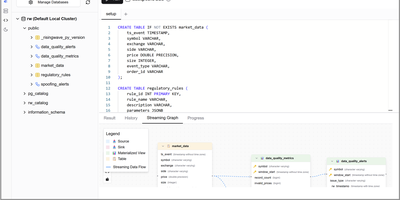
With over 9,100 GitHub stars and production deployments powering real-time analytics at companies like SHOPLINE where it reduced API latency by 76.7%, RisingWave is the PostgreSQL-compatible streaming database that collapses the traditional Debezium-plus-Kafka-plus-Flink-plus-serving-database stack into a single Rust-powered system. The platform continuously ingests data from PostgreSQL and MySQL via native CDC connectors that eliminate Debezium middleware, consumes Kafka, Redpanda, Pulsar, and Kinesis topics, accepts webhook events from SaaS applications, and batch-loads historical data from S3 and data warehouses. Standard SQL defines sources, materialized views, and sinks — no new DSL, no Java, and no custom API — while the PostgreSQL wire protocol means psql, DBeaver, pgAdmin, Grafana, Metabase, Superset, Tableau, and every PostgreSQL client library works without modification. Materialized views are incrementally maintained as events arrive, delivering point lookups in single-digit milliseconds without recomputing aggregates from scratch. For long-term retention, RisingWave writes to Apache Iceberg tables with a hosted REST catalog and automated table maintenance including compaction, small-file optimization, and snapshot cleanup, with data queryable by Spark, Trino, DuckDB, and DataFusion. The disaggregated compute-storage architecture uses S3-based state management for elastic scaling, instant failure recovery measured in seconds rather than the minutes-to-hours typical of RocksDB-based systems, and cost-efficient storage tiering. An MCP server enables AI agents to query and operate RisingWave directly. Running on a dedicated VPS on RepoCloud with guaranteed CPU, RAM, and SSD, full root SSH access, and a browser serial console. Apache 2.0 licensed.