Grimmory
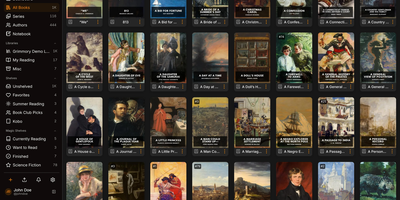
Consolidate fragmented collections of digital novels, graphic novels, manga, and audiobooks into Grimmory, an open-source media library server that combines automated file sorting with rich in-browser reading environments. The server indexes diverse media formats including EPUB, MOBI, AZW3, FB2, PDF, CBZ, CBR, CB7, M4B, and MP3 files across isolated storage directories. Readers explore literature through specialized browser viewports that provide customizable typography, CFI highlight annotations, two-page comic spreads with right-to-left manga modes, and chapter-based audiobook playback with sleep timers. Automated BookDrop watch folders ingest incoming files, retrieving book covers, author biographies, and community ratings from Google Books, Open Library, and Amazon APIs. Dynamic Magic Shelves organize catalogs automatically using nested boolean rule trees that filter books by page counts, genres, release dates, or narrator identities without server reload overhead. External e-readers access media catalogs through standard OPDS feeds or native Kobo and KOReader synchronization endpoints that match documents by binary content hashes. Built-in email delivery sends formatted books directly to Kindle devices with a single click, while OpenID Connect authentication enforces granular multi-user library permissions. Running on a dedicated VPS on RepoCloud with guaranteed CPU, RAM, and SSD, full root SSH access, and a browser serial console. GNU AGPLv3 licensed.
ReadMeABook
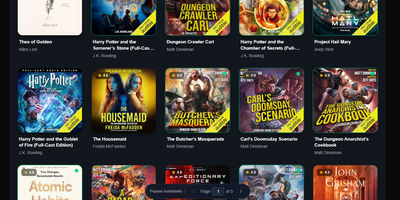
Instead of manually hunting through indexers and stitching chapter files together, ReadMeABook automates the entire audiobook request, download, and M4B library organization pipeline for Audiobookshelf and Plex. Users search an Audible-backed catalog by title, author, narrator, or series, inspect full book summaries with runtime and publisher metadata, and submit one-click requests from a clean browser portal. Once approved, the engine queries Prowlarr across torrent and Usenet indexers, dispatches releases to qBittorrent or SABnzbd, and monitors download progress until completion. Multi-file MP3 downloads merge automatically into a single chapterized M4B audiobook via FFmpeg, complete with embedded cover art, narrator tags, and series ordering metadata before triggering a media server library scan. Not sure what to listen to next? BookDate pairs OpenAI, Anthropic Claude, or local LLM endpoints with a swipeable card deck that learns your reading tastes and queues new titles with a single swipe right. Optional e-book sidecar fetching grabs companion EPUB or PDF files alongside audio releases, while multi-user approval queues, OIDC single sign-on, Goodreads shelf syncing, and Discord, Pushover, Apprise, or ntfy notifications keep household libraries running smoothly. Running on a dedicated VPS on RepoCloud with guaranteed CPU, RAM, and SSD, full root SSH access, and a browser serial console. AGPL-3.0 licensed.
Stump
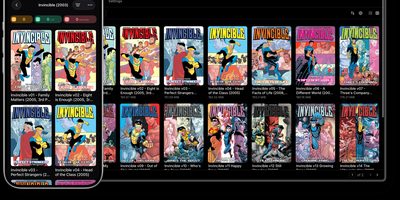
Curating digital comic archives, serialized manga, and electronic book libraries becomes effortless with Stump, a high-performance reading server that streams media collections over OPDS protocols directly to web browsers and e-reader hardware. Readers can organize extensive collections across CBZ, CBR, PDF, and EPUB formats, utilizing automated scanners that extract embedded ComicInfo XML and Calibre metadata tags. The built-in web reader renders high-resolution comic spreads, continuous vertical webtoon scrolls, and reflowable text with customizable color themes, font scaling, and reading direction toggles. Users can highlight passages, create persistent notes inside EPUB editions, and organize complex franchises into custom reading lists, oneshots, and smart filter collections. Bi-directional synchronization integrates with Kobo and KOReader hardware devices, maintaining page progression and bookmark states across handhelds and desktop sessions. Server administrators can configure multi-user access rules, enforce age restriction thresholds, and provision user-scoped API tokens for automated script pipelines and third-party companion tools. GraphQL and REST endpoints expose the entire catalog structure, allowing media collectors to integrate external metadata scrapers and trigger background library indexing tasks. Running on a dedicated VPS on RepoCloud with guaranteed CPU, RAM, and SSD, full root SSH access, and a browser serial console. MIT licensed.
BookLogr
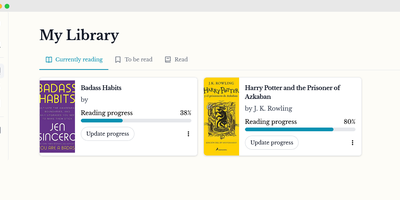
For avid readers who want to catalog their home bookshelves and track annual reading progress without handing personal habits to commercial social networks, BookLogr delivers a self-hosted personal library and reading tracker that replaces Goodreads and The StoryGraph. Searching by title, ISBN-10, or ISBN-13 pulls book covers, author names, page counts, and descriptions directly from OpenLibrary, while manual entry and user-defined custom fields let you record text, numbers, dates, selections, or boolean attributes for rare and indie editions. Configurable library tabs organize titles across Reading, To Be Read, Already Read, Did Not Finish, and All views with instant author filtering. As you read, you can update your current page number or completion percentage, log start and finish dates across multiple re-reads, and rate completed books on a granular 0.5 to 5.0 star scale. Readers can capture page-linked notes and favorite quotes, keeping reflections private or publishing them to a dedicated Notes and Quotes feed on a shareable public profile. Automated Mastodon integration posts reading milestones to the fediverse, while OpenID Connect single sign-on and single-user mode adapt the workspace for households or solo collectors. Built-in Goodreads CSV import and one-click exports to CSV, JSON, and HTML guarantee complete data portability. Running on a dedicated VPS on RepoCloud with guaranteed CPU, RAM, and SSD, full root SSH access, and a browser serial console. Apache-2.0 licensed.
Marimo
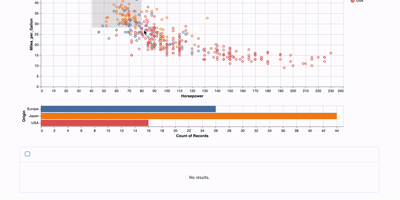
Marimo is a reactive Python notebook that treats cells like spreadsheet formulas: change one cell or interact with a UI widget and every dependent cell automatically re-executes, eliminating the hidden state bugs that make traditional notebooks unreliable. Backed by over 22,000 GitHub stars, notebooks are stored as pure Python files with PEP 723 inline metadata, making them Git-diffable, importable as modules, executable as CLI scripts with parameterized arguments, and testable with PyTest. Built-in SQL cells query Polars, Pandas, PyArrow, DuckDB, SQLite, PostgreSQL, and MySQL databases, with results automatically flowing into the reactive dependency graph. The AI-native editor provides GitHub Copilot autocomplete, context-aware assistants that access live runtime variables, inline code edits powered by configurable models from OpenAI, Anthropic, or local Ollama instances, and a pair mode that lets external AI agents connect over WebSocket. Notebooks become read-only interactive web applications with marimo run, collaborative authoring environments with marimo edit, or embedded flows inside existing FastAPI applications through ASGI middleware. Gallery mode serves multiple notebooks from a single instance with an auto-generated index page. The Docker image ships with SQL support, token-based authentication, health check endpoints at /health and /api/status, and configurable WebSocket or SSE kernel transport for proxy compatibility. Running on a dedicated VPS on RepoCloud with guaranteed CPU, RAM, and SSD, full root SSH access, and a browser serial console. Apache 2.0 licensed.
Bindery
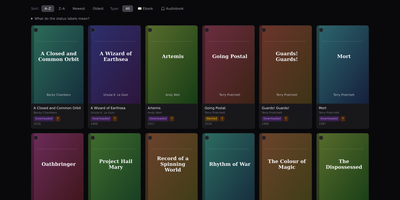
Stop wrestling with dead scrapers and scattered reading folders by orchestrating your digital library through Bindery, an automated ebook and audiobook management platform that tracks favorite authors, monitors release schedules, coordinates indexer searches, and organizes media collections. Users can configure monitoring profiles to automatically track author bibliographies across OpenLibrary, Google Books, and Hardcover without fear of dead endpoints breaking their library. Dual-format tracking allows each book entry to hold separate digital ebook and multi-part audiobook files in distinct directory roots. The integrated search engine evaluates Newznab and Torznab indexers in parallel, scoring releases by edition tags, audio bitrate, narrator names, and release year to grab the highest quality versions. Download jobs pass seamlessly to background clients like SABnzbd, NZBGet, Transmission, or Deluge, moving completed files into custom library folder structures with hardlinks. An interactive release calendar highlights upcoming publications, while the manual metadata editor locks custom titles, genres, and series ordering against upstream refreshes. Readers can browse curated collections directly through the built-in OPDS feed on mobile reading apps or export organized media straight into Calibre and Audiobookshelf. Running on a dedicated VPS on RepoCloud with guaranteed CPU, RAM, and SSD, full root SSH access, and a browser serial console. MIT licensed.
Livebook
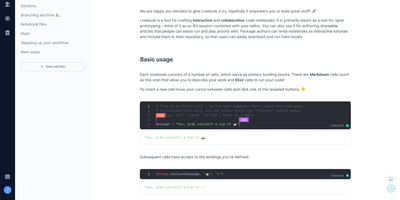
Livebook is an interactive notebook for Elixir where you write code alongside rich Markdown prose, execute it cell by cell with reactive dependency tracking, and deploy finished notebooks as standalone web applications with a single click. Nearly 6,000 GitHub stars reflect the Elixir core team's investment in a platform where code cells run on demand alongside Mermaid diagrams and KaTeX mathematical formulas. The Kino visualization library renders Vega-Lite charts, interactive data tables with sorting and pagination, Leaflet maps, and Mermaid diagrams directly within notebook output cells, while custom Kino components enable building interactive controls with sliders, text inputs, and buttons that feed values back into running code. Smart cells abstract high-level tasks into configurable UI widgets: query PostgreSQL, MySQL, SQLite, and BigQuery databases, train machine learning models with Axon, plot charts, and build map visualizations without writing boilerplate code. Real-time collaboration lets multiple users edit the same notebook simultaneously with cursor presence indicators and synchronized cell evaluation. Notebooks are stored as .livemd files, a Markdown-compatible format that renders cleanly on GitHub and integrates with standard version control workflows. Custom runtimes connect Livebook to existing Elixir applications for live introspection and documentation of running systems. The Docker image at ghcr.io/livebook-dev/livebook exposes ports 8080 and 8081 with password or token authentication. Running on a dedicated VPS on RepoCloud with guaranteed CPU, RAM, and SSD, full root SSH access, and a browser serial console. Apache 2.0 licensed.
BookLore
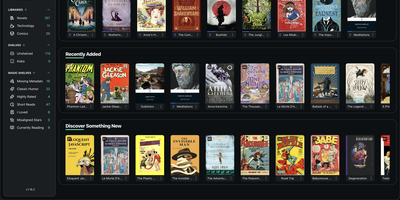
BookLore centralizes personal electronic book, audiobook, and comic collections into an organized private media server equipped with automated metadata scrapers and e-reader synchronization. Users can drop EPUB, PDF, CBZ, and MOBI files into a watched BookDrop directory to trigger automated format parsing, background cover retrieval, and staged queue imports. Integrated metadata scrapers query Google Books, Open Library, Goodreads, and Amazon to automatically fill synopsis summaries, author records, publishing dates, and review scores. Dynamic Magic Shelves categorize volumes through custom rule-based filters, author collections, and full-text search indexes across your complete literature catalog. The browser-based reader renders documents with adjustable typography, night modes, audio playback controls, text annotations, and persistent bookmarking. Hardware e-readers and mobile devices connect through native Kobo Store emulation APIs, bidirectional KOReader progress synchronization, and OPDS catalog feeds. Multi-tenant permissions provide each household member with private reading statistics, personalized shelves, email book delivery, and direct send-to-Kindle dispatch. Running on a dedicated VPS on RepoCloud with guaranteed CPU, RAM, and SSD, full root SSH access, and a browser serial console. GNU AGPLv3 licensed.
LeafWiki
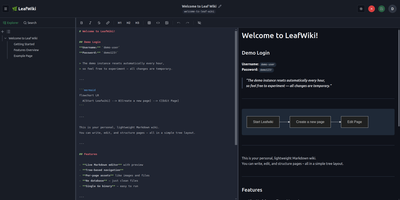
Engineering teams and technical writers maintain operational runbooks, system documentation, and knowledge bases using LeafWiki, an open-source self-hosted wiki that stores page contents directly as human-readable Markdown files on the local filesystem. Authors can compose documentation through a dual-pane editor equipped with live HTML preview, keyboard navigation, autocomplete for internal links, and native rendering for Mermaid diagrams, KaTeX mathematical formulas, and collapsible callout containers. The navigational tree organizes complex documentation into explicit directory hierarchies and custom drag-and-drop page sequences tracked in lightweight configuration files rather than arbitrary alphabetical lists. An integrated SQLite engine indexes page content and custom taxonomy tags for fast full-text searches, automatic incoming backlink tracking, and automated broken link detection. System operators can deploy the single-binary application without external database servers or runtime dependencies, backing up the entire repository by copying the data directory. Administrators can provision granular user roles, configure reverse proxy header authentication for single sign-on gateways, and manage read-only API access keys for automated documentation scripts and continuous integration pipelines. Public viewers can browse technical notes without authentication or switch between dark and light high-contrast themes. Running on a dedicated VPS on RepoCloud with guaranteed CPU, RAM, and SSD, full root SSH access, and a browser serial console. MIT licensed.
Briefer
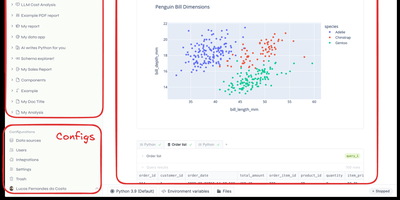
Backed by Y Combinator with 4,300 GitHub stars and growing rapidly since its September 2024 launch, Briefer delivers the first truly unified notebook-and-dashboard platform that eliminates the fragmented workflow of juggling Jupyter for analysis, Tableau for visualization, and Notion for documentation — combining all three in a single Notion-like workspace where SQL query results automatically become Python DataFrames accessible in subsequent code blocks. The built-in AI analyst understands your database schema and notebook context to generate SQL queries, write Python transformations, create visualizations, and fix errors on demand using configurable OpenAI or private LLM backends. Connect directly to PostgreSQL, MySQL, BigQuery, Redshift, Snowflake, and Amazon Athena as data sources, or upload CSV files for immediate analysis. Native point-and-click visualizations produce charts, tables, and dashboards without writing code, while interactive data apps use inputs, dropdowns, and date pickers to create parameterized reports for non-technical stakeholders. Scheduled execution runs notebooks and dashboards periodically with results delivered via Slack integration or public shareable links. Write-back queries modify production data directly from notebooks for ad-hoc pipeline testing. The architecture runs as three Docker containers — web frontend, API server, and optional AI service — backed by PostgreSQL and a Jupyter server for Python execution, deployable via single Docker command, Docker Compose, or Helm charts for Kubernetes. Running on a dedicated VPS on RepoCloud with guaranteed CPU, RAM, and SSD, full root SSH access, and a browser serial console. AGPLv3 licensed.