Floppy
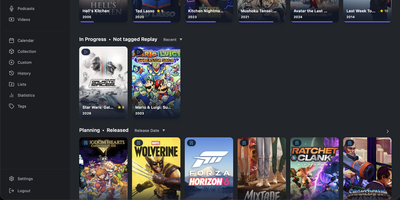
Why split your entertainment life across half a dozen siloed apps when Floppy tracks every movie, television episode, anime season, book, comic, video game, board game, album, and podcast in one unified self-hosted library? A configurable home dashboard shows exactly how much runtime remains in your current shows alongside personalized recommendation rows driven by your genre, studio, cast, and tag history. Music and podcasts are first-class citizens backed by MusicBrainz discography metadata, track-level scoring, Last.fm scrobble polling, and live Pocket Casts episode synchronization. Collectors can catalog physical and digital media ownership down to the exact disc format, video resolution, HDR standard, audio codec, and bitrate, complete with automated Plex collection syncing. Live webhooks and scheduled jobs connect directly to Plex, Jellyfin, Emby, Audiobookshelf, Sonarr, Radarr, and Seerr so watches, listens, and library additions log themselves automatically. You can curate public or private lists with programmable smart-list rules, RSS and JSON feeds, Trakt watchlist imports, and barcode ISBN scanning for physical books. Recap-style statistics let you compare custom date ranges across reading streaks, pages read, listening hours, and top actors or authors, while a REST API and built-in Model Context Protocol server power custom automations. Running on a dedicated VPS on RepoCloud with guaranteed CPU, RAM, and SSD, full root SSH access, and a browser serial console. AGPL-3.0 licensed.
Movary
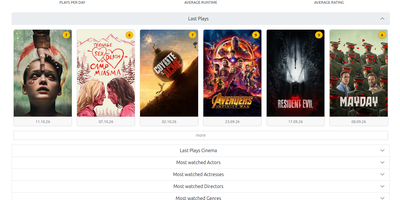
Catalog, rate, and analyze every film you watch with Movary, a self-hosted movie tracking hub and personal cinema diary that replaces Letterboxd and Trakt. Each time a movie finishes playing on Plex, Jellyfin, Emby, or Kodi, automated webhook scrobblers record the viewing session and star rating directly into your timeline without manual logging. You can also bring over years of existing watch history by importing exports from Letterboxd, Trakt, or Netflix, and automatically cross-post newly logged reviews and ratings to Mastodon or feed Watchlist additions straight into Radarr. Customizing your personal dashboard lets you rearrange analytical widgets that break down your viewing habits by most-watched actors, directors, genres, original languages, release decades, and custom watch locations like local cinemas or home theaters. Movie metadata, posters, and ratings pulled from TMDB and IMDb are cached locally on your server, while built-in background job schedules keep artwork and cast details refreshed automatically. Multi-user account controls, TOTP two-factor authentication, granular profile visibility settings, and personal Bearer API tokens make it easy to run a private household log or a shared film club server. Running on a dedicated VPS on RepoCloud with guaranteed CPU, RAM, and SSD, full root SSH access, and a browser serial console. MIT licensed.
Streamystats
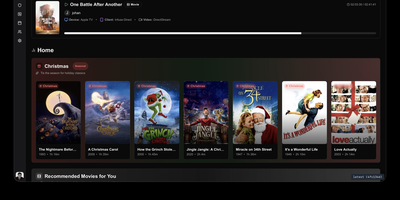
To uncover deep viewing insights and AI-powered content recommendations across your self-hosted Jellyfin media server, Streamystats delivers a comprehensive analytics and watch-history platform. Once connected to one or more Jellyfin instances using native MediaBrowser authentication, the dashboard tracks live playback sessions, per-user watch durations, device and client breakdowns, and library-wide growth metrics without requiring third-party reporting plugins. You can import existing historical logs from Jellystat or the Playback Reporting plugin so years of viewing habits carry over immediately, then explore interactive watch-time graphs, genre radar charts, actor and director leaderboards, and a yearly Wrapped summary. When you enable vector embeddings through OpenAI, OpenRouter, Google Gemini, Voyage AI, or a local Ollama model, the recommendation engine calculates cosine similarity against your watch history and explains exactly which watched movies or series inspired each suggestion. An integrated AI chat assistant equipped with thirteen specialized function-calling tools lets you search your catalog semantically, ask natural-language questions about your viewing statistics, and generate shared movie recommendations for multiple household members at once. Administrators can also mark titles as watched or unwatched with automatic watch-time inference, manage watchlists over an external API, and connect Janitorr for automated media cleanup. Running on a dedicated VPS on RepoCloud with guaranteed CPU, RAM, and SSD, full root SSH access, and a browser serial console. MIT licensed.