Pipelock
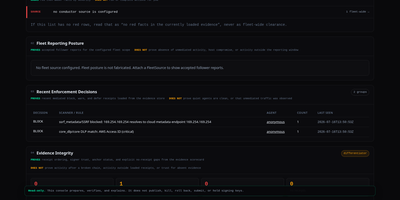
Your AI coding agent has your API keys in its environment and unrestricted network access, which means one prompt injection away from sending those secrets anywhere. Pipelock closes that gap by sitting as a proxy between your agents and every outbound connection, scanning the actual content of HTTP, WebSocket, MCP, and Agent-to-Agent traffic before it leaves your server. An 11-layer scanner pipeline checks every request against 62 credential patterns covering AWS, GCP, Azure, GitHub, OpenAI, Anthropic, SSH keys, and database URLs, then inspects every response for prompt injection using 29 detection patterns with six-pass normalization that catches base64-encoded, leetspeak, and whitespace-obfuscated payloads. The MCP proxy wraps any Model Context Protocol server (stdio, HTTP, or WebSocket) with bidirectional scanning that detects tool description poisoning and mid-session rug-pull changes via SHA-256 fingerprinting. Every scanning decision produces a cryptographically signed action receipt that third parties can verify offline without trusting the agent or the vendor. The Operator Console provides a web dashboard for reviewing evidence scorecards, receipt timelines, agent sessions, enforcement decisions, and fleet posture at a glance. Cross-request taint tracking catches slow-drip exfiltration attempts that spread a secret across multiple calls. Canary tokens plant synthetic secrets that trip alerts the moment an agent tries to exfiltrate them. Pre-built Prometheus metrics and a Grafana dashboard provide real-time visibility into traffic volumes and block rates. Deploy on a dedicated VPS on RepoCloud with guaranteed CPU, RAM, and SSD, full root SSH access, and a browser serial console. Apache 2.0 licensed.
Mastyf
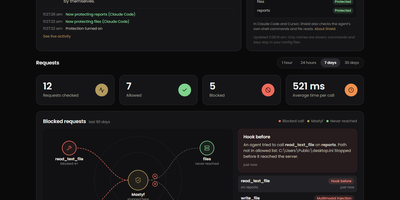
Between an AI agent and its tools sits Mastyf, a security gateway that checks every tool call against your rules before it runs. Home shows whether Protection is on; switching it on routes the MCP servers of Claude Code, Cursor, VS Code, Windsurf, Cline, and Claude Desktop through the proxy and catches servers added later within seconds. Blocked calls never reach the tool. Rules cover prompt injection, path traversal, secret leaks, shell injection, SSRF, encoding tricks, runaway token spending, and tool definitions that change mid-session. Policies are YAML you edit in the dashboard or any editor, with audit, warn, and block modes, hot reload, and a version history with diffs and one-click restore. Starter templates cover HIPAA, PCI-DSS, GxP, and data residency. The dashboard streams every decision into an Activity trail with a heatmap, tests sample calls against your rules, and tracks token spend per server against a monthly budget. Block alerts go to Slack, PagerDuty, or any webhook, and decisions can stream to Splunk, Elastic, OpenTelemetry, or syslog. Threat Lab uses a local Ollama model to invent attack tests and propose new rules, which apply only after you approve them. A client library with LangChain and OpenAI Agents adapters and an HTTP check service let custom agents ask before each tool runs. Running on a dedicated VPS on RepoCloud with guaranteed CPU, RAM, and SSD, full root SSH access, and a browser serial console. AGPL-3.0 licensed.