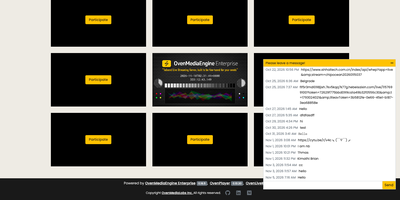
OvenMediaEngine
OvenMediaEngine ingests a broadcast feed once and delivers it to every viewer with sub-second delay over WebRTC and Low Latency HLS. Encoders push through WebRTC with WHIP, SRT, RTMP, or MPEG-2 TS, and the server can also pull RTSP sources and schedule pre-recorded files as live channels. The embedded transcoder converts incoming video to adaptive bitrate ladders in VP8, H.264, H.265, or AV1, so phones on weak signals and televisions on fiber each receive a rendition they can play. WebRTC delivery runs through an embedded signalling server and TURN server, with retransmission and forward error correction keeping pictures intact on imperfect networks. LLHLS streams carry DVR rewind, WebVTT subtitles, timed metadata, and DRM through Widevine, FairPlay, and PlayReady. Recordings dump finished streams to files for video on demand, thumbnails capture stills, and push publishing re-streams to other platforms over RTMP and SRT. Origin-edge clustering spreads a popular event across many servers, admission webhooks and signed policies control who may publish and watch, and a REST API plus monitoring endpoints keep the whole service observable. Running on a dedicated VPS on RepoCloud with guaranteed CPU, RAM, and SSD, full root SSH access, and a browser serial console. AGPL-3.0 licensed.
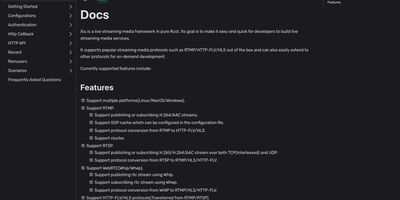
Xiu
Point OBS at it, and the same live stream comes out in whatever protocol each viewer needs. Xiu is an open-source live media server that accepts publishing over RTMP, RTSP, and WebRTC WHIP, then redistributes every stream as RTMP, RTSP, HTTP-FLV, HLS, or low-latency WebRTC WHEP playback. Cameras and encoders pushing H.264, H.265, or AAC over TCP or UDP become browser-friendly HLS and HTTP-FLV without a separate transcoding tier, and GOP caching gets late joiners to a keyframe fast. Static push and pull relaying chains servers together: one origin ingests, regional nodes pull, and audiences play from the node nearest them; RTMP clustering covers larger fan-outs. Every live stream can also be recorded straight to HLS files, giving you an instant archive of broadcasts, lessons, and town halls. Token authentication guards publishing and playback, HTTP callbacks report stream start and stop events to your backend, and an HTTP API answers stream information queries for your own dashboards and automation. Operators shape ports, protocols, relays, and recording in one configuration file or with command-line flags, running a single binary that stays out of the way until the audience arrives. Running on a dedicated VPS on RepoCloud with guaranteed CPU, RAM, and SSD, full root SSH access, and a browser serial console. MIT licensed.
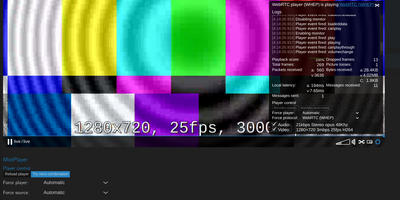
MistServer
Feed one camera, encoder, or file into MistServer and it republishes the same media in the formats your audience actually uses: HLS for phones, DASH for browsers, WebRTC for sub second playback, and RTMP or SRT for the next service in the chain. Publish from OBS over RTMP, SRT, or WHIP, then hand viewers a Meta Player embed that picks a working protocol on its own. Records run straight to disk for later on demand viewing, and push support relays finished streams to external platforms. Processes can repackage, encode, compose, or analyze media between ingest and delivery. A JSON API on the controller port covers configuration and status, stream keys authenticate incoming publishers, and triggers fire your own endpoints on stream events. Operational metrics export to Prometheus for retention and alerting. Access control rules and HTTPS support protect interfaces and media endpoints. File libraries become on demand catalogs with the same delivery rules as live channels. Every input, output, and process ships as a separate small binary, so an installation keeps only the protocol modules it actually serves, and analysers inspect media properties when a stream misbehaves. Running on a dedicated VPS on RepoCloud with guaranteed CPU, RAM, and SSD, full root SSH access, and a browser serial console. Unlicense licensed.