ChatChat
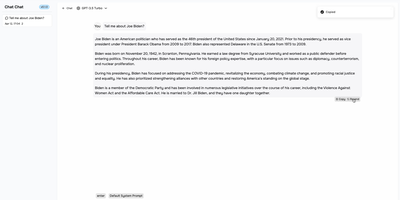
One clean interface in front of Anthropic, OpenAI, Google Gemini, Cohere, and more: Chat Chat is a Next.js front door to the major AI providers, ending the juggling of separate subscriptions, tabs, and UIs per model. Bring your own API keys, pick a provider and model per conversation, and switch between them as the task demands: Claude for long-form reasoning, GPT for code, Gemini for multimodal work - the interface stays identical. Beyond configured presets, custom providers plug in with their own API endpoints and keys, which covers OpenAI-compatible gateways and local inference servers. The design splits into two dedicated modes: a chat interface for conversational work with customizable system prompts, and a search interface that pairs AI processing with query handling for research-style questions. The stack is modern and hackable - Next.js 14, Tailwind CSS, shadcn/ui on Radix primitives, Jotai for state - with full internationalization including English, Chinese, and Japanese. Self-hosting means your conversation history and API keys live on your instance rather than a third-party wrapper service, and pay-per-token API pricing typically beats stacking multiple monthly chat subscriptions. AGPL-licensed and deliberately simple to deploy: one container, environment variables for keys, done.
Zusam
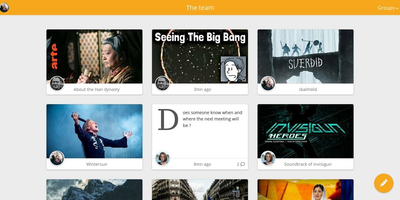
From the German "zusammen," together: Zusam is a private social space for a group of friends - a self-hosted alternative to the family WhatsApp group or the friends Facebook group, with no ads, algorithms, or data harvesting in between. The AGPLv3 project is deliberately modest in scope and stack: a Symfony PHP backend exposing a REST API over SQLite, with a lightweight Preact single-page frontend, designed for a low server footprint that runs comfortably on small hardware. Groups post messages into shared feeds that handle real life well: video and image uploads (with FFmpeg processing), photo albums for trips and events, and rich link previews with inline embeds for YouTube, Vimeo, Imgur, SoundCloud, Twitch, and Bandcamp - so sharing a song or a clip looks the way it should. When something needs to leave the circle, public link generation exposes a single message to non-members without opening the group. The interface is fully responsive and mobile-friendly, targeting Firefox ESR and recent Chrome. It is the small-web answer to a real question: where does a group chat's shared history live when you want it owned by the group instead of a platform?
Nanote
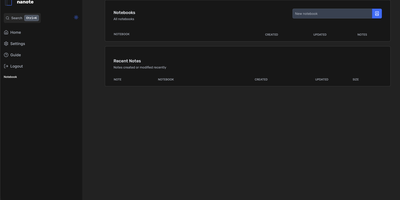
100% portability is Nanote's one non-negotiable principle as a self-hosted note-taking app. There is no database - notebooks are plain folders and notes are plain Markdown files on your filesystem, so the same notes remain fully manageable from a terminal, Notepad, or any other editor, and walking away from Nanote costs nothing because your data was never in a proprietary format to begin with. Built with Nuxt and TypeScript around the Milkdown editor, it layers modern conveniences on that plain-file foundation: fast content search across all notes using OS-optimized tooling (ugrep), native Markdown rendering, image and file attachments, and a mobile-friendly layout for reading and editing on a phone. Clever remark directives make plain text interactive - typing ::file inserts an inline upload picker, while ::today, ::now, and ::tomorrow expand to live dates and times. A fully typed REST API with validation covers automation, and access is protected by a configurable secret key. Deployment is one container with three env vars: paths for notes, uploads, and config, all bind-mountable so your Markdown lives wherever you want it - including inside an existing sync setup. AGPL-licensed and actively daily-driven by its author.
Nametag
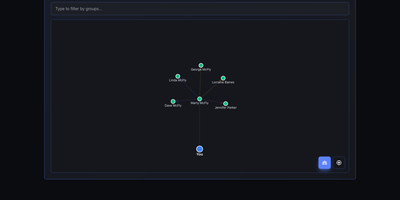
CRM mechanics applied to your actual relationships instead of a sales pipeline: Nametag is a Personal Relationship Manager (PRM). It exists to fix the things you keep forgetting: when you last talked to an old friend, their kids' names, the birthday you missed twice. Contacts are tracked with flexible attributes - names, birthdays, important dates, and free-form notes for everything else - and organized into custom groups. Where it goes beyond a contacts app is relationship mapping: you define how people connect to each other (family, friends, colleagues, or custom relationship types), and an interactive D3.js-powered graph renders your entire personal network so you can see clusters and connections at a glance. Staying in touch is automated: scheduled reminders fire for birthdays, important dates, and reach-out nudges, with optional email delivery via a Resend API key for password resets and reminder notifications. Built with Next.js, it is mobile-responsive, ships with full dark mode, and supports multiple languages including English and Spanish. Because it is self-hosted, there are no account tiers or contact limits - unlimited people and relationships, with every note about your personal life stored on your own server rather than a social-graph company's cloud. A lightweight, single-container deployment makes it one of the easiest personal tools to run.
Monetr
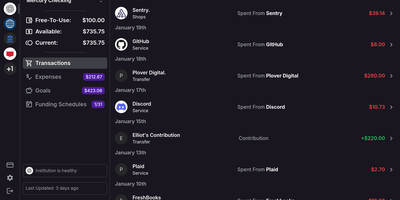
After the bills are covered, how much is actually safe to spend? monetr organizes an entire budgeting application around that one question. Inspired by the defunct Simple bank, it budgets paycheck by paycheck rather than month by month. Funding schedules encode when you get paid - including multiple schedules per account and a weekend-exclusion option for deposits that land early - and every expense or savings goal is tied to one. monetr then calculates how much of each recurring obligation (rent, car payment, subscriptions, on any repeat interval) to set aside from each paycheck, so a large bill never has to come out of a single check. What remains after allocations is surfaced as Free-To-Use, and a forecasting timeline projects contributions, due dates, and leftover funds forward so low-balance periods are visible before they happen. Transactions arrive either as OFX uploads from your bank or automatically through a Plaid connection using your own API credentials, keeping balances and transactions synced without manual entry. The app is mobile-friendly and installable as a PWA on desktop or phone. Self-hosting via Docker Compose is completely free, with all source code public and your financial data on your own hardware.
Keeper
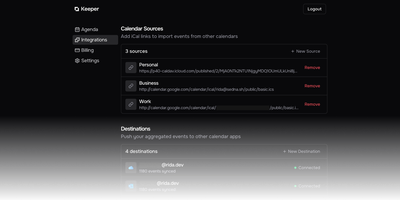
Work, personal, business, and school calendars at different providers double-book because no one system sees your real availability - Keeper solves that multi-calendar collision problem. Its pull-compare-push sync engine aggregates events from Google Calendar, Outlook/Office 365, iCloud, FastMail, any CalDAV server, or read-only iCal/ICS feeds, and pushes blocking events to one or many destination calendars so time slots align everywhere. The design is deliberately content-agnostic - it syncs timeslots, not titles or descriptions, so a personal appointment shows as busy time on your work calendar without leaking details. Sync logic is clean: events Keeper creates carry a traceable UID suffix, deletions propagate, and orphaned entries are purged automatically. A token-authenticated aggregated iCal feed combines selected calendars into one subscribable URL for Apple Calendar or Thunderbird. An optional MCP server gives AI agents read-only calendar access over OAuth 2.1 - list calendars and query events by date range, with no write capability. Built with Next.js and Bun under AGPL-3.0, the standalone Docker image bundles web, API, cron, worker, Redis, and PostgreSQL in one container, and self-hosting unlocks every Pro feature - unlimited calendars and one-minute sync intervals - for free.
Astuto
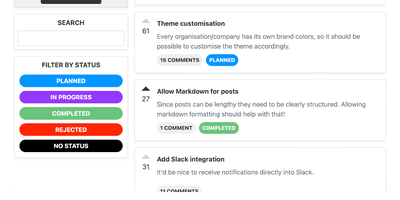
Feature requests, bug reports, upvotes, and a public roadmap: Astuto (Ruby on Rails backend, React frontend) gives users a Canny-style feedback portal so product decisions rest on visible demand rather than the loudest voice in the room. Feedback organizes into as many boards as you want (features, bugs, integrations), each post carrying a custom status you define - "planned," "in progress," "shipped," or whatever matches your process - and those statuses feed a public roadmap view showing users what is actually being worked on. Participation friction is adjustable at both ends: sign-in works with plain email or any OAuth2 provider, anonymous feedback can be enabled for unregistered users, and a moderation queue lets you approve posts before they appear when spam is a concern. Integration hooks are practical rather than sprawling - webhooks fire on events to connect Jira, Trello, or Slack, and a REST API manages the whole feedback space programmatically. Brand customization, an invitation system, private-site settings, and recap emails for administrators complete a deliberately minimal tool: it collects, organizes, and prioritizes feedback well, for free, forever.
MediKeep
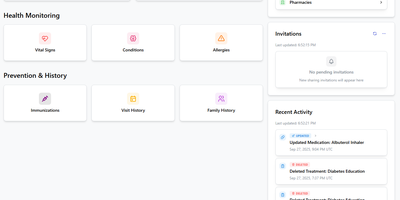
Your medical history, fragmented across a dozen patient portals, in one place on your server: MediKeep (formerly Personal Medical Records Keeper) is a self-hosted health record system. Built with a React frontend and FastAPI backend over PostgreSQL, it organizes 14 categories of medical data - medications with dosages and schedules, conditions, procedures, allergies, immunizations, symptoms, injuries, doctor visits and encounters, treatments, lab results, and even medical equipment with service dates and supplier info. Treatment management is genuinely sophisticated: an advanced mode links treatments to their medications with per-medication overrides for prescriber, pharmacy, and effective dates, and reverse lookup shows which treatments use a given medication. A dashboard summarizes records and recent activity, file uploads attach documents to records, and tagging works across categories. When a new specialist asks for your history, the report builder assembles custom reports by category and exports to PDF, JSON, or CSV - a curated, portable summary instead of a folder of photocopies. Authentication supports Google and GitHub SSO with OIDC providers like Keycloak and Authelia expected to work, and the built-in backup system protects the archive. Health data is exactly what should never live in someone else's cloud.
Notifuse
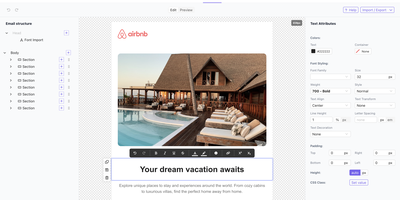
Marketing campaigns and transactional mail from one open-source platform: Notifuse is a modern, self-hosted alternative to Mailchimp, Brevo, and Klaviyo without per-email or per-contact pricing. Built with Go and React on PostgreSQL, it separates concerns cleanly: a drag-and-drop visual builder composes responsive templates from MJML components with Liquid variables like {{ contact.first_name }} and per-template version history; campaigns add A/B testing across subject lines, content, and send times; and a REST transactional API serves application-triggered mail. Delivery routes through your choice of provider - Amazon SES, Mailgun, Postmark, SendGrid, SparkPost, Mailjet, or plain SMTP - with multi-provider failover. Contacts carry custom fields and a full activity timeline (messages, profile changes, webhook events), and real-time segmentation builds dynamic rules over properties, activity, and subscriptions. Event-driven automations create behavioral sequences, a notification center gives recipients self-service preference management, and an S3-compatible file manager handles images with CDN delivery. Multi-tenant workspaces with isolated databases and custom domains suit agencies. Open and click tracking report engagement in real time.
Journiv
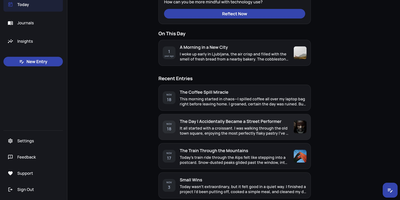
A Day One alternative that keeps your most personal writing on your own server: Journiv is journaling purpose-built for self-hosters. The FastAPI backend runs on SQLite by default with optional PostgreSQL, Redis, and Celery for background work, behind a clean, minimal web UI. Unlike general note-taking apps, it ships the features journaling actually needs: customizable moods and mood groups, activity tracking, goals with automated progress from logged activities, and daily writing prompts filterable by category and difficulty so a blank page never stalls you. Quick Log captures a moment in seconds and expands into a full entry later; "On This Day" resurfaces entries from past weeks, months, and years. Multiple journals separate work, gratitude, and personal writing, with tags and full-text search across everything, plus media uploads with automatic thumbnails and an Immich integration for linking photo-library memories. Analytics chart mood trends and writing patterns over time. Data portability is taken seriously: native import of Day One exports, JSON/Markdown/HTML export, and a standalone HTML viewer that opens your archive in any browser with no server running. OIDC single sign-on works with Authentik or Keycloak, and multi-arch images cover amd64 and arm64.

Upvote RSS
The antidote to doomscrolling: Upvote RSS turns Reddit, Hacker News, Lemmy, Lobsters, PieFed, Mbin, and trending GitHub repositories into calm, filtered RSS feeds. The MIT-licensed PHP app's killer feature is intelligent filtering: beyond simple score thresholds, the "posts per day" filter analyzes a community's recent history and computes the score cutoff that yields your target volume - say, exactly three r/technology posts daily - while a percentage-based threshold mode stays consistent as communities grow. Feeds are rich, not bare links: parsed full-article content via Readability (with optional Readability.js, Mercury, or Browserless for JavaScript-heavy pages), embedded videos and image galleries, top-voted comments with pinned-moderator filtering, scores, reading-time estimates, and optional AI summaries through Ollama, OpenAI, Gemini, Anthropic, Mistral, DeepSeek, or any OpenAI-compatible endpoint - with automatic provider fallback. A web UI builds the feed URL interactively with live preview; paste the result into any RSS reader. Reddit support includes custom domains like old.reddit.com plus NSFW filtering and blurring. Caching via filesystem, Redis, or APCu keeps repeated fetches cheap and avoids re-running paid summarizations.

LubeLogger
Vehicle maintenance records shouldn't live in a homemade spreadsheet and a shoebox of receipts - LubeLogger exists because of exactly that. It's a self-hosted .NET web application (from Hargata Softworks) that gives every vehicle in your garage a complete digital history: service, repair, and upgrade records categorized and searchable, with invoices and receipts attached as documents; fuel fill-ups that compute economy in MPG, UK MPG, L/100KM, or KM/L without spreadsheet tedium; taxes, odometer logs, inspections, equipment, and supplies inventory for tracking the parts and fluids on your shelf. The reminder system is what saves engines: recurring reminders trigger by date, odometer reading, or whichever comes first - exactly how real service intervals work - so oil changes and timing belts stop relying on memory. A dashboard summarizes expenses by year, month, and category, a planner tracks to-dos by type, priority, and progress, and professional vehicle reports print a full history - genuinely useful when selling a car. Collaboration is built in: invite household members as collaborators on shared vehicles, with single sign-on support. Custom fields adapt records to your needs, CSV import/export moves data freely, an API enables automation, and the mobile-tested UI installs as a PWA on iOS and Android. MIT-licensed.
Omni Tools
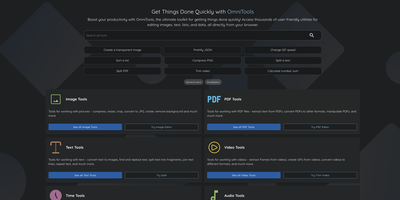
The ad-riddled "free online tools" sites people paste sensitive text into and upload confidential PDFs to - OmniTools replaces that whole ecosystem with one self-hosted app. It bundles 50+ utilities behind one clean React/TypeScript interface: image tools (resize, convert, crop, edit), video and audio tools (trim, reverse, convert), PDF tools (split, merge, edit), text and list utilities (case converters, formatters, shufflers), plus date/time, math, and data-format helpers for JSON, CSV, and XML. The architectural decision that makes it trustworthy is that all file processing happens entirely client-side in the browser - the server only serves static assets, and nothing you process ever leaves your device. That design has a pleasant side effect: the host needs almost no resources (people run it on a Raspberry Pi Zero), because your browser does the work while the server just delivers files. The Docker image is a remarkable 28 MB, making it one of the fastest apps to deploy and cheapest to keep running. There are no ads, no tracking, no accounts, and no upload limits. With multi-language support and an MIT license, it works equally well as a personal toolbox or a team-wide internal utility portal - one URL that replaces a bookmark folder full of questionable converters. Actively developed with 50 contributors and 9,500+ GitHub stars.
BentoPDF
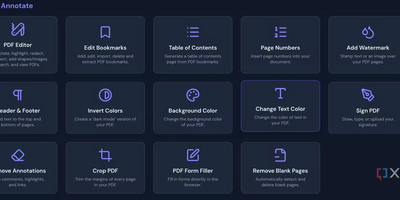
Merge, split, compress, convert, edit, annotate, redact, OCR, and sign PDFs - BentoPDF packs over 130 tools into a privacy-first toolkit that runs entirely in the browser through WebAssembly. Files are never uploaded - processing happens in browser memory on the user's machine and disappears when the tab closes, which makes the tool GDPR-clean by architecture and safe for financial, legal, and internal documents. The engine combines WASM builds of PyMuPDF, Ghostscript, and CoherentPDF; Tesseract handles OCR with searchable text-layer output; Office conversions cover Word, Excel, and PowerPoint; and digital signatures use X.509 certificates (PFX/PEM) with the private key staying on the client. Because there is no server-side processing, deployment is a static-file exercise: a single Docker container, or any static host. A dedicated self-hosted build strips the marketing pages while keeping every tool, and air-gapped deployments are first-class - an automated script bundles the WASM modules, OCR language data, and fonts for fully offline networks. No accounts, no limits, no watermarks; TypeScript and Vite under the hood.
Moocup
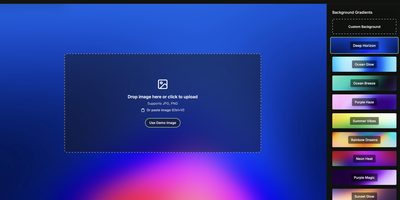
Drop your screenshot, a base style is applied, style it however you wish, and export - "that's basically it," says Moocup's own author, and the description holds. The workflow is genuinely seconds long. Drag an image in and it lands on an attractive backdrop immediately; from there you adjust backgrounds, gradients, padding, borders, shadows, and framing with live preview until it matches your taste, then export a high-quality image ready for a portfolio page, README, blog post, tweet, or slide deck. There are no accounts, no watermarks, and no upload to anyone's cloud - as a self-hosted static app, your screenshots never leave your infrastructure, which matters when the screenshot shows a proprietary dashboard or unreleased product. It runs entirely in the browser from a tiny nginx container, works on any device, and requires zero design skill: the smart defaults do the heavy lifting, and everything else is optional tinkering.
Wally
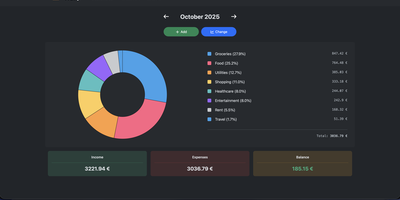
Started as an ExpenseOwl-inspired project, Wally grew into a lightweight, self-hosted expense tracker more capable in every direction its author touched. The backend is Python FastAPI over SQLite, which means every deployment ships a full REST API with interactive documentation at /api/docs - automating imports or wiring in external tools requires no reverse engineering, and when the optional login page is enabled you can mint scoped API keys from the Settings page for token-based integrations. The transactions view is built on AG Grid, bringing real search, column sorting, and per-column filtering to your ledger, with a footer totaling rows, income, and expenses for whatever slice you have filtered. Dashboards go beyond the usual monthly doughnut: a Change button swaps in year-scale line graphs so you can track a single category - restaurants, say - across time. Recurring transactions edit intelligently, letting you apply changes to all instances or only future ones. CSV import and export use a simple six-column format handled from Settings, the refined dark theme is genuinely easy on the eyes, and the interface is translated into more than ten languages. The whole thing runs from one small container with a single data volume.
ExpenseOwl
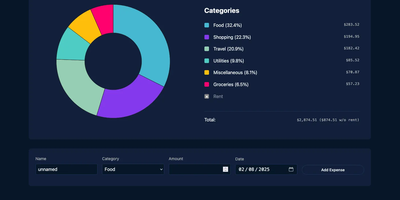
Log a date, amount, and category; get a clean monthly pie chart and a cashflow strip showing income, expenses, and net balance - ExpenseOwl is expense tracking stripped to what actually matters. The MIT-licensed Go application deliberately is not a budgeting system - no envelopes, no accounts, no double-entry, no bank sync - because its author found tools like Firefly III and Actual too heavy for the simple question "where did this month's money go?" The dashboard makes that question fast: click a pie slice to exclude fixed costs like rent and see discretionary spending clearly, then drill into a chronological table view to inspect or delete individual transactions. Recurring transactions handle salaries and subscriptions automatically, optional tags add a second classification axis, and settings cover custom categories, currency symbol, and a configurable month start date for non-calendar pay cycles. CSV import migrates data from virtually any other tool, and CSV export keeps your data portable. It ships as a self-contained binary and multi-architecture Docker image with zero internet interaction, stores data in flat JSON files by default (PostgreSQL optional), and installs as a PWA on phones. Single-user by design; pair it with an authenticating reverse proxy if exposed publicly.
BeaverHabits
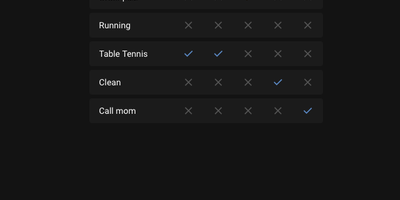
No targets, no gamification spiral, no motivational nagging: Beaver Habit Tracker is a self-hosted habit tracker deliberately built without "Goals". The core loop is honest: add habits, check them off each day, watch streaks accumulate on a calendar view. Its design follows behavioral-science basics - make it obvious (visual streak cues), make it attractive (progress is the motivator), make it satisfying (tracking becomes its own reward). Beyond the daily checklist it supports per-day notes intelligently grouped per habit, periodic habits, habit categories and tags, drag-to-reorder (manual or automatic), dark mode, and detailed streak and frequency views. Data lives where you choose: a single SQLite database or flat JSON files on a mounted volume, with JSON export and import for full portability. A REST API opens automation - community integrations already cover Stream Deck buttons, Home Assistant triggers, and CalDAV. The Python app ships as one Docker container with no external dependencies; environment variables tune everything from first day of week and index-page columns to iOS standalone PWA mode, and single-user setups can bypass the login entirely with TRUSTED_LOCAL_EMAIL. BSD-3-Clause licensed with no commercial restrictions - a well-executed single-purpose tool whose mobile PWA works anywhere a browser does.