OpenWiki
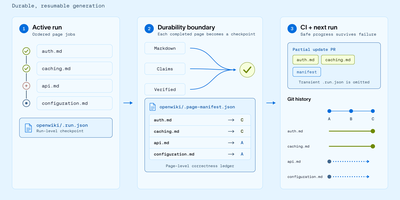
With over 15,900 GitHub stars and 40,000 weekly npm downloads in its first two months, OpenWiki from LangChain has rapidly become the standard for AI-generated codebase documentation. Built on the Deep Agents framework, it deploys a documentation agent that reads your repository's source code, tests, and configuration, then synthesizes a complete linked Markdown wiki with architecture overviews, integration guides, data-flow diagrams, and validated Mermaid visualizations. Two operating modes cover distinct workflows: code mode generates repository documentation in an openwiki/ folder with automatic AGENTS.md and CLAUDE.md integration for Codex, Claude Code, OpenCode, and Cursor, while personal mode builds a local knowledge base from nine connectors including Notion, Slack, Gmail, X/Twitter, Hacker News, LangSmith, Custom MCP, Web Search, and local git repositories. Thirteen model providers are supported out of the box — OpenAI, Anthropic, Gemini, AWS Bedrock, GitHub Copilot, OpenRouter, Nebius, Fireworks, Baseten, NVIDIA NIM, and any OpenAI-compatible endpoint like Ollama or LM Studio. Grounded Claims track every material assertion back to versioned source evidence, flagging stale propositions before they propagate. The interactive visualizer renders wiki pages as an explorable node graph with a side-by-side Markdown reader, exportable as a static site for GitHub Pages or MkDocs. Self-updating CI workflows via GitHub Actions, GitLab CI, or Bitbucket Pipelines open documentation PRs automatically when code changes. Running on a dedicated VPS on RepoCloud with guaranteed CPU, RAM, and SSD, full root SSH access, and a browser serial console. MIT licensed.
Auto Company
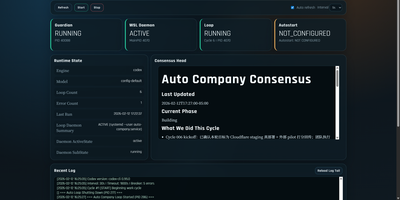
With over 2,700 GitHub stars, Auto Company is the first open-source framework that runs a fully autonomous AI company 24/7 — 14 specialized agents modeled after Jeff Bezos (CEO strategy), Werner Vogels (CTO architecture), Charlie Munger (critical analysis), DHH (full-stack engineering), Kelsey Hightower (DevOps), Seth Godin (marketing), and eight more domain experts collaborate through dynamic squad formation to ideate products, write code, deploy infrastructure, and execute marketing campaigns without human intervention. The five-layer architecture separates execution, orchestration, cognition, workflow routing, and observability, while the consensus memory pattern uses a single markdown file as a relay baton between cycles — no vector databases, no Redis, no embeddings required. A bash loop invokes Claude Code or OpenAI Codex CLI every 30 seconds, each cycle selecting 2-5 agents from the 14-person pool based on task context. Over 30 reusable skills handle specialized tasks from frontend design to competitive analysis and deployment automation. Circuit breakers trigger cooldown after consecutive errors, rate-limit detection auto-sleeps on API throttling, and sandbox rollback protects against destructive changes. The Python-powered web dashboard displays real-time cycle status, cost tracking per cycle averaging under $2, and agent activity visualization, with CLI control via make start, stop, monitor, pause, and resume. Supports macOS via launchd, Windows via WSL with systemd, and native Linux deployment. The npx create-auto-co command scaffolds a new AI company in seconds. Running on a dedicated VPS on RepoCloud with guaranteed CPU, RAM, and SSD, full root SSH access, and a browser serial console. MIT licensed.
OpenMAIC
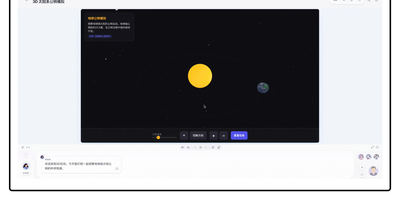
Developed by Tsinghua University researchers and validated across more than 700 students, OpenMAIC converts raw prompts, PDFs, Office documents, audio, and video into complete, multi-agent virtual learning environments. The platform leverages Next.js, LangGraph state machines, and a pluggable `@openmaic/storage` layer to orchestrate autonomous AI professors and student avatars that lecture, debate at roundtables, answer inquiries, and illustrate complex equations on a real-time SVG whiteboard. Its Pro Agent Workbench features durable PostgreSQL-backed sessions, twenty specialized curriculum-building skills, and granular JSON Patch slide editing with full `.pptx` import fidelity. OpenMAIC supports rich scene modalities including automated quiz grading, Project-Based Learning milestones, and Deep Interactive Mode offering in-browser code execution, interactive mind maps, and Three.js 3D physics simulations. Built-in audio pipelines connect with VoxCPM2 for zero-shot voice cloning, Azure STT, and FunASR for speech recognition, alongside a dedicated Chromium-FFmpeg rendering microservice for one-click MP4 video exports. Flexible model routing interfaces seamlessly with OpenAI, Anthropic Claude, Google Gemini, Amazon Bedrock, DeepSeek, and local Ollama or Lemonade instances, while OpenClaw integration enables direct classroom generation from Slack, Discord, Feishu, and Telegram. Running on a dedicated VPS on RepoCloud with guaranteed CPU, RAM, and SSD, full root SSH access, and a browser serial console. MIT licensed.
LobeHub
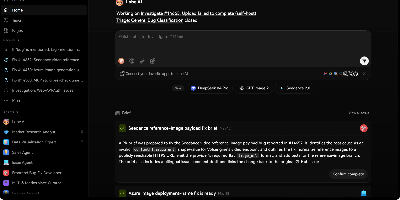
With over 82,000 GitHub stars and 700,000+ downloads, LobeHub has evolved from its origins as LobeChat into a comprehensive multi-agent AI collaboration platform where humans and autonomous agent teams co-evolve. The platform's Agent Harness architecture functions as an operating system between AI models and applications, handling prompt presets, tool orchestration, lifecycle hooks, planning, filesystem access, and sub-agent management across 25+ model providers including OpenAI, Anthropic Claude, Google Gemini, DeepSeek, Mistral, Groq, AWS Bedrock, Azure OpenAI, and local models through Ollama. Agent Groups enable sophisticated collaboration with sequential, parallel, iterative, and debate orchestration modes, allowing multiple specialized agents to tackle complex workflows simultaneously. The Agent Builder creates production-ready agents from natural language descriptions with auto-configuration, drawing from a marketplace of 505+ pre-built agents and 10,000+ MCP-compatible skills and plugins. Pages provide collaborative document editing with multi-agent co-authoring, while Schedules automate agent runs around the clock without human supervision. The knowledge base leverages PostgreSQL with pgvector for RAG-powered retrieval, and Personal Memory gives agents transparent, editable context that evolves through continual learning. The full self-hosted stack deploys via Docker Compose with PostgreSQL, Redis, RustFS for S3-compatible storage, and SearXNG for private web search, all configurable through environment variables. Running on a dedicated VPS on RepoCloud with guaranteed CPU, RAM, and SSD, full root SSH access, and a browser serial console. LobeHub Community licensed.
TradingAgents GUI
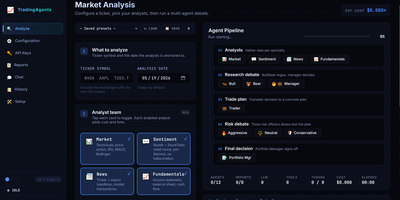
Built atop the TauricResearch TradingAgents framework with nearly 100,000 GitHub stars, TradingAgents GUI transforms a CLI-only multi-agent LLM stock analysis pipeline into a polished web application accessible at localhost:5000. The system deploys twelve specialized AI agents — fundamental analysts, sentiment experts, technical analysts, bull and bear researchers, a trader, risk management team, and portfolio manager — who collaboratively debate market conditions through structured LangGraph workflows before producing a final BUY, SELL, or HOLD recommendation. The interface supports ten LLM providers including OpenAI, Anthropic, Google, OpenRouter, DeepSeek, Ollama, xAI, Qwen, GLM, and MiniMax, with a first-run wizard that auto-detects configured API keys and tests connections. A live pipeline visualization shows each agent's status with real-time progress bars, while the tabbed output area separates Live Feed, Reports preview, and Tool calls into dedicated panes. The three-pane Reports tab provides searchable indexing, table-of-contents navigation, and export to Markdown, HTML, or PDF formats. Report length control across Concise, Standard, and Comprehensive modes saves up to 50% on token costs. Multi-session chat allows pinning past reports as grounding context with live token counting and context-window warnings. Three built-in themes — Terminal, Modern, and Bloomberg — persist per browser. Docker Compose deployment maps port 5000 with persistent report storage. Running on a dedicated VPS on RepoCloud with guaranteed CPU, RAM, and SSD, full root SSH access, and a browser serial console. Apache 2.0 licensed.
OpenMontage
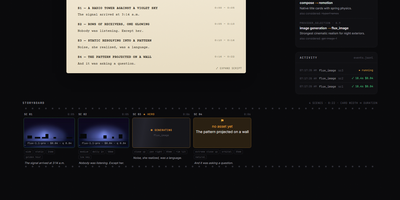
Reaching #1 on GitHub Trending with over 48,000 stars, OpenMontage is the first open-source agentic video production system — transforming AI coding assistants like Claude Code, Cursor, Copilot, Windsurf, and Codex into complete video studios that handle research, scripting, scene planning, asset generation, editing, and final rendering through natural language prompts. Twelve production pipelines cover animated explainers, cinematic trailers, documentary montages, talking heads, screen demos, podcast repurposing, character animation, localization and dubbing, avatar spokesperson videos, hybrid productions, clip factory batch processing, and animation workflows. Over 100 registered Python tools connect to 60+ providers including Kling, Runway Gen-4, Google Veo 3.1, FLUX, Google Imagen 4, ElevenLabs, and Suno AI for cloud generation, plus Piper TTS, WAN 2.1, Hunyuan, and CogVideo for fully local GPU rendering — while free footage from Archive.org, NASA, Wikimedia Commons, Pexels, and Unsplash powers the documentary montage pipeline's CLIP-indexed retrieval system for real-motion video without paid generation APIs. Two composition engines — Remotion for React-based programmatic video and HyperFrames for HTML/GSAP motion graphics — render final output with spring animations, word-level captions, kinetic typography, and SVG character rigs. A seven-dimension scored provider selector, pre-compose validation gates, post-render ffprobe self-review, slideshow risk scoring, configurable budget caps with per-action approval thresholds, and the Backlot live web dashboard for visual production monitoring enforce production-grade quality at every stage. Running on a dedicated VPS on RepoCloud with guaranteed CPU, RAM, and SSD, full root SSH access, and a browser serial console. AGPL-3.0 licensed.
Ever Works
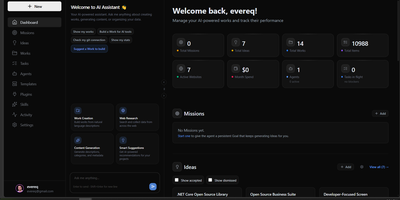
Ever Works transforms a single text prompt into a fully researched, written, coded, and deployed website through autonomous AI agents that operate on a configurable 15-step generation pipeline. Unlike one-shot builders, it continuously improves generated content on a schedule, keeping sites fresh without manual intervention. The platform integrates with six AI providers (OpenAI, Anthropic, Google, Groq, Mistral, Ollama) via gateways like OpenRouter and Vercel AI Gateway, while its plugin system connects ten search providers including Tavily, Brave, Exa, SerpAPI, and Perplexity for deep autonomous research. Every generation is Git-native — code and content live in your own GitHub repositories as commits, providing full version control, portability, and zero vendor lock-in. The monorepo ships a NestJS 11 REST API with JWT authentication, a Next.js 16 web dashboard for managing works, a CLI for terminal operations, an MCP server for AI agent integration, and admin tooling. Content management supports items, categories, tags, and collections, while deployment targets include Vercel and Kubernetes. Background processing runs on Trigger.dev with BullMQ scheduling, and monitoring leverages Sentry plus PostHog for error tracking and product analytics. The platform supports OAuth via GitHub and Google, subscription billing, email notifications, and AI chat conversations for natural-language interaction with your generated works. Running on a dedicated VPS on RepoCloud with guaranteed CPU, RAM, and SSD, full root SSH access, and a browser serial console. AGPL-3.0 licensed.
BlogFactory
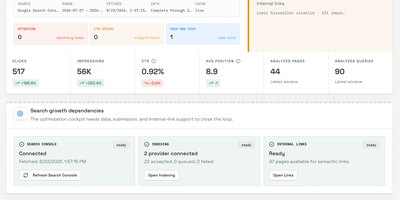
BlogFactory is the first open-source agent control plane purpose-built for multi-site content operations, shipping 16 distinct capabilities across four operational pillars — Operate, Grow, Control, and Deliver — in its v0.1.0 release. The platform keeps source evidence, AI-generated drafts, revisions, SEO metadata, human review, preflight checks, and CMS delivery destinations in one workspace while enforcing a server-side authority ceiling that prevents agents from ever publishing live content, accessing credentials, or performing administrative actions. AI agents connect through a Streamable HTTP MCP endpoint with OAuth authentication and site-scoped tool discovery, compatible with Codex, ChatGPT, and any MCP-capable client. Content creation supports single articles from keywords, titles, URLs, PDFs, text, or YouTube sources, batch campaigns, and programmatic content via reusable templates with structured data rows. The Search Growth module connects Google Search Console complete-day data to ranked optimization opportunities, 30-day growth plans, content classification by signal type (growing, low-CTR, almost-ranking, page-two, zero-click), indexing checks, and semantic internal-link suggestions. Brand Voice separates global voice rules, writer profiles, knowledge context, and brand guidelines from article mechanics. Approved drafts are delivered as CMS drafts to WordPress, Ghost, Wix, or Framer through idempotent, optimistic-locking-protected handoffs with explicit destination selection and preflight validation. The stack runs on React/Vite, a Hono/TypeScript API, PostgreSQL, and MinIO via Docker Compose, with providers including OpenRouter, OpenAI, and Google services under a bring-your-own-AI model. Running on a dedicated VPS on RepoCloud with guaranteed CPU, RAM, and SSD, full root SSH access, and a browser serial console. AGPL-3.0 licensed.
MetaMCP
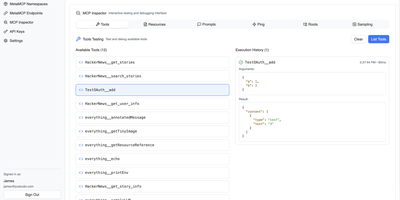
With 2,600+ GitHub stars, MetaMCP solves the MCP server sprawl problem by aggregating any number of upstream servers into a single authenticated endpoint that any MCP client connects to once. Group servers into namespaces — development tools in one, data sources in another — then publish each namespace as its own SSE, Streamable HTTP, or OpenAPI endpoint with API-key authentication in headers or query parameters, or full OAuth per the MCP Spec 2025-06-18 standard. The aggregation engine discovers tools, resources, and prompts from all active servers in parallel, prefixes tool names with server identifiers to prevent collisions, and applies configurable middleware including tool filtering to reduce context-window bloat and description overrides to improve LLM comprehension. The web management UI lets you configure MCP servers with stdio, SSE, or Streamable HTTP transports, toggle servers active or inactive per namespace, create and revoke API keys per endpoint, and inspect discovered tools with their schemas. Nested MetaMCP support enables hierarchical architectures where one MetaMCP instance consumes another, creating multi-level tool organization with automatic name resolution. Compatible with Claude Desktop, Claude Code, Cursor, Open WebUI, and any MCP-compatible client through a single connection URL. The Docker container packages the TypeScript backend with PostgreSQL for configuration persistence, exposing the management UI on port 12005 and MCP endpoints on configurable ports. Running on a dedicated VPS on RepoCloud with guaranteed CPU, RAM, and SSD, full root SSH access, and a browser serial console. MIT licensed.
Tymeslot
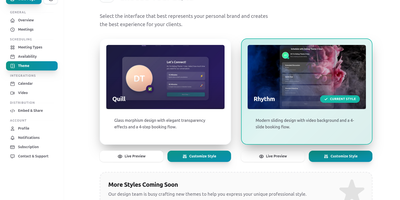
Built on Elixir's fault-tolerant OTP runtime, Tymeslot delivers the complete scheduling toolkit that Calendly charges for and Cal.com relicensed away from open source in 2026. Share one booking link and let clients pick available slots — your calendar stays synchronized and double-bookings disappear automatically through real-time availability checking against Google Calendar, Microsoft Outlook, and any CalDAV server including Nextcloud. Meeting types support configurable durations, buffer times, and availability windows that clients can book without email back-and-forth. Phoenix LiveView powers the real-time UI with WebSocket connections that update instantly as bookings arrive, without client-side JavaScript framework overhead. The platform attaches Zoom video rooms to confirmed bookings through your own Marketplace app credentials, sends confirmation and reminder emails via SMTP, Postmark, SendGrid, Mailgun, or AhaSend, and supports custom booking page themes with embed options for integration into existing websites. Circuit breakers, connection pooling, and graceful degradation maintain availability during provider outages. Authentication supports local accounts, GitHub OAuth, and reCAPTCHA protection on public booking forms. Self-hosting deploys as a single container with PostgreSQL embedded — no separate database container required. Two named volumes persist uploads and database state, while the same image powers the managed cloud at tymeslot.app so self-hosted users get identical features without a crippled community edition. Deploy via Docker, Cloudron with automatic updates, or Railway from a community template. Running on a dedicated VPS on RepoCloud with guaranteed CPU, RAM, and SSD, full root SSH access, and a browser serial console. AGPL-3.0 licensed.
Atlas
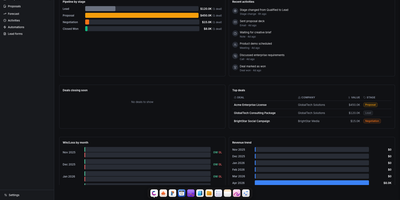
Atlas delivers a complete business operations platform in a single Docker Compose deployment, replacing the need for separate CRM, HRM, project management, invoicing, and file storage subscriptions. The CRM module provides pipeline management with Kanban views, contacts, companies, deals, leads, forecasting, saved views, and web-to-lead forms with Gmail integration for per-user email tracking inside deal timelines. HRM handles employees, departments, org charts, leave management, and attendance tracking. The invoicing system generates professional invoices with recurring billing, customizable templates, and payment tracking. Agreements provides PDF contract generation with legally-binding e-signatures, sequential signing workflows, counterparty linking, audit trails, and automated reminders. Projects integrates time tracking, billing, client management, budgets, and reporting in one view. Drive offers file storage with versioning, sharing, comments, activity logs, and password-protected links with Google Drive import and export. The calendar syncs bidirectionally with Google Calendar across month, week, day, year, and agenda views. Write provides rich text documents with cover images, comments, and templates, while Draw adds an Excalidraw-based whiteboard canvas with PDF export and presentation mode. The platform supports five languages, multi-tenant isolation, role-based permissions, and includes an Odoo importer that ingests res.partner, crm.lead, and CRM activity CSV exports for migration. Built on React, TypeScript, Vite, TanStack Query, and Zustand on the frontend with Express, Drizzle ORM, PostgreSQL, Redis, and BullMQ on the backend. Running on a dedicated VPS on RepoCloud with guaranteed CPU, RAM, and SSD, full root SSH access, and a browser serial console. AGPL-3.0 licensed.
Customermates
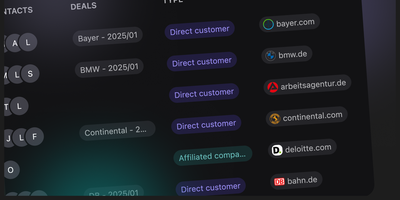
Customermates delivers a modern CRM purpose-built for teams who want practical customer management without enterprise-heavy complexity. The platform manages contacts, organizations, deals, services, and tasks through clean pipeline workflows while integrating AI agent capabilities, REST API access, webhook events, n8n automation connections, and Model Context Protocol tooling for AI-native operations. Team collaboration features include role-based permissions, comprehensive audit logging tracking every data change, and workspace organization for multi-team deployments. The deal pipeline provides customizable stages with drag-and-drop management, while task assignments and service tracking connect directly to contact and organization records for complete relationship context. API-first architecture exposes all CRM data through documented endpoints enabling custom integrations, reporting dashboards, and third-party tool connections. The n8n integration enables no-code workflow automation for lead routing, follow-up sequences, notification triggers, and cross-system data synchronization. Self-hosting requires only two files — a Docker Compose configuration and environment variables — with the published image at ghcr.io/customermates/customermates:latest running database migrations automatically on first boot. PostgreSQL provides the data layer with no additional infrastructure dependencies beyond a reverse proxy for TLS termination. The Community Edition includes unlimited users, unlimited records, full API access, n8n automation, and audit logging at zero cost. Running on a dedicated VPS on RepoCloud with guaranteed CPU, RAM, and SSD, full root SSH access, and a browser serial console. AGPL-3.0 licensed.
Knowhere
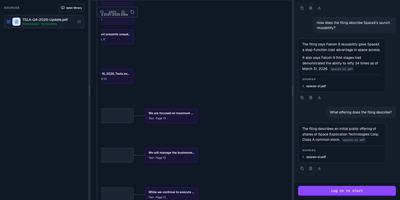
With 2,600+ GitHub stars since its May 2026 open-source launch, Knowhere solves the last-mile problem of document intelligence for AI systems — transforming complex unstructured PDFs, reports, and multi-page documents into structured JSON chunks that LLMs can consume without hallucination. The platform processes documents through an AI-native parsing pipeline that handles 20+ page documents with deep hierarchies, intricate tables, and multimodal content including images with OCR, achieving 95% precision in information extraction while reducing token costs by 50% compared to raw document ingestion. The knowledge tree architecture maintains historical context across multiple documents, enabling cross-document graph navigation for agentic retrieval that goes beyond simple chunk-based RAG. Built on Python 3.11+ with MinerU as the default PDF parser, the backend API runs alongside async workers that process document ingestion, graph construction, and embedding generation. The self-hosted Docker Compose stack packages the API server, processing workers, and Next.js dashboard for managing API keys, webhooks, and document-processing jobs, backed by PostgreSQL and Redis. Both Python and Node.js SDKs provide programmatic access for integration into existing AI pipelines and agent frameworks. LLM providers include DeepSeek and Alibaba Cloud DashScope with configurable key rotation for rate-limit management. Deploy on a dedicated VPS on RepoCloud with guaranteed CPU, RAM, and SSD, full root SSH access, and a browser serial console. Apache 2.0 licensed.
Arkon
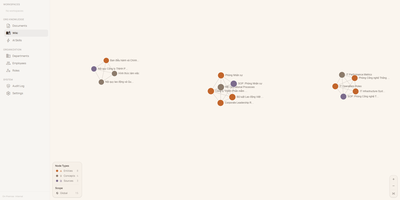
With 1,200+ GitHub stars since its April 2026 launch, Arkon provides an enterprise-grade knowledge management layer that turns scattered organizational documentation into AI-accessible structured context. The platform runs as a centralized MCP server, compiling your SOPs, policies, technical docs, and institutional knowledge into a versioned wiki with draft-approval workflows, then serving that wiki to Claude Desktop, Claude.ai, Cursor, and any MCP-compatible client through a single permission-scoped endpoint. OAuth 2.1 with PKCE authentication eliminates manual token management — employees authenticate through a browser login while the system discovers endpoints automatically via RFC 8414. The RBAC v2 system supports custom roles with granular permissions, department-scoped AI Skills, workspace isolation, and comprehensive audit logging so every query and access event is traceable. RAG retrieval powered by pgvector embeddings enables AI clients to search across all organizational documents with source attribution, while the AI Skills system lets teams define reusable instruction sets scoped to specific departments or roles. The architecture runs seven Docker containers coordinated by Compose: PostgreSQL with pgvector for embeddings and metadata, Redis for caching, MinIO for document storage, a FastAPI backend, two ARQ async workers for embedding generation and document processing, and a Next.js frontend portal accessible on port 3119. API keys are encrypted at rest with Fernet, and no telemetry leaves the deployment. Running on a dedicated VPS on RepoCloud with guaranteed CPU, RAM, and SSD, full root SSH access, and a browser serial console. PolyForm Internal Use licensed.
ServerBee
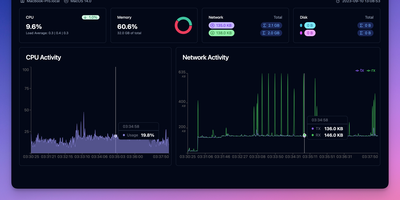
ServerBee delivers complete fleet monitoring from a single Rust binary that embeds both the server and web UI, requiring no external database or heavy runtime. Lightweight agents installed on each node stream CPU, memory, disk, network, load, temperature, GPU, and disk I/O metrics over persistent WebSocket connections to a central server backed by embedded SQLite. The real-time React dashboard presents 17 drag-and-drop widget types across custom layouts, with historical charts spanning one hour to 30 days and monthly traffic statistics with billing-cycle prediction and cost insights including burn rate and per-resource unit cost scoring. Network monitoring covers ICMP, TCP, and HTTP ping probes, service monitors for SSL certificates, DNS records, HTTP keyword matching, TCP ports, and WHOIS expiration, plus network-quality probing across 96 China 3-ISP and international presets with IP-quality and streaming-unlock detection. Remote management features include a web terminal with sandboxed file manager, Docker container stats with logs and events, firewall configuration, and agent auto-update capabilities. Public status pages display 90-day uptime timelines, while alerting supports email and webhook notifications with flexible trigger expressions. A native iOS companion app provides mobile monitoring access. Deploy via Docker or download the single binary for Linux, macOS, or Windows, running on a dedicated VPS on RepoCloud with guaranteed CPU, RAM, and SSD, full root SSH access, and a browser serial console. AGPL-3.0 licensed.
xyOps
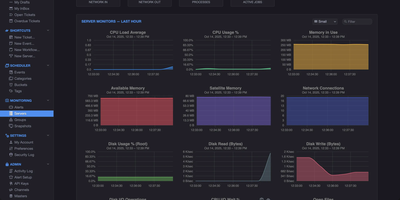
With 4,500+ GitHub stars and version 1.0.92 released August 2026, xyOps delivers a complete operations platform that unifies workflow automation, job scheduling, server monitoring, alerting, and incident response in one self-hosted system. The platform uses a distributed architecture where a central conductor coordinates lightweight xySat satellite agents running on Linux, macOS, or Windows worker nodes via persistent WebSocket connections. The visual workflow builder lets you chain events, triggers, actions, and monitors into multi-step pipelines with conditional logic, fan-out/fan-in parallelism, multiplex controllers for fleet-wide execution, and configurable resource limits. QuickMon provides per-second CPU, memory, disk, and network visibility streamed live to the web UI, while user-defined monitor plugins sample metrics every minute with time-series storage at hourly, daily, monthly, and yearly resolutions. Alert triggers evaluate expressions against live data and fire notifications via email, webhook, or custom actions, with full server snapshots attached showing every running process, network connection, and resource utilization at the moment of detection. Failed jobs and alerts automatically create tickets with linked logs, metrics history, and context for end-to-end incident tracking. The plugin marketplace supports extensions written in any language, and the Docker plugin enables container-based job execution. Deploy via Docker with persistent volumes on port 5522 for the web UI and 5523 for API access, running on a dedicated VPS on RepoCloud with guaranteed CPU, RAM, and SSD, full root SSH access, and a browser serial console. BSD-3-Clause licensed.
Open Connector
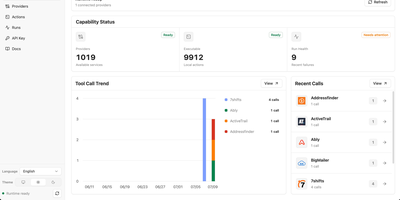
With over 5,000 GitHub stars since its June 2026 launch, OOMOL OpenConnector bridges the gap between AI agents and the real world by handling the authentication nightmare that stops LLMs from calling external APIs safely. The runtime connects to more than 1,000 SaaS providers — GitHub, Gmail, Notion, Slack, Microsoft, HubSpot, Google Workspace, and hundreds more — through 10,000+ prebuilt typed Actions that agents can discover and execute without ever touching raw credentials. OAuth2 flows, API key rotation, custom credentials, and no-auth providers are all managed centrally with AES-encrypted storage, scoped runtime tokens, and configurable action allowlists and blocklists that enforce least-privilege access. Agents interact through five access surfaces: the Model Context Protocol endpoint at /mcp for Claude and other MCP-capable hosts, a full REST API at /v1 for programmatic control, an auto-generated OpenAPI specification for code generation, a TypeScript SDK for application integration, and the oo CLI for local agent relay. The built-in Web Console provides browser-based administration for configuring OAuth apps, managing connections, inspecting action schemas, and reviewing execution logs with redacted inputs. Deploy via Docker Compose with SQLite for single-server setups, run from source on Node.js 22+, or push to Cloudflare Workers with D1 and R2 for edge deployment. Running on a dedicated VPS on RepoCloud with guaranteed CPU, RAM, and SSD, full root SSH access, and a browser serial console. Apache 2.0 licensed.
TaxHacker
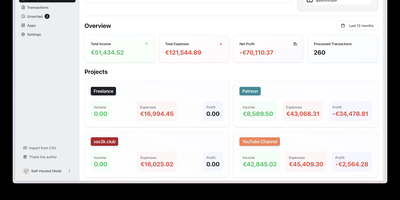
With 6,600+ GitHub stars and created by vas3k — one of the indie developer community's most recognized builders — TaxHacker is the self-hosted AI accounting application that turns receipt chaos into structured financial intelligence without surrendering a single document to third-party cloud services. Upload photos of receipts, invoices, or PDF bank statements, and the LLM pipeline automatically extracts dates, merchants, amounts, line items, tax breakdowns, and vendor information into an Excel-like structured database with custom fields you define through your own AI prompts. Currency handling covers 170+ fiat currencies and 14 cryptocurrencies (BTC, ETH, LTC, and more) with automatic conversion using historical exchange rates from the actual transaction date — critical for international freelancers filing in one reporting currency. The AI layer supports OpenAI (GPT-4o, GPT-4.1-mini), Google Gemini, Mistral, or fully local models via Ollama, LM Studio, vLLM, and LocalAI through OpenAI-compatible endpoints for complete air-gapped deployments. Features include multi-project workspace isolation, custom categories with AI-driven auto-classification, bulk document upload with batch processing, email server monitoring for automated attachment ingestion, flexible CSV export with attached documents, and comprehensive tax report generation. The tech stack runs Next.js 15+ for the frontend and tRPC API, Prisma ORM for database models and migrations, PostgreSQL 17+ for persistence, and Ghostscript plus GraphicsMagick for PDF rendering. Running on a dedicated VPS on RepoCloud with guaranteed CPU, RAM, and SSD, full root SSH access, and a browser serial console. MIT licensed.