Apache ShenYu
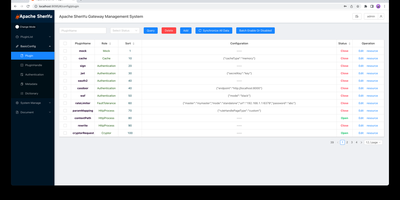
Put one governed doorway in front of every service you run: Apache ShenYu is an API gateway that proxies, secures, and manages traffic for HTTP, Dubbo, gRPC, WebSocket, and MQTT backends from a single entry point. Every request flows through an ordered, hot-pluggable plugin chain, so you compose exactly the behavior each route needs instead of accepting a fixed gateway feature set. Selectors give you coarse, service-level routing and rules refine it down to individual methods, matched against headers, paths, and parameters. Authentication and edge security come from JWT, OAuth 2.0, request-signing, and WAF plugins, while rate limiting, circuit breaking, and load balancing protect fragile upstreams from traffic spikes. You reshape calls in flight with request, response, and parameter mapping, and convert protocols so a gRPC or Dubbo service answers ordinary HTTP clients. Newer releases add AI gateway plugins that proxy LLM calls with prompt processing, token limits, and sensitive-word filtering, plus an MCP server plugin for exposing tools to AI agents. The ShenYu Admin console on its own port manages plugins, selectors, rules, users, and permissions, then pushes changes live to every gateway replica over WebSocket, ZooKeeper, Nacos, etcd, or HTTP long polling. Metrics, tracing, and logging plugins stream operational data to Kafka or Elasticsearch, and client SDKs for Java, Go, Python, and .NET let services register themselves automatically. Running on a dedicated VPS on RepoCloud with guaranteed CPU, RAM, and SSD, full root SSH access, and a browser serial console. Apache-2.0 licensed.
ZincSearch
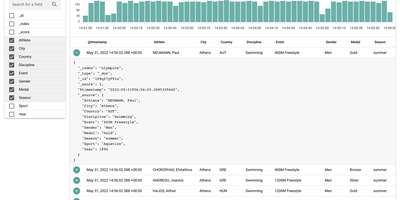
ZincSearch runs full-text search as a single Go binary that consumes a fraction of the memory and CPU that Elasticsearch demands while staying API-compatible, earning 17,800+ GitHub stars as a lightweight alternative. The bluge-powered indexing library processes documents through analyzers, tokenizers, and token filters while maintaining Elasticsearch-compatible ingestion APIs for single-record and bulk operations, letting existing pipelines connect with minimal configuration changes. Schema-less document ingestion accepts JSON payloads without predefined mappings, allowing different documents within the same index to carry different field structures while the engine automatically detects and indexes field types. An embedded Vue.js web console provides a browser-based interface for creating indexes, querying with full-text syntax, browsing results with hit highlighting, managing users, and monitoring system status. A dual API architecture exposes native ZincSearch endpoints under /api alongside Elasticsearch-compatible endpoints under /es, supporting boolean operators, wildcards, phrase matching, fuzzy search, date ranges, and aggregation pipelines including terms, histogram, date histogram, and range aggregations. Multi-tenancy with user-level access control isolates data across teams. Official SDKs for Go, Python, and Node.js provide typed client libraries for programmatic integration. Deploys via Docker or direct binary download with no external dependencies beyond disk storage. Running on a dedicated VPS on RepoCloud with guaranteed CPU, RAM, and SSD, full root SSH access, and a browser serial console. Apache 2.0 licensed.

SuperTokens
Powering authentication for over 15,000 GitHub stargazers and production deployments across startups and enterprises alike, SuperTokens delivers the complete login infrastructure that Auth0, Firebase Auth, and AWS Cognito charge premium prices for — entirely open source under Apache 2.0 with no per-user limits. The Java-based core service runs as a lightweight HTTP microservice that connects to PostgreSQL or MySQL and handles email-password login, passwordless magic links and OTP via email or SMS, social OAuth with Google, GitHub, Facebook, Apple, and any custom OIDC provider, phone-password authentication, and time-based one-time password multi-factor authentication. Session management uses rotating refresh tokens with anti-CSRF and anti-session-fixation protections, verifying tokens locally in your backend SDK without network round-trips to the core. Frontend SDKs for React, React Native, Angular, Vue, and vanilla JavaScript provide pre-built UI components for login, signup, email verification, and password reset flows, all customizable through an override system that lets you add pre- and post-API logic, custom hooks, and user event handlers. The built-in user management dashboard enables administrators to view users, reset passwords, revoke sessions, modify roles, and manage email verification status. Multi-tenancy and organization support powers B2B SaaS applications with tenant-level authentication configuration and Enterprise SSO via SAML and OIDC. Migration tools support bulk importing millions of existing password hashes, TOTP secrets, and role mappings. Running on a dedicated VPS on RepoCloud with guaranteed CPU, RAM, and SSD, full root SSH access, and a browser serial console. Apache 2.0 licensed.

Sylius
One install, many shops: Sylius runs separate storefronts with their own languages, currencies, and countries from a single admin panel. Products are simple or configurable. Define a size option, generate variants from S through XXL, and track stock per variant. Attributes, translations, and a nested taxon tree keep the catalog organized. Prices are set per channel. Catalog promotions add sale badges and struck-through prices. Cart promotions pair rules, like a minimum item total, with actions, like a fixed order discount, optionally behind coupon codes. Shipping methods carry delivery windows, zone eligibility, and shipping and tax categories. Order pages show items, shipping, taxes, promotions, payment state, and customer details. The dashboard charts sales and paid orders over time and lists pending work. A ready-made storefront covers product pages, a cart, checkout with address, shipping, payment, and review steps, customer accounts with order history, and product reviews. Custom frontends talk to separate shop and admin REST APIs, documented in OpenAPI. Every enabled locale adds a translation section to products, taxons, shipping methods, and promotions. Running on a dedicated VPS on RepoCloud with guaranteed CPU, RAM, and SSD, full root SSH access, and a browser serial console. MIT licensed.
Apprise-API
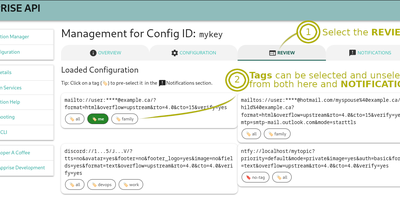
One REST call, 130+ notification services: Apprise API wraps the well-known Apprise library in a lightweight Django/Gunicorn microservice, so "send an alert" works the same whether it goes to Slack, Discord, Telegram, Teams, email, SMS, Pushover, or PagerDuty - each addressed by a simple URL scheme. It solves the credential-sprawl problem cleanly: instead of embedding provider tokens in every app, cron job, and CI pipeline, you centralize them here and everything else just POSTs a body and title. Two modes cover every workflow. Stateless calls to /notify carry target URLs in the payload (or fall back to a default set via APPRISE_STATELESS_URLS); stateful mode stores named configurations server-side under keys, so /notify/{KEY} fans out to everything registered - with tag-based routing (comma for OR, space for AND) selecting which endpoints fire per message. Messages take info, success, warning, or failure types in text, Markdown, or HTML, with attachments up to a configurable size. A built-in web UI manages and tests configurations, APPRISE_CONFIG_LOCK makes the store read-only, service allow/deny lists restrict which schemes work, webhook remapping adapts third-party payloads, and a Prometheus /metrics endpoint watches the gateway itself.
Authorizer
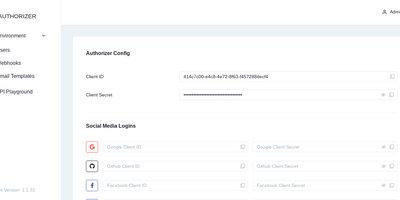
Your users belong in your own database - Authorizer, an open-source authentication and authorization server shipping as a single Go binary, keeps them there. It connects to 13+ backends - PostgreSQL, MySQL, SQLite, SQL Server, MariaDB, MongoDB, Cassandra, ScyllaDB, ArangoDB, DynamoDB, Couchbase, YugabyteDB, PlanetScale, and CockroachDB - so identity data lives beside the application it protects instead of in an auth vendor's cloud. The server is fully OAuth 2.0 and OpenID Connect compliant, including authorization code flow with PKCE, a JWKS endpoint, token revocation, and nine JWT signing algorithms. Login options cover email/password, magic links, TOTP multi-factor, SMS OTP via Twilio, and social providers including Google, GitHub, Apple, Microsoft, and Discord. Authorization goes beyond roles: an embedded OpenFGA engine provides Zanzibar-style relationship-based permission checks in process. APIs are exposed over GraphQL, REST, and gRPC, with SDKs for JavaScript, React, Go, and Python, plus themeable built-in login pages and an admin dashboard. Apache 2.0 licensed.
BitRouter
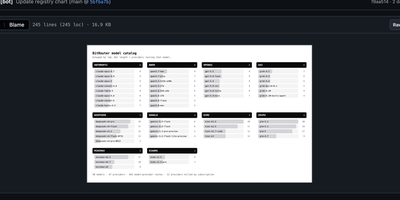
BitRouter is a context-aware LLM router that learns which model delivers the cheapest successful outcome per workflow step, cutting agent costs by up to 80% while maintaining 96% quality versus all-frontier baselines. Point any agent runtime at http://localhost:4356 with a one-line OPENAI_BASE_URL change and BitRouter routes to OpenAI, Anthropic, Google, Groq, DeepSeek, Mistral, Moonshot, MiniMax, Nvidia, and any OpenAI-compatible endpoint simultaneously, normalizing authentication, streaming, and cross-protocol translation between wire formats. The act-observe-evaluate-learn loop traces every hop with cost, tokens, and latency attribution, scores each decision against a versioned policy-lock.yaml, then tightens routes automatically with no LLM judge in the path. Native MCP gateway auto-discovers tools from connected servers and makes them routable and governed alongside model calls. Agent Client Protocol integration enables the TUI to manage Claude Code, Codex, OpenCode, OpenClaw, Gemini, and Copilot sessions in real time with inline tool-call approval and live streaming. Built-in guardrails inspect, redact, or block risky content before requests leave your network. Virtual keys scope API access per agent or user without exposing upstream credentials. Per-agent spend caps and loop guards contain runaway cost automatically. Multi-account failover reroutes mid-run so rate limits never re-pay completed work. Ships as a single Rust binary via npm or Cargo. Running on a dedicated VPS on RepoCloud with guaranteed CPU, RAM, and SSD, full root SSH access, and a browser serial console. Apache 2.0 licensed.
ScribeCrate
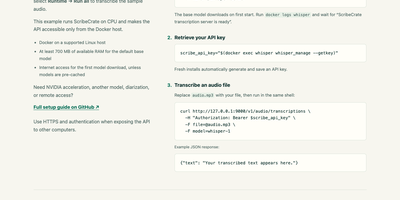
ScribeCrate is a self-hosted speech-to-text API that turns recordings into transcripts, subtitles, and English translations on your own server. It speaks the OpenAI Whisper API fluently: point any compatible client at your server's address, swap in your API key, and uploads come back as text. Ask for plain text, JSON with timestamps, or ready-to-publish SRT and WebVTT subtitle files, and for long recordings the segments can stream back over SSE as they are decoded. Turn on speaker diarization and every segment is labeled with who is speaking, which makes interview and meeting transcripts readable at a glance. Choose the model that fits the job, from tiny for quick drafts to large-v3 for maximum accuracy, and run it on a modest CPU, a Raspberry Pi class ARM board, or an NVIDIA GPU. Almost any recording works: MP3, M4A, WAV, WebM, OGG, and FLAC are all accepted, and with models cached in advance the server keeps transcribing with no internet connection at all. Running on a dedicated VPS on RepoCloud with guaranteed CPU, RAM, and SSD, full root SSH access, and a browser serial console. MIT licensed.

Larasend
Larasend gives Laravel teams a self-hosted transactional email platform that sends through their own Amazon SES or Cloudflare account while keeping the dashboard, delivery logs, and message data on their own servers. Send mail with a simple POST to the emails API, or point existing mailables and notifications at the Larasend transport with one environment variable and no code rewrite. Every message lands in an activity dashboard where you can filter by status, search recipients and message IDs, open a preview with headers and metrics, and resend failures in one click. Delivery, bounce, complaint, open, and click events stream back from the provider and update each message timeline, so a missing receipt becomes a traceable record instead of a support mystery. Suppression lists build themselves from bounces and complaints, and guardrails watch complaint rates and verified domains before reputation damage can spread. Scoped API keys with expiration and rotation keep each project separate, while workspace roles control who can view, send, and administer. When replies arrive, the shared inbox threads inbound and outbound mail into conversations your team can assign, snooze, annotate, and answer with attachments and drafts. Webhooks notify your other systems about deliveries and inbound mail, and reusable templates keep recurring notices consistent across projects. Running on a dedicated VPS on RepoCloud with guaranteed CPU, RAM, and SSD, full root SSH access, and a browser serial console. MIT licensed.
Amplication
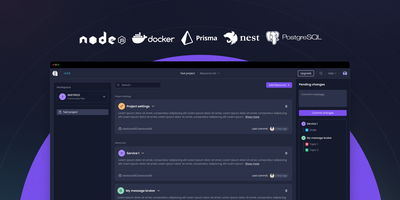
Amplication turns entity definitions into production-ready backend services, generating NestJS with Prisma and Apollo GraphQL for Node.js or ASP.NET Core for .NET, eliminating months of boilerplate. The plugin-driven Data Service Generator hooks into code generation lifecycle events, enabling teams to inject CI/CD manifests, proprietary authentication schemes, testing configurations, and cloud-specific deployment targets for AWS, Azure, and GCP without forking the core generator. Blueprint templates encode organizational architecture standards, security policies, and coding conventions into reusable foundations that keep every generated service consistent across the engineering organization. Jovu AI translates natural language requests into entities, relationships, fields, modules, DTOs, and custom API actions, automatically aligning each resource with predefined standards. Generated services include full CRUD operations with input validation, Swagger/OpenAPI documentation, authentication middleware, database-agnostic ORM via Prisma, optional React Admin interfaces, and Jest test scaffolding. Code output syncs to Git repositories as pull requests, preserving standard review workflows while letting developers edit every generated line and add custom business logic. Supports PostgreSQL, MySQL, and MongoDB as database targets. Over 16,000 GitHub stars with enterprise adoption. Apache 2.0 licensed.
MillionSend
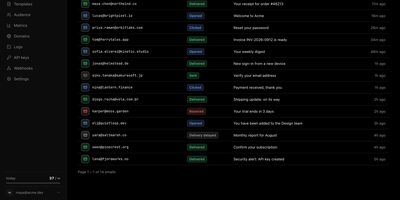
MillionSend is an open-source email platform you run yourself that sends transactional and marketing mail through your own AWS SES account behind a Resend-compatible API. Every message you send becomes a row in the dashboard, and every row opens into a timeline of SES events with the raw payload and the SMTP diagnostic when something bounces. Daily metrics chart sent, delivered, opened, clicked, bounced, and complained volumes against SES thresholds, and broadcasts stop on their own at five percent bounces or 0.1 percent complaints before Amazon can pause your account. Contacts live once for the whole team with custom properties and subscribe state, while segments and topics decide exactly who receives each broadcast. You compose broadcasts from reusable templates with per-contact merge fields, schedule them ahead, and cancel them while they wait. Applications that only speak SMTP send through the relay on port 2587 with an API key as the password, and HTTP integrations use idempotency keys, request logs with secrets redacted, and signed webhooks with a delivery history. Guided domain setup handles DKIM records, hard bounces and complaints are suppressed automatically, and every recipient gets an RFC 8058 one-click unsubscribe. Receiving and agent-ready inboxes are included in beta for mail sent to your verified domains. Running on a dedicated VPS on RepoCloud with guaranteed CPU, RAM, and SSD, full root SSH access, and a browser serial console. AGPL-3.0 licensed.
Yaade
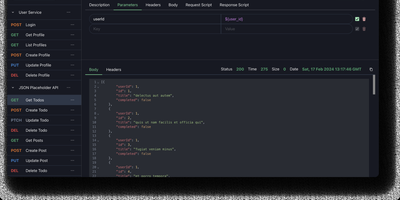
Yet Another API Development Environment delivers a self-hosted alternative to Postman designed from the ground up for teams that need secure, collaborative API development without sending sensitive credentials through third-party cloud services. The multi-user system manages team members with role-based permissions and supports external authentication through OAuth2 and OIDC providers, while all data persists in an H2 file-based database that survives container and server restarts. REST and WebSocket request testing includes environment variable substitution, request chaining, and Markdown documentation for each endpoint. The JavaScript scripting engine runs request and response scripts for automated testing and data extraction, with cron job scheduling and API-triggered execution for continuous integration workflows. Collections import directly from OpenAPI specifications and Postman exports, while outbound export generates request code in multiple languages and frameworks. The browser extension proxy for Chrome and Firefox routes requests through the user's browser to bypass CORS restrictions when testing localhost and internal APIs, with an alternative server-side proxy for headless environments. Single-file data import and export simplifies backup and migration between instances. The React and Vite frontend ships with dark mode enabled by default. Running on a dedicated VPS on RepoCloud with guaranteed CPU, RAM, and SSD, full root SSH access, and a browser serial console. MIT licensed.
JobSpy API
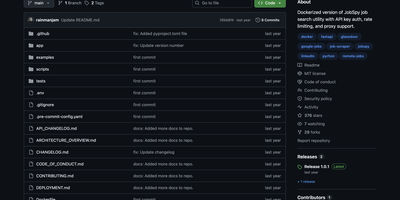
JobSpy API turns seven major job boards into a single REST endpoint, aggregating listings from LinkedIn, Indeed, Glassdoor, Google Jobs, ZipRecruiter, Bayt, and Naukri through one GET request. Built on FastAPI with the Python JobSpy scraping library, the API returns structured JSON or downloadable CSV containing job titles, companies, locations, salaries, descriptions, posting dates, and direct application URLs. Filters cover search terms, location, distance radius, job type (full-time, part-time, contract, internship), remote status, hours since posting, country, and salary range. Interactive Swagger UI and ReDoc interfaces provide try-it-now functionality for testing queries directly in the browser. Security includes x-api-key header authentication with configurable rotation, per-endpoint rate limiting with adjustable thresholds, and response caching with configurable TTL to reduce redundant scraping. Global proxy support routes outbound requests through HTTP/HTTPS proxies to avoid IP-based rate limiting from job boards. Environment variables control everything from default search parameters and logging levels to CORS origins and documentation paths. Health check and ping endpoints integrate with uptime monitoring services. Docker Compose exposes the API on a configurable port. MIT licensed.
Traduora
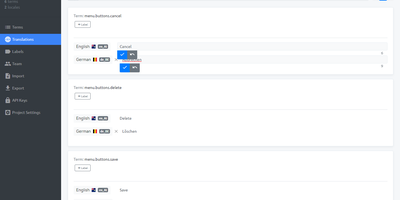
Teams that ship one app in many languages keep every string, translator, and reviewer in a single workspace by hosting their own Traduora translation management platform. Developers import the files they already have: JSON, YAML, PO, XLIFF, CSV, Android XML, iOS Strings, Java properties, PHP array, or RESX. Each string becomes a term that can carry a context note and colored labels. A search bar and a label filter narrow long lists in seconds. Translators open a locale and type inline beside a reference language, with per-locale progress showing how much is finished and a toggle that hides what is already done. Colleagues join by email invitation as admins, editors, or viewers, with optional Google sign-in. Build pipelines get their own API clients, each with a role, to fetch and push translations over a REST API. Exports go back out in whichever format each platform wants, with fallback-locale and untranslated-key options. Mobile and web teams can keep iOS, Android, and website copy in sync from a single source of truth. Running on a dedicated VPS on RepoCloud with guaranteed CPU, RAM, and SSD, full root SSH access, and a browser serial console. AGPL-3.0 licensed.

Ntfy
ntfy sends push notifications to your phone or desktop with a single curl command: publish a message to any topic and every subscriber receives it instantly, no signup or API key required. Over 31,000 GitHub stars and 106 releases since 2021 back a server supporting five priority levels mapped to distinct notification sounds and vibration patterns, emoji tags for visual classification, click actions that open URLs when tapped, and up to three action buttons per notification for view, HTTP callback, broadcast, or clipboard copy operations. File attachments push images from surveillance cameras, documents, or any binary payload directly to mobile devices. Subscriptions work through JSON streams, Server-Sent Events, WebSockets, or raw text, with server-side filtering by priority, tags, and message ID. Authentication enforces topic-level access control through Basic Auth, Bearer tokens, or query parameters, with a built-in user and ACL management system. UnifiedPush compatibility lets ntfy serve as a push distributor for Mastodon, Matrix, and other federated services. Web Push via VAPID keys delivers browser notifications without the mobile app. The server ships as a single statically linked Go binary or Docker image supporting amd64, armv7, and arm64 architectures, consuming 30-50 MB RAM at idle with SQLite-backed message caching. Integrations include Grafana, Prometheus Alertmanager, Uptime Kuma, Home Assistant, and Ansible Semaphore. Running on a dedicated VPS on RepoCloud with guaranteed CPU, RAM, and SSD, full root SSH access, and a browser serial console. Apache 2.0 / GPLv2 dual-licensed.