DeepWiki
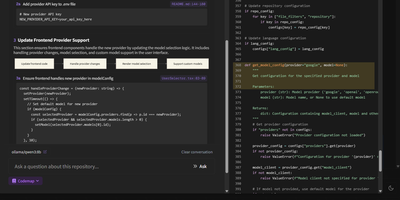
Transform complex code repositories into searchable, interactive wikis with DeepWiki, an automated documentation platform that maps architectural relationships and provides instant answers to technical questions about any codebase. Software engineers can submit public or private repositories from GitHub, GitLab, or Bitbucket to generate comprehensive project overviews, component breakdowns, and interactive Mermaid diagrams illustrating data pipelines and class hierarchies. The built-in Ask interface allows developers to query system logic using retrieval-augmented answers grounded directly in repository source files. Teams can trigger iterative deep research sessions that perform multi-step codebase investigations to explain intricate execution paths, uncover hidden dependencies, and summarize complex algorithms across hundreds of files. Interactive Codemap tours provide guided walkthroughs of critical entry points, letting reviewers inspect synchronized code viewer panels with exact line references while onboarding to unfamiliar services. Developers can export complete wiki structures for offline sharing, customize documentation depth from high-level summaries to granular module analyses, and connect local or cloud model endpoints to process sensitive internal code securely. Running on a dedicated VPS on RepoCloud with guaranteed CPU, RAM, and SSD, full root SSH access, and a browser serial console. MIT licensed.
GitNexus
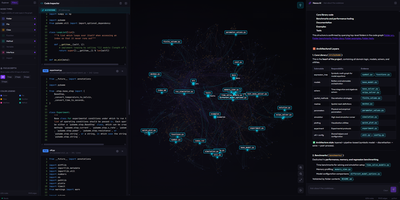
GitNexus turns any codebase into an interactive knowledge graph that maps every dependency, call chain, functional cluster, and execution flow, giving AI coding assistants the deep structural awareness they need to stop breaking things. Drop a repository URL or ZIP file into the browser-based explorer and watch Tree-sitter parsers decompose your code into a navigable property graph you can zoom, click, and query. The MCP server integrates directly with Cursor, Claude Code, Codex, Antigravity, and other editors through 16 specialized tools covering architectural queries, impact analysis, safe multi-file renames, change detection, and cross-repo contract matching. Need to know the blast radius before touching a shared utility? The impact analyzer traces every caller, implementer, and downstream consumer in milliseconds. Teams reviewing pull requests get automated blast-radius annotations powered by the same graph. The registry architecture lets a single MCP server manage multiple indexed repositories simultaneously, so switching between projects requires zero re-indexing. For visual exploration, the web interface renders interactive community-clustered graphs where you can trace execution paths, browse file trees, and chat with an AI agent grounded in the graph's structural data rather than raw file snippets. Everything runs locally; your source code never leaves the machine. Running on a dedicated VPS on RepoCloud with guaranteed CPU, RAM, and SSD, full root SSH access, and a browser serial console. PolyForm Noncommercial 1.0.0 licensed.