OpenViking
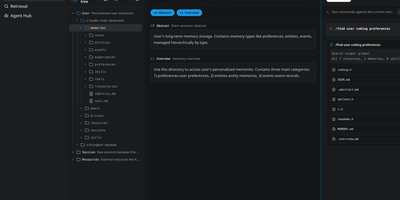
OpenViking is a self-hosted context database that gives AI agents persistent, structured memory by organizing knowledge, skills, and session history into a hierarchical virtual filesystem accessible through the viking:// URI protocol. Instead of dumping everything into a flat vector store and hoping semantic search finds the right chunks, agents navigate their context with familiar commands like ls, tree, and find, locating exactly the information they need through deterministic paths combined with semantic search. Every resource is automatically processed into three layers: a 100-token L0 abstract for quick filtering, a 2,000-token L1 overview for content navigation, and the full L2 detail loaded only when confirmed necessary. This tiered approach cuts token consumption by 83 to 96 percent compared to conventional RAG while improving task completion rates by 15 to 49 percent on benchmark tests. The built-in memory self-iteration loop automatically analyzes task execution and user feedback, updating agent memory directories so the system continuously learns and improves. You can connect to any LLM provider, including Ollama for fully local inference, OpenAI, or compatible gateways. The Web Studio UI at the /studio endpoint provides visual browsing of the entire context filesystem, and the REST API on port 1933 supports programmatic access. Deploy via Docker, Kubernetes with the included Helm chart, or as a standalone service. Running on a dedicated VPS on RepoCloud with guaranteed CPU, RAM, and SSD, full root SSH access, and a browser serial console. AGPL-3.0 licensed.
libSQL
libSQL bridges the gap between SQLite's legendary simplicity and the server-accessible database model developers expect from PostgreSQL and MySQL, adding network access, replication, and vector search while maintaining full file format and API compatibility. The sqld (SQL daemon) component transforms SQLite into a network-accessible database server accepting queries via HTTP with JSON payloads, WebSocket connections, and a Hrana protocol optimized for low-latency edge access. Client libraries for TypeScript, JavaScript, Rust, Go, and Python connect to sqld identically to any traditional client-server database, while the LD_PRELOAD compatibility layer enables switching existing SQLite applications from local to remote mode without code changes. Embedded replicas synchronize a local SQLite copy inside your application process with the primary server, delivering sub-millisecond read latency while maintaining consistency through streaming replication. Bottomless replication continuously backs up database state to S3-compatible object storage with generation-based snapshots and WAL page shipping, providing point-in-time recovery without manual backup scheduling. Native vector search enables semantic similarity queries directly within SQL using cosine distance functions, eliminating the need for external vector database infrastructure. Read replica support distributes query load across multiple sqld instances, and integration with mvSQLite adds multi-version concurrency for high-availability deployments. Created by Turso with 17,100+ stars and active production deployment. Running on a dedicated VPS on RepoCloud with guaranteed CPU, RAM, and SSD, full root SSH access, and a browser serial console. MIT licensed.
Portabase
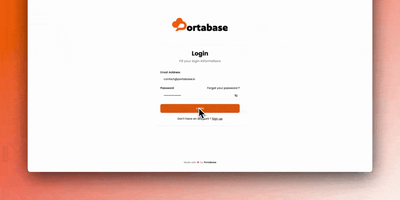
Portabase takes a zero-trust approach to database backups: lightweight Rust/Tokio agents deploy next to each database, encrypt dumps with AES-GCM before data ever leaves the host, and poll the Next.js control plane outbound every five seconds requiring zero inbound firewall rules. This architecture contains blast radius if the dashboard is compromised while supporting ten engines with stable backup and restore: PostgreSQL 12 through 18, MySQL 5.7 through 9, MariaDB 10 and 11, MongoDB 4 through 8, SQLite 3.x, Redis 2.8+, Valkey 7.2+, Firebird 3.0 through 5.0, Microsoft SQL Server 2017 through 2022 including Azure SQL, and Docker volumes on Engine 20.10+. Encrypted backups store on configurable backends including local filesystems, any S3-compatible provider (AWS, MinIO, RustFS), Google Cloud Storage, and Azure Blob Storage. Cron-based scheduling with Grandfather-Father-Son retention policies automates backup lifecycle management, while on-demand restore targets any compatible server for cross-environment recovery. The CLI installs agents with a single command and auto-updates when new versions ship. A RESTful API with MCP server integration enables automation from CI/CD pipelines and AI agent workflows. Developed by a non-profit under Apache-2.0. 1,270+ stars and 174 releases since October 2024. Running on a dedicated VPS on RepoCloud with guaranteed CPU, RAM, and SSD, full root SSH access, and a browser serial console.
Redash
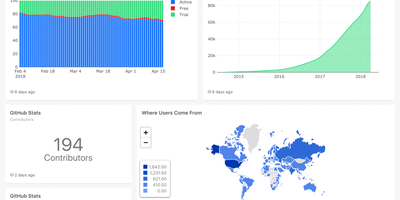
Used by millions of users at thousands of organizations worldwide and holding 29,000+ GitHub stars, Redash is the most established open-source SQL-first business intelligence tool — enabling anyone from analysts to executives to query databases, visualize results, and share dashboards without writing a single line of application code. The browser-based query editor supports SQL and NoSQL with schema browsing, auto-complete, query snippets, and parameterized queries that turn static reports into interactive data applications. Native connectors span 35+ data sources including PostgreSQL, MySQL, Amazon Redshift, Google BigQuery, Snowflake, ClickHouse, MongoDB, Elasticsearch, Databricks, Apache Presto, Microsoft SQL Server, and REST APIs — with an extensible data source API for custom integrations. Visualization types cover line, bar, area, pie, scatter, box plot, funnel, cohort, sankey, sunburst, choropleth map, and pivot tables, all draggable onto shared dashboards with cross-filtering parameters. Scheduled refreshes automatically update query results at configurable intervals, while threshold-based alerts notify teams via email, Slack, or webhook when metrics cross defined boundaries. SAML and Google OAuth SSO integration, role-based access control, API key management, and query-level permissions ensure enterprise-grade security for sensitive datasets. The self-hosted stack deploys via Docker Compose with PostgreSQL for metadata storage, Redis for job queuing, and Celery workers for background task execution. Running on a dedicated VPS on RepoCloud with guaranteed CPU, RAM, and SSD, full root SSH access, and a browser serial console. BSD 2-Clause licensed.
Dagster
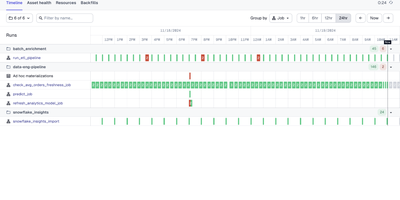
With nearly 16,000 GitHub stars, 5.7 million monthly PyPI downloads, and 400+ contributors, Dagster is the most widely adopted asset-centric data orchestration platform — replacing task-oriented schedulers like Apache Airflow with a declarative model where every pipeline is defined as Python functions producing data assets such as tables, datasets, machine learning models, and reports. The built-in asset graph provides automatic lineage tracking across your entire data platform, showing exactly how data flows from ingestion through transformation to downstream consumption in a single unified view. Declarative Automation goes beyond cron scheduling with event-driven conditions that intelligently trigger materializations based on upstream freshness, data quality signals, and dependency state. The integrated data catalog auto-generates documentation from asset metadata, ensuring it never drifts out of sync with production. Native first-class integrations connect dbt, Snowflake, BigQuery, Databricks, Fivetran, Airbyte, Spark, Great Expectations, Tableau, Power BI, AWS, GCP, and Azure without custom glue code. The web UI visualizes asset graphs, run history, schedules, sensors, and partitioned materializations with built-in alerting via Slack and PagerDuty. Dagster Pipes enables executing arbitrary code in external environments including Spark clusters, Kubernetes Jobs, and cloud functions. Deploy via Docker Compose on a single VM with separate containers for the webserver, daemon, and code locations, or use official Helm charts for production Kubernetes with K8sRunLauncher scaling each run as an independent Job. Running on a dedicated VPS on RepoCloud with guaranteed CPU, RAM, and SSD, full root SSH access, and a browser serial console. Apache-2.0 licensed.
HeadlessX
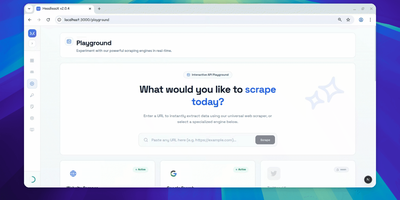
With 2,000 GitHub stars and 10 releases since its September 2025 launch, HeadlessX delivers a self-hosted browser automation platform that replaces Chromium-based scraping with Camoufox — a Firefox fork performing kernel-level fingerprint spoofing to achieve 0% detection across Cloudflare, DataDome, PerimeterX, and other anti-bot systems where Puppeteer and Playwright regularly fail. The web dashboard provides workspace-based job organization with a visual interface for configuring scrape targets, managing browser profiles, monitoring queue status, and viewing extracted results in real time. The protected REST API accepts requests with API key authentication for programmatic access, supporting HTML extraction, screenshot capture, PDF generation, and structured data parsing with configurable stealth parameters. Profile-based scraping maintains persistent browser contexts with cookie jars, localStorage, and fingerprint configurations that survive between requests — reducing cold-start latency from 25 seconds to under 2 seconds on subsequent requests. Queue-backed workflows enable batch processing of URLs with configurable concurrency, retry logic, and webhook notifications on completion. The Google AI Search integration provides AI-assisted web research workflows through dedicated endpoints. Remote MCP support exposes automation capabilities as tool endpoints for AI agent integration. Deploy via the official CLI with `headlessx init` and `headlessx start` commands, scaffolding a Docker Compose stack with Caddy reverse proxy for automatic HTTPS. Running on a dedicated VPS on RepoCloud with guaranteed CPU, RAM, and SSD, full root SSH access, and a browser serial console. MIT licensed.
dbx
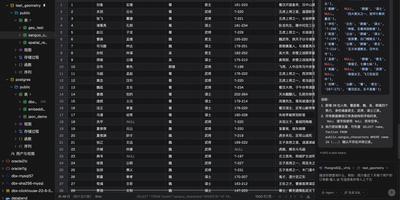
Universal database administration across modern enterprise infrastructure is simplified through dbx, a lightweight web client and SQL studio supporting over ninety database engines. Database administrators connect to MySQL, PostgreSQL, SQLite, Redis, MongoDB, ClickHouse, DuckDB, Oracle, and Microsoft SQL Server through authenticated network connections and encrypted SSH tunnels. The interactive query editor provides real-time multi-schema autocomplete, syntax linting, execution plan analysis, and natural language SQL query synthesis powered by configurable large language model backends. Teams visualize complex relational database architectures using interactive entity-relationship diagrams that map table foreign key constraints, primary indexes, and table partition layouts automatically. Operators inspect live Redis memory usage breakdowns, monitor real-time server command throughput, and manage key expirations without opening raw terminal sessions. The editable data grid supports multi-row modifications, foreign key reference lookups, CSV and JSON exports, and binary blob data inspection directly inside the browser viewport. Software developers expose connected databases directly to external AI coding assistants through native Model Context Protocol server endpoints. Running on a dedicated VPS on RepoCloud with guaranteed CPU, RAM, and SSD, full root SSH access, and a browser serial console. Apache-2.0 licensed.
Gorse
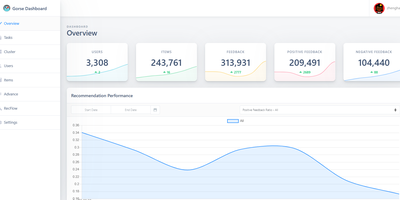
Gorse generates personalized recommendations from your application's user interaction data through automatically trained models, requiring no machine learning expertise to deploy or operate. Over 10,000 GitHub stars and production deployments processing millions of interactions validate a multi-source architecture that merges candidates from latest-item, user-to-user, item-to-item, and collaborative filtering recommenders, then ranks them using factorization machines or LLM-based rerankers with configurable query and document templates. Multimodal content support processes text, images, and video metadata via embedding vectors stored in BF16 format, with optional Qdrant, Weaviate, or Milvus integration for distributed similarity search. The visual RecFlow editor provides a drag-and-drop interface for designing recommendation pipelines, connecting data sources to recommenders and rankers without writing configuration files. A distributed cluster separates concerns across master nodes for model training and dashboard hosting, worker nodes for offline recommendation generation, and server nodes for real-time API endpoints, all scaling horizontally behind load balancers. Online evaluation analyzes recommendation quality from recent user feedback with configurable cache sizes and expiration intervals. RESTful APIs expose CRUD endpoints for users, items, and feedback alongside recommendation retrieval with category filters and API key authentication. Stores data in MySQL, PostgreSQL, MongoDB, or ClickHouse with Redis caching. Running on a dedicated VPS on RepoCloud with guaranteed CPU, RAM, and SSD, full root SSH access, and a browser serial console. Apache 2.0 licensed.
Bloomberg Terminal
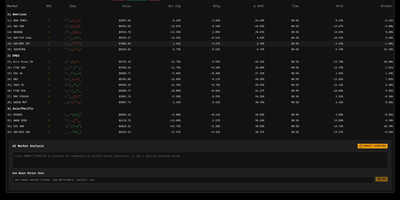
With 1,450+ GitHub stars and a live demo on Vercel, this Bloomberg Terminal clone delivers a professional-grade financial dashboard without the $24,000 annual seat license. The Next.js 15 App Router with React 19 and TypeScript serves a single-page terminal interface optimized for constantly mutating financial data, with partial pre-rendering enabling sub-500ms initial loads even on data-heavy views. Upstash Redis caches AlphaVantage market data to minimize API calls while maintaining sub-second update latency through React Query polling with configurable refresh rates. OpenAI integration provides AI-powered market insights, sentiment analysis, and trend interpretation directly within the terminal interface. Multiple specialized views cover market data tables with bid/ask spreads, financial news aggregation with category filtering, market movers highlighting top gainers and losers, and volatility analysis with historical comparison charts. Jotai atoms manage local state for watchlists, layout preferences, and terminal sessions while React Query handles server-state synchronization with aggressive stale-while-revalidate caching. The shadcn/ui component library with Tailwind CSS delivers accessible, keyboard-navigable interface elements styled after Bloomberg's iconic dark terminal aesthetic. Security features include origin restriction, rate limiting via Redis, and Zod-based input validation on all API routes. Motion (formerly Framer Motion) animates transitions between views and data updates without layout shift. Running on a dedicated VPS on RepoCloud with guaranteed CPU, RAM, and SSD, full root SSH access, and a browser serial console. MIT licensed.
Briefer
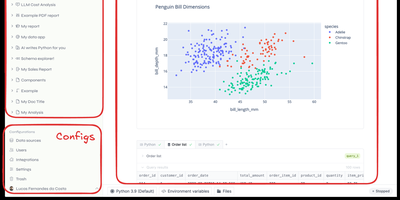
Backed by Y Combinator with 4,300 GitHub stars and growing rapidly since its September 2024 launch, Briefer delivers the first truly unified notebook-and-dashboard platform that eliminates the fragmented workflow of juggling Jupyter for analysis, Tableau for visualization, and Notion for documentation — combining all three in a single Notion-like workspace where SQL query results automatically become Python DataFrames accessible in subsequent code blocks. The built-in AI analyst understands your database schema and notebook context to generate SQL queries, write Python transformations, create visualizations, and fix errors on demand using configurable OpenAI or private LLM backends. Connect directly to PostgreSQL, MySQL, BigQuery, Redshift, Snowflake, and Amazon Athena as data sources, or upload CSV files for immediate analysis. Native point-and-click visualizations produce charts, tables, and dashboards without writing code, while interactive data apps use inputs, dropdowns, and date pickers to create parameterized reports for non-technical stakeholders. Scheduled execution runs notebooks and dashboards periodically with results delivered via Slack integration or public shareable links. Write-back queries modify production data directly from notebooks for ad-hoc pipeline testing. The architecture runs as three Docker containers — web frontend, API server, and optional AI service — backed by PostgreSQL and a Jupyter server for Python execution, deployable via single Docker command, Docker Compose, or Helm charts for Kubernetes. Running on a dedicated VPS on RepoCloud with guaranteed CPU, RAM, and SSD, full root SSH access, and a browser serial console. AGPLv3 licensed.
OpenSearch
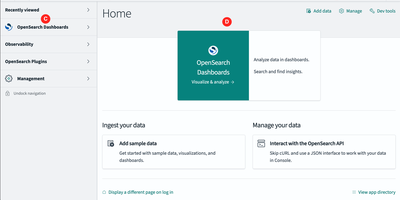
OpenSearch is a search and analytics platforms, powering full-text search, log analytics, observability, and AI-powered vector retrieval at petabyte scale. The distributed engine provides BM25 full-text search alongside k-NN vector search using NMSLIB, Faiss, and Lucene libraries, enabling semantic search, hybrid search combining keyword and vector scoring through normalization processors, neural sparse search, and retrieval-augmented generation workflows with built-in ML Commons for model hosting. OpenSearch Dashboards delivers interactive visualization with Discover for log exploration, custom dashboards, alerting, anomaly detection using Random Cut Forest algorithms, and Security Analytics with detection rules mapped to MITRE ATT&CK. Native Prometheus integration with full PromQL support unifies metrics alongside logs and traces in a single observability interface, while Data Prepper handles telemetry ingestion from OpenTelemetry collectors, Fluent Bit, and Logstash-compatible pipelines. SQL and Piped Processing Language queries with a visual PPL builder enable analysts to query data without learning the native DSL. Index State Management automates index lifecycle with rollover, shrink, and delete policies, while cross-cluster replication and searchable snapshots on S3-compatible storage provide disaster recovery. Scoped API keys, field-level security, document-level security, and audit logging deliver enterprise-grade access control. Docker Compose deploys multi-node clusters alongside the Kubernetes operator for orchestrated production environments. Running on a dedicated VPS on RepoCloud with guaranteed CPU, RAM, and SSD, full root SSH access, and a browser serial console. Apache 2.0 licensed.
Airbyte
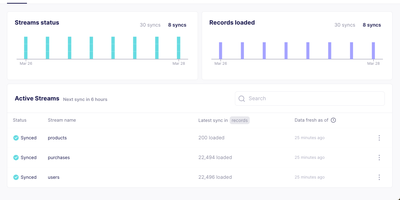
Backed by over 21,800 GitHub stars and more than 1,000 community contributors, Airbyte has become the standard open-source data movement platform, powering ELT pipelines for organizations ranging from startups to Fortune 500 enterprises. The platform provides 600+ pre-built connectors covering PostgreSQL, MySQL, MongoDB, Snowflake, BigQuery, Redshift, S3, Salesforce, HubSpot, Stripe, Shopify, Google Analytics, and hundreds of additional APIs, databases, and SaaS applications. The no-code Connector Builder lets practitioners create new source connectors in minutes by pointing at an API documentation URL, while the Python CDK enables custom connectors with full programmatic control for complex authentication flows and pagination strategies. Airbyte's AI agent capabilities include the MCP Gateway for Model Context Protocol integration, the open-source Agent SDK compatible with pydantic-ai, LangChain, OpenAI Agents, and FastMCP, and a Context Store that lets AI agents query business data across connected systems without runtime API stitching. Change Data Capture streams incremental updates from PostgreSQL, MySQL, and SQL Server using Debezium, while dbt integration handles post-load transformations within the pipeline. Self-hosted deployment uses Kubernetes via the abctl CLI tool, which bootstraps a local kind cluster with a single command, or Helm charts for production clusters with Keycloak OIDC authentication and secrets management through AWS Secrets Manager, Google Secrets Manager, or HashiCorp Vault. Running on a dedicated VPS on RepoCloud with guaranteed CPU, RAM, and SSD, full root SSH access, and a browser serial console. ELv2 licensed with MIT-licensed connectors.
Garnet
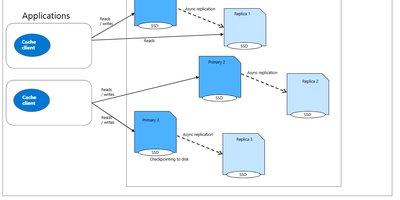
Garnet is Microsoft Research's cache-store built on .NET that speaks the Redis RESP wire protocol while delivering up to 10x higher throughput and 4x lower tail latency than comparable alternatives on identical hardware. The Tsavorite storage engine provides a cache-friendly, shared-memory architecture scaling linearly across CPU cores, supporting both in-memory operation and tiered storage across local SSDs and Azure Storage for datasets exceeding available RAM. Cluster mode enables sharded deployments with replication, dynamic key migration for live rebalancing, non-blocking checkpointing, and automatic failover using standard Redis cluster commands. The RESP implementation covers raw strings, sorted sets, lists, hashes, sets, bitmaps, HyperLogLog, streams, pub/sub, Lua scripting, and client-side transactions, allowing StackExchange.Redis, Jedis, redis-py, and other Redis clients to connect without modification. C#-based extensibility lets developers define custom commands and new data types as server-side stored procedures, compiled and loaded at runtime without restarting the server. TLS encryption, ACL-based access control, and operation logging complete the production feature set. Deployed across Microsoft services including Windows & Web Experiences, Azure Resource Manager, and Azure Resource Graph. Nearly 12,000 GitHub stars. MIT licensed.
MySQL
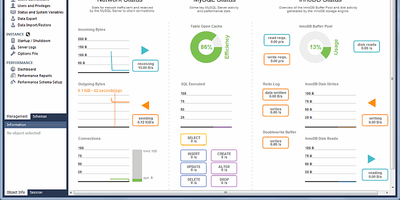
Powering Facebook, Uber, Twitter, and Booking.com, MySQL processes billions of queries daily as the world's most widely deployed open-source relational database. Its default InnoDB storage engine delivers full ACID compliance with row-level locking, crash recovery, and foreign key enforcement, making it the backbone of mission-critical e-commerce, SaaS, and financial applications. MySQL's Document Store bridges relational and NoSQL paradigms, allowing developers to work with schema-less JSON collections alongside traditional SQL tables through the X DevAPI protocol. For high availability, InnoDB Cluster combines Group Replication, MySQL Router, and MySQL Shell into an integrated solution with automatic failover, while InnoDB ClusterSet extends this across data centers for disaster recovery. The database supports multiple storage engines including MyISAM for read-heavy analytics, Memory for temporary high-speed caching, and Archive for compressed historical data. Native JSON functions like JSON_TABLE() transform document data into relational result sets, and spatial data types enable GIS applications. MySQL integrates with every major programming language through official connectors for Python, Java, Node.js, PHP, C++, and .NET, and works seamlessly with frameworks like Django, Laravel, Rails, and Spring. Replication topologies support read replicas for horizontal scaling, and the new Change Stream Applier in MySQL 26.7 enables configurable parallel transaction application with up to 1,024 workers per channel. Running on a dedicated VPS on RepoCloud with guaranteed CPU, RAM, and SSD, full root SSH access, and a browser serial console. GPLv2 licensed.
Label Studio
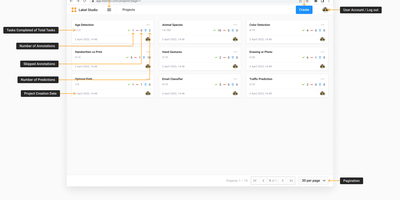
Images, text, audio, video, HTML, PDFs, and time series, labeled in one tool with a standardized output format: Label Studio is the open-source data labeling platform for building training datasets. Computer vision tasks cover classification, object detection (boxes, polygons, ellipses, keypoints), and semantic segmentation; audio work spans transcription, speaker diarization, and emotion recognition; NLP handles named entity recognition and document classification with taxonomies up to 10,000 classes; and GenAI workflows support LLM fine-tuning data and RLHF response ranking. Labeling interfaces are fully configurable with an XML-like templating language, so the UI matches the task instead of the reverse. The ML backend SDK turns any model into a connected web server for pre-annotation (model predicts, humans verify), interactive labeling (real-time predictions as annotators draw regions or highlight text), and model evaluation - cutting annotation time dramatically on large datasets. Data imports from S3, GCS, or file uploads; the Data Manager filters and explores tasks; exports convert to the format your ML library expects via label-studio-converter. Multi-user accounts tie every annotation to its author, and webhooks, a Python SDK, and REST API embed labeling into any pipeline. Self-hosting keeps proprietary training data - often a company's most sensitive asset - entirely on your infrastructure.
Nhost
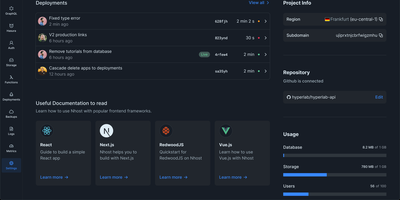
Backed by 9,200 GitHub stars and venture funding led by Nauta Capital, Nhost is the open-source Firebase alternative that replaces Google's proprietary document store with a relational PostgreSQL foundation from day one. The Hasura integration auto-generates a real-time GraphQL API with subscriptions, role-based permissions, and remote schemas from your PostgreSQL tables, while event triggers and cron triggers automate backend workflows without custom infrastructure. Authentication supports email and password, magic links, phone OTP via SMS, social OAuth providers including Google and GitHub, WebAuthn for passwordless login with Face ID, fingerprints, and YubiKeys, plus two-factor authentication. Since the Q1 2026 release, Nhost Auth also functions as a full OAuth2 and OpenID Connect provider, allowing your Nhost project to issue tokens to third-party applications the same way GitHub or Google do. The S3-compatible storage service handles file uploads with automatic image optimization, virus scanning, and presigned URLs for secure direct downloads. Node.js serverless functions deploy JavaScript and TypeScript backend logic without managing servers, while the Nhost CLI spins up the complete local stack via Docker for development with automatic database migration tracking and Hasura metadata management. The MCP server integration exposes project documentation and data schemas to AI assistants for intelligent query building. SDKs cover JavaScript, TypeScript, React, Vue, Next.js, and Dart for Flutter. Running on a dedicated VPS on RepoCloud with guaranteed CPU, RAM, and SSD, full root SSH access, and a browser serial console. MIT licensed.
Quickwit
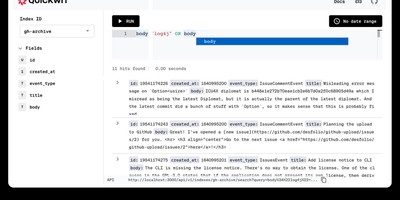
With over 11,000 GitHub stars and now backed by Datadog while remaining fully Apache 2.0 licensed, Quickwit delivers the search performance Elasticsearch users expect at a fraction of the infrastructure cost by moving the index to object storage instead of expensive local SSDs. The Rust-based engine, built on the Tantivy search library with SIMD-accelerated vectorized processing and zero garbage collection overhead, achieves sub-second search latency directly against Amazon S3, Azure Blob Storage, Google Cloud Storage, or any S3-compatible backend like MinIO and Ceph. The Elasticsearch-compatible REST API covers ingest, search, query DSL, and aggregations, enabling existing log shippers including Vector, Fluent Bit, and Syslog to migrate without rewriting configurations. Native OpenTelemetry Protocol endpoints accept logs and traces via gRPC, while Jaeger integration provides a drop-in distributed tracing backend. Ingestion from Apache Kafka, Amazon Kinesis, and Apache Pulsar supports streaming pipelines with multi-index partitioning, and the schemaless JSON indexing mode eliminates the need for upfront schema definitions. Stateless searchers and indexers scale horizontally on Kubernetes or bare metal, with a control plane that distributes indexing tasks and a janitor that manages retention policies and GDPR-compliant deletions. The built-in web UI displays search results and cluster state, while the official Grafana data source enables log exploration dashboards. Running on a dedicated VPS on RepoCloud with guaranteed CPU, RAM, and SSD, full root SSH access, and a browser serial console. Apache 2.0 licensed.
Parseable
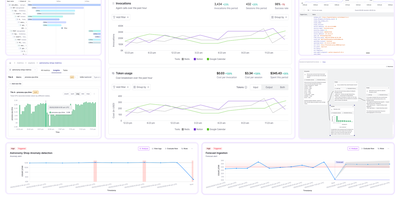
Parseable replaces expensive Elasticsearch clusters and fragmented monitoring stacks with a single Rust binary that ingests, queries, and stores logs, metrics, and traces on commodity object storage at a fraction of the cost. The data lake architecture decouples stateless compute from S3-compatible storage, enabling independent scaling of ingestion throughput and query capacity while cutting storage costs by up to 90% compared to indexed alternatives. OpenTelemetry-native OTLP ingestion accepts telemetry from existing OTel collector pipelines, Prometheus Remote Write endpoints, Kafka consumers, eBPF probes, and popular logging agents including Fluentd, Fluent Bit, and Vector without proprietary format conversions. The SQL-first query interface enables cross-signal analysis across all telemetry types, while native PromQL support with 50+ functions and 12 aggregation operators provides Prometheus-compatible metrics querying that works directly with Grafana dashboards. Built-in features include customizable dashboards, real-time alerting with Webhook, Slack, and Alertmanager targets, role-based access control, OpenID single sign-on integration, LogIQ automatic unstructured-to-structured log transformation, smart caching for frequently accessed data, and retention policies for lifecycle management. AI-powered Keystone Q&A provides natural language to SQL conversion and dataset summarization. All data stored as standard Apache Parquet on object storage remains accessible to any Parquet-compatible engine (DuckDB, Spark, Trino), ensuring zero vendor lock-in. Deploys on AWS S3, Azure Blob, Google Cloud Storage, MinIO, Wasabi, and DigitalOcean Spaces. Running on a dedicated VPS on RepoCloud with guaranteed CPU, RAM, and SSD, full root SSH access, and a browser serial console. Apache 2.0 licensed.