Cube
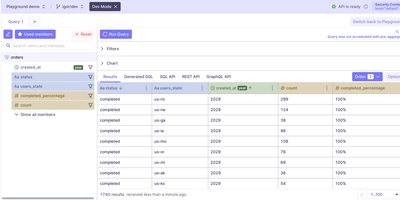
BI tools, customer-facing apps, and AI agents all receive the same governed answer from Cube Core, an open-source semantic layer where every metric is defined once, in code. Models are written in YAML or JavaScript. Cubes describe business entities with measures, dimensions, and joins. Views curate datasets for consumers. Git holds every version, with code review and CI like any other codebase. Queries arrive through a Postgres-compatible SQL API with a MEASURE function, through REST returning JSON, or through GraphQL, which means any tool that speaks Postgres connects without custom drivers. Sources include Snowflake, BigQuery, Databricks, Amazon Athena, Presto, and Postgres. Pre-aggregations declared in the model refresh in the background and live in Cube Store. An aggregate-aware planner routes matching queries to those rollups, and dashboards answer in milliseconds without rescanning the warehouse. Access policies set member-level visibility, row-level filters, and data masking from the security context. Multi-tenant SaaS analytics becomes practical: each customer sees only their own rows, whichever API asks. A development-mode Playground, meant for local use and never for public exposure, composes queries from measures and dimensions, shows the generated SQL, charts the results, and copies ready-made SQL, REST, and GraphQL calls. Running on a dedicated VPS on RepoCloud with guaranteed CPU, RAM, and SSD, full root SSH access, and a browser serial console. Apache 2.0 licensed.
drawDB
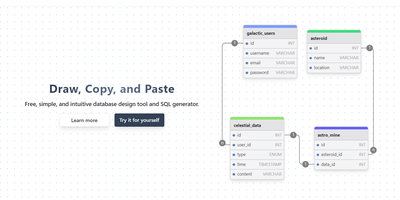
Schema design with no account and a few clicks: drawDB is the browser-based entity-relationship diagram editor and SQL generator - an AGPL-3.0 React project with over 37,000 GitHub stars. Draw tables with columns, data types, defaults, and constraints; connect fields to create foreign-key relationships; group tables into labeled subject areas; and annotate with notes. When the design is ready, one export produces CREATE TABLE DDL - with constraints, indexes, and foreign keys - targeted at MySQL, PostgreSQL, SQLite, MariaDB, SQL Server, or Oracle. Diagrams can be database-specific, unlocking every native type plus dialect features like PostgreSQL enums and composite custom types, or generic for portability across all supported flavors. The reverse direction works too: paste existing DDL into the import dialog and drawDB renders your live schema as a navigable diagram - the fastest way to document an inherited database. Versioning and migration-script generation track schema evolution, full editor ergonomics (undo/redo, copy/paste, duplicate, themes) keep iteration fast, and diagrams export as PNG, SVG, or shareable JSON. Everything runs client-side against browser storage - no backend database connection needed - so the self-hosted Docker deployment is a featherweight static app that keeps proprietary schema designs entirely on your infrastructure.