Chatwoot
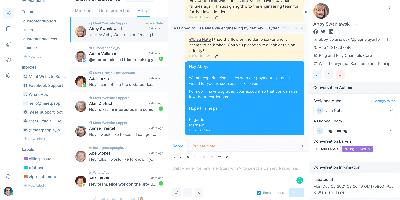
Unleash the power of Chatwoot, the open-source superhero in the world of customer experience! This platform is perfect for businesses craving to connect with their customers across a multitude of channels without breaking the bank. Wave goodbye to the high-and-mighty likes of Intercom, Zendesk, and Salesforce Service Cloud, and say hello to a wallet-friendly powerhouse. Chatwoot turns your agents into customer service ninjas, armed with the latest in workload management, performance tracking reports that refresh themselves (because who has time for that?), and automations that work smarter, not harder. Zap through conversations with lightning-fast responses and manage your social media and email interactions in a single bound. Plus, with Chatwoot, you get to be the Sherlock of customer satisfaction, deducing your CSAT scores on autopilot. All this hosted on RepoCloud, where the cost is as tiny as the effort you'll need to switch over. Get ready to engage, enlighten, and entertain your customers with Chatwoot!
Dittofeed
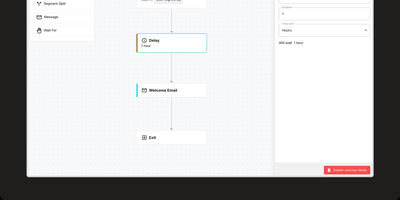
Automate transactional and marketing messages across email, SMS, mobile push, WhatsApp, Slack, and custom webhooks from a single visual journey canvas. Dittofeed provides the capabilities of Customer.io or Braze while keeping customer PII within your own infrastructure and eliminating volume-based pricing entirely. The drag-and-drop journey builder creates multi-trigger automations with branching logic, wait nodes, random cohort splits for A/B testing, and local timezone delivery without writing code. User segments combine trait conditions, event history, and array-based filtering through AND/OR operators with real-time evaluation. Template authoring supports both a low-code visual editor and direct HTML/MJML input, with templates reusable across journeys and one-off broadcasts. Data flows in through Segment integration, Reverse ETL connections, or the REST API with Web, Node.js, and React Native SDKs. Message delivery routes through SendGrid, Amazon SES, Twilio, or SignalWire with per-channel analytics tracking opens, clicks, bounces, and unsubscribes. Authentication supports Keycloak, AWS Cognito, and GCP OAuth for enterprise SSO. Embeddable iframe and headless React components let SaaS platforms white-label journey builders into their own products. Deploy on RepoCloud with a dedicated VPS for full GDPR compliance under the MIT license.
Rocket.Chat
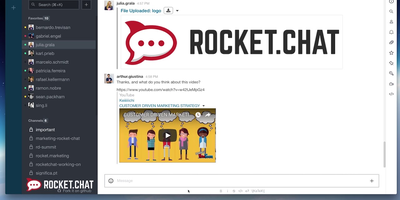
Blast off into productivity space with Rocket.Chat SIX, the ultimate team collaboration cosmos! Imagine a place where your messages, tasks, and projects all live in harmony, orbiting around your team's efficiency like a well-organized galaxy. This isn't just any old chat platform; it's a customizable universe where you're the master of your data domain, with the power to tweak, integrate, and innovate to your heart's content. Ready to provide stellar customer service? Engage with your clients in a way that's so contextually on-point, they'll feel like you're mind-reading across the cosmos. Plus, with a chat engine that's like a gravitational pull for user engagement, your app or website will become the center of your users' universe. And for the security-conscious space cadets, fear not! Rocket.Chat SIX is locked down tighter than a spaceship hatch, with end-to-end encryption and a buffet of deployment options to satisfy your security appetite. All this, hosted on RepoCloud, where the cost is as lightweight as zero-gravity. So why settle for a terrestrial tool when you can have a celestial experience? Rocket.Chat SIX: because your team deserves to collaborate in a universe that's light-years ahead!
Waline
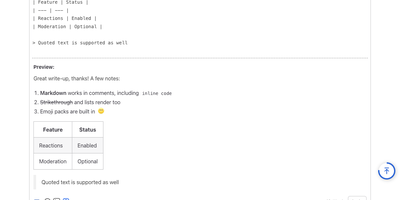
Any blog, documentation site, or static website can host a complete comment section by running its own Waline server, with Markdown, emoji, reactions, and moderation tools included. A visitor writes as a guest, registers an account, or signs in with GitHub, Twitter, Facebook, Weibo, or QQ, and a live preview shows the formatting before anything is posted. Comments accept tables, strikethrough, highlighted code blocks, TeX formulas, custom emoji packs, and Giphy GIF search. On submission, a sanitizer strips scripts and styles while Akismet, per-IP rate limits, keyword and IP block lists, duplicate detection, and reCAPTCHA or Turnstile screen for spam, and an optional review queue holds the comment back until a moderator approves it. The site owner then hears about it by email, WeChat, QQ, Telegram, PushPlus, Discord, or Lark, and the commenter receives reply emails. Once published, readers react with up to nine emoji and sort threads by latest, oldest, or hottest, while pageview and comment counters can appear anywhere on a site and recent-comment and top-commenter widgets fill sidebars. Moderators edit, approve, flag, or delete from the web admin panel, manage users and custom labels, and import earlier discussions from Disqus, Twikoo, Valine, Typecho, Artalk, Commento, or WordPress. Comments stay in your own database, and the widget offers a dark theme and ten languages. Running on a dedicated VPS on RepoCloud with guaranteed CPU, RAM, and SSD, full root SSH access, and a browser serial console. GPL-2.0 licensed.

Cusdis
Comments for small sites without Disqus's baggage: Cusdis is a lightweight, privacy-first, open-source comment system for embedding under blog posts and articles. The embedded JavaScript SDK is about 5 KB gzipped (Disqus is roughly 24 KB), sets no cookies, runs no tracking, and does not require readers to create an account or sign in before commenting. Integration is two lines: a container div with your app ID and an async script tag, with ready-made adapters for common frameworks and static site generators. Moderation is approval-based - new comments stay hidden until you approve them from the dashboard, and email notifications include a Quick Approve link that approves or replies to a comment from your phone without logging in. A webhook fires on every new comment for integrations like Telegram notifications. The widget ships with built-in i18n and dark mode. The stack is TypeScript and Next.js with a Prisma data layer, deployable via Docker with PostgreSQL. Deliberately minimalist: no ads, no reader profiling, and your comment data lives in your own database.