Airi
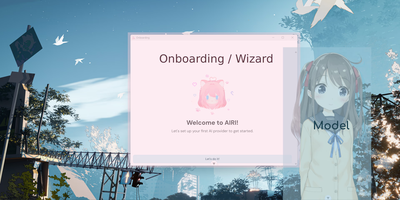
Project AIRI is the most popular open-source AI companion platform — a self-hosted recreation of Neuro-sama that brings AI-powered virtual characters into your world across web, desktop, and mobile. The system renders Live2D, Spine, and VRM 3D character models with auto-blink, eye tracking, and lip-sync driven by real-time voice synthesis, while the xsAI abstraction layer connects to 40+ LLM providers including OpenAI GPT-4, Anthropic Claude, Google Gemini, DeepSeek, and local models via Ollama and OpenRouter. Built from day one on WebGPU, WebAudio, Web Workers, WebAssembly, and WebSocket technologies, the browser version runs entirely client-side with PWA offline support while the server runtime enables persistent memory via PostgreSQL with pgvector embeddings and DuckDB WASM for client-side storage. The Minecraft agent plays autonomously using mineflayer with pathfinding, and a Factorio integration provides cooperative gameplay. Social integrations deploy your companion as a Discord bot joining voice channels, a Telegram bot, and a Twitter/X agent posting and replying autonomously. The desktop Stage Tamagotchi app provides an always-on-screen companion for Windows and macOS, while Stage Pocket brings the experience to mobile. Voice features include client-side speech recognition via VAD, multiple TTS providers including ElevenLabs, and screen vision capabilities. Running on a dedicated VPS on RepoCloud with guaranteed CPU, RAM, and SSD, full root SSH access, and a browser serial console. MIT licensed.
Pumpkin
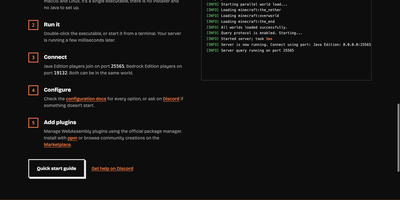
Why keep a Java runtime on the server just to host Minecraft, when Pumpkin runs from a single native executable and lets Java and Bedrock players share a world? Java Edition clients join on port 25565 and Bedrock clients on 19132, although Bedrock support is still marked work in progress. Builds exist for Windows, Linux, macOS, and Android. On launch, the console reports the worlds loaded and the server ready within milliseconds. Plugins are sandboxed WebAssembly modules that raise console permission prompts and pass signature checks, and authors can write them in Rust, Kotlin, Python, Go, C#, C/C++, D, Zig, or TypeScript. The ppm package manager searches and installs community plugins from the Pumpkin Market, and PatchBukkit loads some Bukkit and Paper plugins, with expected gaps. One pumpkin.toml file holds ports, MOTD, view distance, whitelist, authentication, compression, PvP, chat, resource packs, and world options, while chunks save in Anvil, Linear, or the native Pump format. Velocity and BungeeCord forwarding fit proxy networks, and the Query protocol plus Minecraft Server Management Protocol cover monitoring and remote administration. A public parity tracker lists every vanilla block, entity, item, and command as implemented, partial, or planned, so gaps are easy to spot before a world moves. Today it suits private survival worlds, test servers, and plugin development. It is early software, so the project advises backups. Running on a dedicated VPS on RepoCloud with guaranteed CPU, RAM, and SSD, full root SSH access, and a browser serial console. GPL-3.0 licensed.