OpenSearch
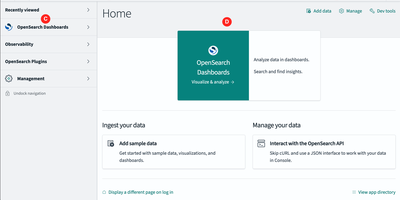
OpenSearch is a search and analytics platforms, powering full-text search, log analytics, observability, and AI-powered vector retrieval at petabyte scale. The distributed engine provides BM25 full-text search alongside k-NN vector search using NMSLIB, Faiss, and Lucene libraries, enabling semantic search, hybrid search combining keyword and vector scoring through normalization processors, neural sparse search, and retrieval-augmented generation workflows with built-in ML Commons for model hosting. OpenSearch Dashboards delivers interactive visualization with Discover for log exploration, custom dashboards, alerting, anomaly detection using Random Cut Forest algorithms, and Security Analytics with detection rules mapped to MITRE ATT&CK. Native Prometheus integration with full PromQL support unifies metrics alongside logs and traces in a single observability interface, while Data Prepper handles telemetry ingestion from OpenTelemetry collectors, Fluent Bit, and Logstash-compatible pipelines. SQL and Piped Processing Language queries with a visual PPL builder enable analysts to query data without learning the native DSL. Index State Management automates index lifecycle with rollover, shrink, and delete policies, while cross-cluster replication and searchable snapshots on S3-compatible storage provide disaster recovery. Scoped API keys, field-level security, document-level security, and audit logging deliver enterprise-grade access control. Docker Compose deploys multi-node clusters alongside the Kubernetes operator for orchestrated production environments. Running on a dedicated VPS on RepoCloud with guaranteed CPU, RAM, and SSD, full root SSH access, and a browser serial console. Apache 2.0 licensed.
Label Studio
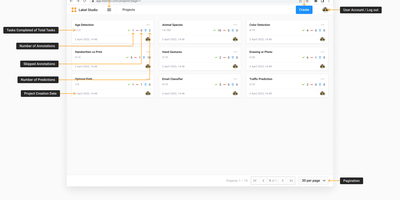
Images, text, audio, video, HTML, PDFs, and time series, labeled in one tool with a standardized output format: Label Studio is the open-source data labeling platform for building training datasets. Computer vision tasks cover classification, object detection (boxes, polygons, ellipses, keypoints), and semantic segmentation; audio work spans transcription, speaker diarization, and emotion recognition; NLP handles named entity recognition and document classification with taxonomies up to 10,000 classes; and GenAI workflows support LLM fine-tuning data and RLHF response ranking. Labeling interfaces are fully configurable with an XML-like templating language, so the UI matches the task instead of the reverse. The ML backend SDK turns any model into a connected web server for pre-annotation (model predicts, humans verify), interactive labeling (real-time predictions as annotators draw regions or highlight text), and model evaluation - cutting annotation time dramatically on large datasets. Data imports from S3, GCS, or file uploads; the Data Manager filters and explores tasks; exports convert to the format your ML library expects via label-studio-converter. Multi-user accounts tie every annotation to its author, and webhooks, a Python SDK, and REST API embed labeling into any pipeline. Self-hosting keeps proprietary training data - often a company's most sensitive asset - entirely on your infrastructure.
LibrePhotos
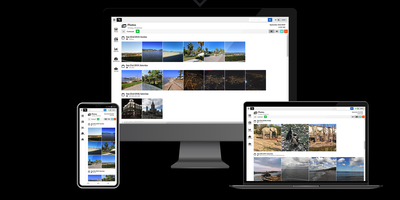
With over 8,000 GitHub stars and continuous development since 2020, LibrePhotos delivers the core intelligence of Google Photos — face recognition, object detection, semantic search, and automatic album generation — entirely on your own hardware without sending a single photo to a third-party server. The Django 5 backend processes uploaded media through a machine learning pipeline that runs face detection via the face_recognition library, clusters identified faces using scikit-learn and HDBSCAN, generates image captions through BLIP and Moondream 2, and classifies scenes using Places365 or Google's SigLIP 2 vision-language model with zero-shot classification against 900+ real-world tags. Semantic search lets you find photos by natural language queries like "sunset at the beach" without manual tagging, while metadata search filters by person, camera, lens, file type, and filesystem path. The React 18 frontend built with Vite presents a timeline view, fullscreen lightbox with slideshow mode, photo detail sidebar showing location and people, and a folder navigation view with breadcrumb paths. RAW files from any camera are converted via ImageMagick, videos processed through FFmpeg, and Live Photos paired with their RAW+JPEG counterparts as unified entries. Public album sharing via link provides fine-grained privacy controls, and duplicate detection uses perceptual hashing to identify near-identical images. Deployment runs as a single unified Docker container or via Docker Compose with Kubernetes manifests also available. Running on a dedicated VPS on RepoCloud with guaranteed CPU, RAM, and SSD, full root SSH access, and a browser serial console. MIT licensed.
Kokoro FastAPI
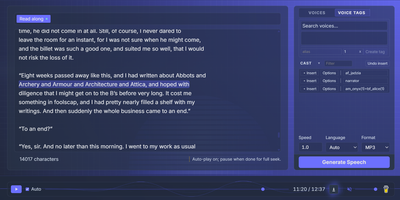
Kokoro-FastAPI turns text into natural-sounding speech across eight languages by serving the 82-million-parameter Kokoro-82M model through an OpenAI-compatible REST API, so any existing OpenAI SDK client can generate audio by just changing the base URL. With over 5,300 GitHub stars since December 2024, the fully Dockerized FastAPI server covers American English, British English, Spanish, French, Hindi, Italian, Japanese, Brazilian Portuguese, and Mandarin Chinese with language-specific phoneme processing. Inline voice mixing blends multiple profiles using weighted ratios like af_bella(2)+af_heart(1), automatically normalizing weights and caching combined voicepacks as PyTorch tensor files for reuse. Audio streams in real time over HTTP with configurable chunk sizes, or generates complete files in MP3, WAV, OPUS, FLAC, AAC, or PCM formats with speed control from 0.25x to 4.0x. Per-word timestamped captions with speaker-tagged voice labels enable subtitle generation for podcasts, audiobooks, and accessibility workflows. Pre-built Docker images support NVIDIA GPU acceleration via CUDA, experimental AMD GPU inference via ROCm, and CPU-only deployment on linux/amd64 and linux/arm64 architectures, with Apple Silicon MPS support available through direct UV execution. The integrated web interface at port 8880 provides browser-based speech generation, while the Swagger UI at /docs exposes the full API reference. Debug endpoints report system statistics for monitoring inference load. Running on a dedicated VPS on RepoCloud with guaranteed CPU, RAM, and SSD, full root SSH access, and a browser serial console. Apache 2.0 licensed.
Laminar
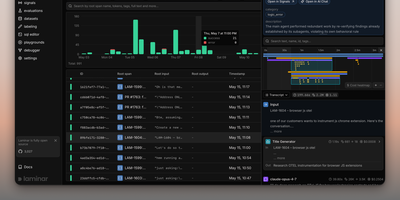
Backed by Y Combinator (S24) and processing traces from thousands of AI agents in production, Laminar is the open-source observability platform that treats agent debugging as a first-class engineering discipline rather than an afterthought. Its OpenTelemetry-native SDK auto-instruments Vercel AI SDK, LangChain, OpenAI, Anthropic, Gemini, Browser Use, Stagehand, Mastra, Pydantic AI, and the OpenAI Agents SDK with a single line of code, capturing every LLM turn, tool call, and sub-agent delegation as nested spans with full input/output data and token costs. The Signals engine lets you describe failures in plain language — "agent is stuck in a loop" or "tool returned empty results" — then reads every trace and alerts via Slack when it detects a match. A built-in debugger records runs and replays them from cache so each iteration takes seconds, designed for Claude Code, Cursor, or Codex to drive the repair loop via the MCP server or CLI. Run code-first evaluations in Python or TypeScript locally or in CI/CD pipelines, build datasets from production traces, and query everything with raw SQL through custom dashboards, the in-app editor, or your coding agent. The Rust backend delivers 20x trace compression, a custom real-time streaming engine, ultra-fast full-text search, and gRPC ingestion, while ClickHouse powers columnar analytics and PostgreSQL stores application state. Running on a dedicated VPS on RepoCloud with guaranteed CPU, RAM, and SSD, full root SSH access, and a browser serial console. Apache 2.0 licensed.
OpenLIT
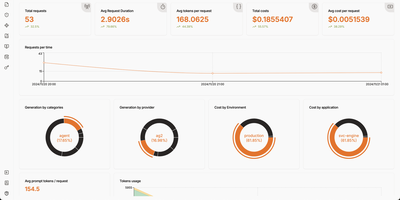
Your AI application is burning through API tokens faster than you can refresh the billing page, and you have no idea which prompt template is responsible. OpenLIT plugs that visibility gap with a self-hosted observability platform built specifically for LLM workloads. Add one line of code to instrument 90+ LLM providers, agent frameworks, and vector databases, then watch every request flow through a tracing dashboard that shows tokens consumed, latency measured, and dollars spent per call, per model, per environment. The requests view lists every LLM interaction with provider, model, cost, and token breakdown in a filterable table, while the trace detail panel lets you drill into individual spans to read the exact prompt sent and response received. Prompt Hub turns prompts into versioned artifacts you deploy, rollback, and A/B test without touching application code. OpenGround compares models side by side on the same input, so you can evaluate cost-versus-quality tradeoffs before committing to a provider. Automated evaluations run LLM-as-a-judge scoring on live production traces, flagging hallucinations, bias, and toxicity in real time. The Vault stores and rotates API keys centrally so secrets stay out of your codebase. Custom dashboards let you build drag-and-drop monitoring views with charts, stat cards, and tables backed by SQL queries against ClickHouse. GPU utilization, memory, temperature, and power metrics feed into the same platform for end-to-end infrastructure visibility. Running on a dedicated VPS on RepoCloud with guaranteed CPU, RAM, and SSD, full root SSH access, and a browser serial console. Apache 2.0 licensed.
Doccano
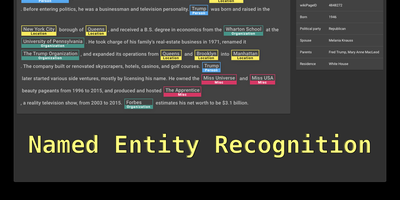
Doccano is a text annotation platforms for building machine learning training datasets. The web-based interface supports text classification for sentiment analysis and document categorization, sequence labeling for named entity recognition with overlapping entity support and relation extraction between labeled spans, and sequence-to-sequence annotation for text summarization and machine translation pairs. Collaborative annotation enables multiple annotators to work on the same project simultaneously with per-user progress tracking, annotation guidelines, example assignment to specific members, and filtering by assignee. Auto-labeling integrates with external machine learning model APIs through configurable request and response mapping templates, allowing pre-annotation that annotators can review and correct. Data import accepts plain text, JSONL, CoNLL, and Excel formats, while export produces JSONL and CoNLL datasets compatible with spaCy, Hugging Face Transformers, PaddleNLP, and other training frameworks through the doccano-transformer library. The Django backend with Django REST Framework exposes a complete RESTful API for programmatic project creation, dataset management, and annotation retrieval via the official doccano-client Python library. Celery handles background tasks including dataset import and export processing with Flower providing task monitoring. One-click deployment supports AWS CloudFormation and Heroku alongside Docker Compose for self-hosted environments. Running on a dedicated VPS on RepoCloud with guaranteed CPU, RAM, and SSD, full root SSH access, and a browser serial console. MIT licensed.
Forge
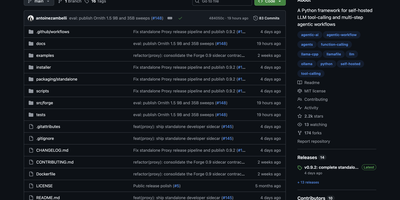
Forge intercepts failing LLM tool calls and fixes them before they derail your agent workflow, applying rescue parsing, retry nudges, response validation, and step enforcement between your AI clients and local model backends. The proxy server mode drops in as a transparent intermediary speaking both the OpenAI chat-completions API and the Anthropic Messages API, so tools like Aider, Claude Code, Continue, and opencode connect through it without configuration changes. Under the hood, the WorkflowRunner provides a complete agentic loop manager with system prompt injection, tool execution, context compaction with configurable thresholds, and VRAM budgeting for consumer GPUs with 12-32 GB. SlotWorker enables priority-queued access to shared inference slots with automatic preemption for multi-agent architectures. The guardrails middleware exposes a two-method check-and-record API that wraps into any existing orchestration loop, providing malformed tool-call rescue parsing, retry nudge generation, required step enforcement, and prerequisite ordering without taking over execution control. Backend adapters support generic OpenAI-compatible endpoints, Ollama, llama-server, Llamafile, vLLM, and Anthropic with automatic model discovery and health checking. Architecture Decision Records document every design choice. Launched February 2026, already at 2,200+ GitHub stars. MIT licensed.
Chatterbox TTS
With 26,000 GitHub stars and consistent victories over ElevenLabs in blind evaluations, Chatterbox delivers state-of-the-art text-to-speech with zero-shot voice cloning requiring only 5 seconds of reference audio. The model family spans three architectures: Chatterbox Multilingual V3 (500M parameters, 23+ languages including Arabic, Chinese, Japanese, Korean, Hindi, French, German, Spanish, and Portuguese), Chatterbox-Turbo (350M parameters optimized for voice agents with a single-step distilled decoder achieving ~200ms time-to-first-speech), and Chatterbox-Nano (110M parameters running 3x faster than realtime on 8 CPU cores for edge deployment). Unique among open-source TTS systems, Chatterbox introduces emotion exaggeration control — adjusting intensity from monotone to dramatically expressive via a single parameter — and native paralinguistic tagging where tokens like [laugh], [cough], [chuckle], and [gasp] inject natural vocal reactions inline without post-processing. The alignment-informed inference pipeline eliminates hallucinations and repetition artifacts common in autoregressive TTS. Built-in PerTh neural watermarking embeds imperceptible forensic identifiers in generated audio for provenance tracking. Trained on 500,000 hours of cleaned speech data across all supported languages. Voice conversion scripts enable transforming existing audio into any cloned voice. Deploy via pip install with PyTorch, serve through Gradio interfaces or custom FastAPI endpoints, and expose via HTTP streaming or WebSocket for sub-200ms conversational applications. Running on a dedicated VPS on RepoCloud with guaranteed CPU, RAM, and SSD, full root SSH access, and a browser serial console. MIT licensed.
Farfalle
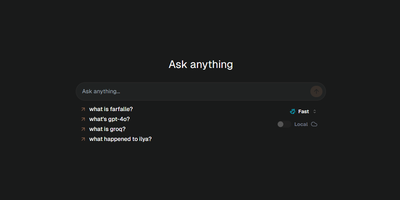
Live web search plus an LLM of your choice: Farfalle is an open-source, self-hosted answer engine in the Perplexity mold. Queries route through one of several search providers - self-hosted SearXNG for a fully independent stack, or Tavily, Serper, and Bing APIs - and the model composes a cited answer from the retrieved results. Model flexibility is the core design: run llama3, mistral, gemma, or phi3 locally through Ollama for zero per-query cost and full privacy, use cloud models like GPT-4o or Groq-hosted Llama 3 for speed, or route to any provider via LiteLLM. An Expert Search mode uses an agent that plans a multi-step search strategy and executes it for harder questions, and chat history keeps prior research sessions available. The stack is a Next.js and shadcn/ui frontend over a FastAPI backend with Redis rate limiting, shipped as a pre-built Docker image. A browser search-engine entry pointing at your instance makes it the default search from the address bar. Paired with SearXNG and Ollama, the whole pipeline runs with no external API at all.