Dub
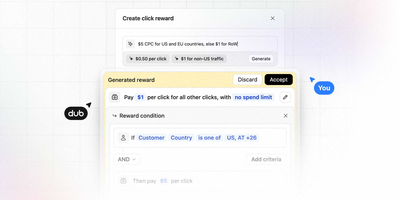
With 24,000 GitHub stars and infrastructure processing over 100 million clicks and 2 million links monthly for marketing teams at Twilio, Buffer, Framer, Perplexity, and Vercel, Dub is the most widely adopted open-source link attribution platform — unifying branded short links, real-time conversion analytics, and affiliate programs in a single self-hostable tool. Create short links on custom domains with built-in QR code generation, device and geographic targeting rules, A/B testing for destination URLs, deferred deep linking for mobile apps, and custom social media preview cards. The attribution engine tracks the complete customer journey from first click through lead capture to final sale, calculating lifetime value, retention rates, and multi-touch attribution across campaigns. Real-time analytics visualize clicks, leads, and revenue with filtering by geography, device, browser, referrer, operating system, and UTM parameters — plus an "Ask AI" feature that generates personalized reports from natural language queries. The partner program module enables embedded referral and affiliate programs with custom reward structures, automated payouts, and partner dashboards for product-led growth. Programmatic link creation via native SDKs for TypeScript, Python, Go, PHP, and Ruby supports enterprise-scale campaigns with real-time webhook notifications on link events. Migration assistants import existing links from Bitly, Rebrandly, and Short.io with redirects preserved. Running on a dedicated VPS on RepoCloud with guaranteed CPU, RAM, and SSD, full root SSH access, and a browser serial console. AGPLv3 licensed.

Erxes
Replacing HubSpot, Zendesk, Intercom, and Linear with a single self-hosted platform, erxes delivers an Experience Operating System trusted by over 4,000 GitHub stars and built on a modern Nx-powered monorepo architecture. The core ships with six foundational modules — My Inbox for omnichannel conversations across email, web chat, voice, and Discord; Contacts for unified customer profiles; Products for catalog management; Segments for behavioral targeting; Automation for visual workflow builders; and Documents for template generation. Beyond the core, a plugin marketplace activates Frontline for ticket management and omnichannel support queues, Sales for deal pipelines and lead scoring, Operations for project boards with cycle management, Content for headless CMS and knowledge bases, and Team for employee directories, time clocks, and internal chat. The technical stack combines GraphQL Federation with Apollo Server v4 and tRPC v11 microservices on Node.js, React 18 micro-frontends via Rspack Module Federation with TailwindCSS 4, MongoDB with Mongoose for persistence, Redis for caching, BullMQ for job queues, and Elasticsearch for full-text search. Deployment supports Docker Compose orchestration with automatic service discovery across all plugin containers. The Global Profile architecture enables agencies to manage multiple client brands under a single login with separated data stores. iOS and Android SDKs embed the messenger widget directly into mobile applications. Running on a dedicated VPS on RepoCloud with guaranteed CPU, RAM, and SSD, full root SSH access, and a browser serial console. AGPLv3 licensed.
HitKeep
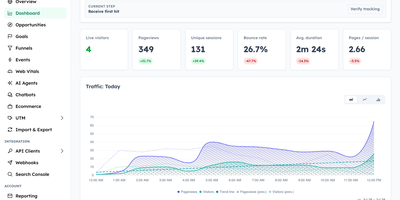
HitKeep is a sovereign web analytics platform that consolidates cookieless visitor telemetry, conversion funnels, e-commerce revenue reports, and AI engine visibility into a privacy-respecting dashboard that replaces Google Analytics and complex tracking clouds. Marketing teams can monitor inbound visitor journeys without installing intrusive consent banners or violating regional GDPR regulations. Custom conversion funnels and goal milestones track user registrations, checkout transactions, newsletter subscriptions, and software downloads with exact revenue attribution. Integrated Google Search Console synchronization brings organic search queries, keyword impression rankings, and click-through metrics directly alongside real-time pageview logs. A dedicated artificial intelligence visibility dashboard monitors crawling bots, retrieval citations, and direct referral visits originating from ChatGPT, Claude, Perplexity, and other generative search agents. Growth analysts can pose natural language questions to an embedded AI reporting assistant, generating instant cohort breakdowns and engagement trends without assembling complex manual filters. Site operators can configure custom tracking domains, whitelist reverse proxy networks, filter out referrer spam, and schedule automated database backups across persistent storage volumes. Complete data sovereignty controls allow teams to export raw event telemetry into open Parquet and CSV archives or stream metrics into external business intelligence warehouses via webhooks. Running on a dedicated VPS on RepoCloud with guaranteed CPU, RAM, and SSD, full root SSH access, and a browser serial console. MIT licensed.
Plausible
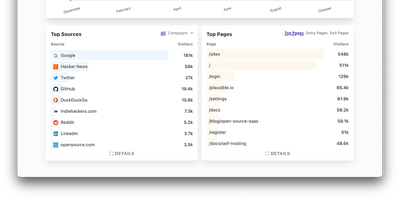
Built as a direct rejection of the adtech model, Plausible is the best-known privacy-first web analytics tool - lightweight, cookie-free, and open-source. It sets no cookies and stores no personal data: unique visitors are counted via a hash of IP plus User-Agent that rotates every 24 hours and is never stored raw, so no consent banner is required and GDPR compliance is structural rather than contractual. The tracking script is under 1 KB - orders of magnitude lighter than GA - and the dashboard is a deliberate contrast to GA4's sprawl: one fast-loading page with visitors, sources, top pages, countries, devices, and UTM breakdowns, filterable by any dimension. Custom events and goals track signups and clicks, Google Search Console integration pulls in search queries, scheduled email reports keep stakeholders updated, and the Stats API (v2) plus CSV export feed data anywhere. This is the AGPL-licensed Community Edition, the same Elixir codebase that powers Plausible's cloud service, running as three containers: the web app, PostgreSQL for accounts, and ClickHouse for event storage - which means self-hosters get direct SQL access to raw analytics data the cloud version never exposes. Traffic data stays entirely on your server, with no visitor caps or per-pageview pricing.

HeyForm
Typeform's conversational format, self-hosted: HeyForm is the open-source form builder that presents one question at a time. Forms present one question at a time, which measurably improves completion rates compared to long static pages. It supports 40+ field types, from text, email, and phone inputs to picture choices, date pickers, star ratings, signatures, and file uploads. Conditional logic shows or hides questions based on earlier answers, routes respondents to different endings, and redirects to URLs, so a single form can serve multiple flows. Completed submissions land in a results dashboard with drop-off and completion analytics, and connect outward through webhooks or integrations with Zapier, Make, Google Sheets, Notion, Airtable, and Slack. Theming covers fonts, colors, backgrounds, and custom CSS, so embedded forms look native to your site rather than like a third-party widget; the JavaScript embed library renders them inline, as popups, or full-page, with shareable standalone links as the default. Team workspaces and projects with member management let multiple teams share one instance without mixing data. Self-hosting removes per-response pricing entirely - unlimited forms and submissions for flat hosting cost - and keeps lead data, feedback, and quiz answers in your own MongoDB, simplifying GDPR compliance. The stack is a NestJS server and React webapp backed by MongoDB and KeyDB, distributed under GPLv3 as a Docker image.
GrowChief
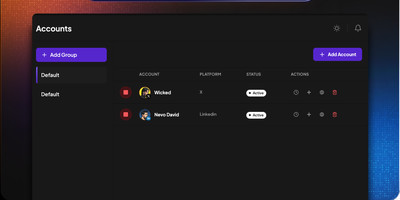
GrowChief delivers a self-hostable social media automation engine that replaces expensive SaaS tools like PhantomBuster, Expandi, and Zopto with a Docker-deployable alternative you fully control. The React and NestJS monorepo architecture runs headful Chrome via xvfb with Playwright and Patchright for maximum stealth — natural mouse movements and randomized interaction patterns make automation indistinguishable from manual browsing. Temporal orchestration manages workflow execution with built-in concurrency control that throttles actions to one every ten minutes per account even when ten workflows trigger simultaneously, preventing rate-limiting and account flags. The enrichment waterfall resolves profile URLs from partial data — provide an email address or organization name and GrowChief queries multiple providers to locate the correct social profile automatically. Working hours scheduling ensures outreach runs only during configurable business hours regardless of when leads enter the pipeline via the public REST API. Proxy support accepts custom SOCKS5 and HTTP proxies per account for geographic distribution and IP isolation. The public API enables full workflow management and lead injection from n8n, Make, Zapier, or any HTTP client, with a dedicated n8n custom node shipping ready to install. The multi-step workflow builder lets you chain connection requests, profile visits, message sends, and conditional delays into repeatable sequences. Running on a dedicated VPS on RepoCloud with guaranteed CPU, RAM, and SSD, full root SSH access, and a browser serial console. AGPL-3.0 licensed.
Dittofeed
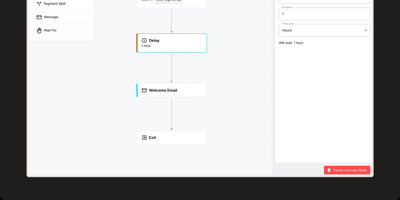
Automate transactional and marketing messages across email, SMS, mobile push, WhatsApp, Slack, and custom webhooks from a single visual journey canvas. Dittofeed provides the capabilities of Customer.io or Braze while keeping customer PII within your own infrastructure and eliminating volume-based pricing entirely. The drag-and-drop journey builder creates multi-trigger automations with branching logic, wait nodes, random cohort splits for A/B testing, and local timezone delivery without writing code. User segments combine trait conditions, event history, and array-based filtering through AND/OR operators with real-time evaluation. Template authoring supports both a low-code visual editor and direct HTML/MJML input, with templates reusable across journeys and one-off broadcasts. Data flows in through Segment integration, Reverse ETL connections, or the REST API with Web, Node.js, and React Native SDKs. Message delivery routes through SendGrid, Amazon SES, Twilio, or SignalWire with per-channel analytics tracking opens, clicks, bounces, and unsubscribes. Authentication supports Keycloak, AWS Cognito, and GCP OAuth for enterprise SSO. Embeddable iframe and headless React components let SaaS platforms white-label journey builders into their own products. Deploy on RepoCloud with a dedicated VPS for full GDPR compliance under the MIT license.
Mixpost
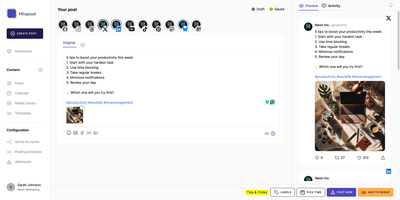
Mixpost puts Facebook, Instagram, X, LinkedIn, YouTube, TikTok, Pinterest, Threads, Bluesky, Mastodon, Pixelfed, and Google Business under a single scheduling dashboard — plan content visually on a drag-and-drop calendar, queue posts for optimal engagement windows, and track audience growth per platform without juggling twelve separate apps or paying per-seat SaaS fees. Built on Laravel with a Vue.js 3 and Inertia.js frontend styled with Tailwind CSS, the Lite edition provides unified content management where each post supports platform-specific customization with individual captions, media attachments, hashtag groups, and first-comment scheduling. Posting queues automate publishing at configurable time slots throughout the day. The media library provides a centralized asset manager with drag-and-drop uploads, stock photo integration via Unsplash, and Tenor GIF search. AI-powered content assistance generates and optimizes post copy. Per-platform analytics dashboards display audience growth, engagement metrics, reach, and impressions with exportable reports. Team workspaces support role-based permissions for collaborative content management across departments. External integrations connect through the REST API, webhooks, n8n, Zapier, and RSS feeds, plus an MCP server for AI assistant publishing. Deploy via Docker Compose with MySQL and Redis. Running on a dedicated VPS on RepoCloud with guaranteed CPU, RAM, and SSD, full root SSH access, and a browser serial console. MIT licensed.
Kutt
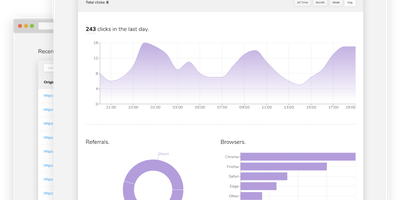
Built for self-hosting from the ground up, Kutt is a modern, MIT-licensed URL shortener: zero-configuration setup, no build step, and SQLite, PostgreSQL, or MySQL with optional Redis caching. Links carry real management features - custom slugs from a configurable alphabet (confusable characters like 0/O and l/1 omitted by default), password protection, descriptions, expiration times, and the ability to edit a destination URL without changing the short link already in circulation. Custom domains make branded short links first-class: add as many as you like and serve each under your own name instead of a third-party's. Private, per-link statistics track clicks, browsers, operating systems, and countries without logging visitor IPs or sensitive data. An admin page manages users and links instance-wide, and two environment flags (DISALLOW_REGISTRATION, DISALLOW_ANONYMOUS_LINKS) lock the instance down for private use; OpenID Connect login integrates with an existing identity provider. Automation runs through a documented REST API - create, list, delete, and pull stats - plus Chrome and Firefox extensions and ShareX compatibility for shortening from anywhere. Built with Node.js and React, deployed in one Docker container, it replaces Bitly with something you own: your domain, your analytics, and links that never die with a vendor.
Marketing Dashboard
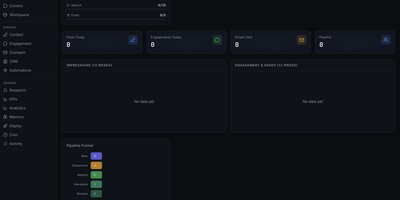
This is a marketing operations control center that replaces fragmented CRM, outreach, content, and analytics tools with a unified self-hosted interface designed for AI agent-assisted go-to-market teams. The CRM module manages leads through a configurable pipeline funnel with stages from New through Sequenced, Replied, Interested, and Booked, tracking source attribution, industry segments, company size, lead quality scores, and LinkedIn URLs per contact. Outreach sequencing supports email campaigns with pause controls, audit endpoints, suppression workflows, and engagement tracking. The content operations surface provides calendar views, content item management, performance metrics, and approval queues for editorial control. Analytics and KPI dashboards show impressions, engagement, and send volumes over configurable time periods, with optional connectors to Plausible, Google Analytics 4, X, and LinkedIn for cross-platform reporting. The OpenClaw-native agent runtime enables dynamic agent and squad discovery, workspace management, session monitoring, and communications surfaces. Automation scheduling uses cron job templates with OpenClaw-compatible schedule variants including cron expressions, every intervals, and at timestamps. The tech stack combines Next.js 16 App Router with React 19, Tailwind CSS 4, Recharts, and Zustand for state management. Authentication supports session cookies, API keys, and optional Google OAuth with role-based access controls. All state persists locally in SQLite via better-sqlite3 with no required external infrastructure. On RepoCloud, deploy Marketing Dashboard on a dedicated VPS with persistent SQLite storage, root SSH access, and complete control over your marketing operations data, all under the MIT license.
Ackee
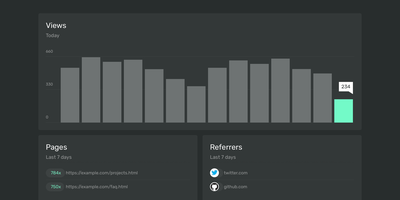
Page views, referrers, browsers, and screen sizes - Ackee delivers the analytics developers actually check, from a deliberately minimal Node.js and MongoDB stack that skips both Matomo's weight and Google Analytics' cloud dependency. Its defining constraint is anonymization: no cookies, no unique user tracking, and a multi-step anonymization process that keeps visitors unidentifiable while the aggregate numbers stay useful. In its default anonymous mode Ackee collects no personally identifiable information at all, which means GDPR and CCPA compliance out of the box and no cookie consent banner on your sites. A detailed mode adds screen size, language, and per-visit referrers - still without cookies or fingerprinting. Integration mirrors the Google Analytics pattern: create a domain in settings, drop the generated ackee-tracker snippet into your pages, and data appears in a clean single-page dashboard. One instance tracks multiple domains, and custom events capture button clicks, signups, and conversions. The distinctive engineering choice is the fully documented GraphQL API: everything the dashboard shows comes from that API, so you can query active visitors, average duration, and view statistics programmatically, feed data in from apps and services beyond websites, or build an entirely custom interface on top. If you want bare-minimum analytics with a real API and zero privacy anxiety, this is the tool.
Posta
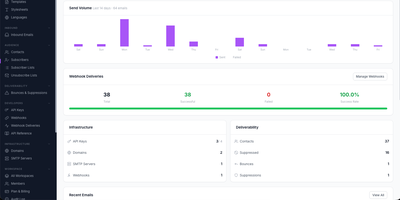
Built as a developer-first alternative to SendGrid, Mailgun, and Postmark, Posta delivers a complete self-hosted email infrastructure platform handling both outbound delivery and inbound reception through a single HTTP API with official SDKs for Go, PHP, and Java. The Go backend processes email through Redis and Asynq with automatic retries, priority queues, and async delivery while PostgreSQL stores templates, contacts, campaigns, and delivery analytics. Outbound features include versioned multi-language templates with variable substitution and stylesheet inlining, bulk campaigns with subscriber targeting and A/B testing per-variant metrics, scheduled timezone-aware delivery with draft/paused/cancelled lifecycle states, email address verification checking syntax, MX records, disposable domains, and role accounts, plus web view links with signed expiring URLs and one-click unsubscribe headers. The built-in SMTP receiver with TLS handles inbound email at your domains, parses messages and attachments, scores spam, and forwards structured payloads to your application via HMAC-verified webhooks with real-time SSE notification streams. The Vue-based dashboard manages templates, SMTP server pools, domains, contacts, API keys, campaigns, and email logs with dark and light mode support while admin-level platform metrics expose delivery rate trends, bounce rate graphs, and latency percentiles alongside Prometheus integration and daily health reports. Deploy via Docker with PostgreSQL and Redis. Running on a dedicated VPS on RepoCloud with guaranteed CPU, RAM, and SSD, full root SSH access, and a browser serial console. Apache 2.0 licensed.
BlogFactory
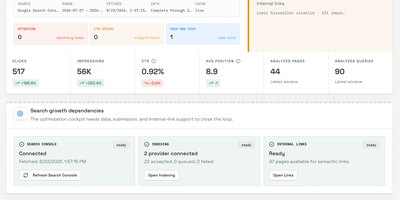
BlogFactory is the first open-source agent control plane purpose-built for multi-site content operations, shipping 16 distinct capabilities across four operational pillars — Operate, Grow, Control, and Deliver — in its v0.1.0 release. The platform keeps source evidence, AI-generated drafts, revisions, SEO metadata, human review, preflight checks, and CMS delivery destinations in one workspace while enforcing a server-side authority ceiling that prevents agents from ever publishing live content, accessing credentials, or performing administrative actions. AI agents connect through a Streamable HTTP MCP endpoint with OAuth authentication and site-scoped tool discovery, compatible with Codex, ChatGPT, and any MCP-capable client. Content creation supports single articles from keywords, titles, URLs, PDFs, text, or YouTube sources, batch campaigns, and programmatic content via reusable templates with structured data rows. The Search Growth module connects Google Search Console complete-day data to ranked optimization opportunities, 30-day growth plans, content classification by signal type (growing, low-CTR, almost-ranking, page-two, zero-click), indexing checks, and semantic internal-link suggestions. Brand Voice separates global voice rules, writer profiles, knowledge context, and brand guidelines from article mechanics. Approved drafts are delivered as CMS drafts to WordPress, Ghost, Wix, or Framer through idempotent, optimistic-locking-protected handoffs with explicit destination selection and preflight validation. The stack runs on React/Vite, a Hono/TypeScript API, PostgreSQL, and MinIO via Docker Compose, with providers including OpenRouter, OpenAI, and Google services under a bring-your-own-AI model. Running on a dedicated VPS on RepoCloud with guaranteed CPU, RAM, and SSD, full root SSH access, and a browser serial console. AGPL-3.0 licensed.
Oxigen
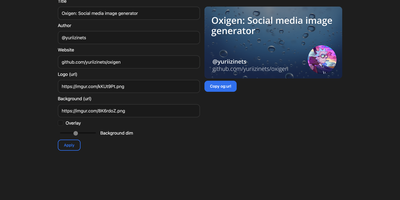
The social preview cards shown when links hit Twitter, LinkedIn, Slack, or Discord, generated on the fly: Oxigen is a small Go service for dynamic Open Graph images, no designer required per page. Instead of exporting static images per page, you compose a card once and drive it with parameters: title, author, website, logo, background image, and background dimming all arrive as URL query arguments, so your og:image meta tag simply points at the Oxigen endpoint with the page's own values substituted in. Every blog post, product page, and doc gets a branded, correctly sized preview generated on the fly. A built-in web UI covers interactive composition - tweak the text and imagery, watch the preview update, copy the resulting URL - while the same rendering path serves programmatic API use from static site generators, CMS templates, or build pipelines. Rendering is pure Go using the gg 2D graphics library, freetype fonts, and the imaging package, built on the kyoto framework by that project's author. Deployment is one stateless container on port 80 with no database and no external dependencies, so instances scale and restart freely.