ChurchCRM
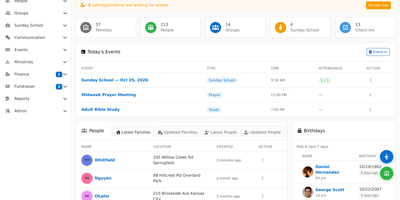
Church offices juggle member directories, giving records, event rosters, and volunteer schedules, and ChurchCRM, a free church management system, brings all of it into one browser-based workspace. Administrators keep a record for every person and family, with contact details, roles, notes, custom properties, and a timeline, while visitors submit a self-registration form that staff approve before it reaches the printed directory. Treasurers log donations against family pledge accounts, follow numbered giving envelopes and multi-year pledges, and batch gifts into deposit slips with printable bank forms. Ministry leaders organize teams, committees, Bible studies, and Sunday School rosters, then schedule volunteers into positions with substitutions and reminder email. Events can be one-time or recurring, appear on month, week, day, and list calendars beside birthdays and anniversaries, and collect attendance through kiosk tablets that alert parents by email or SMS. Members sign in to a portal to update their details, confirm their household, and check the church calendar and their volunteer schedule. A family map shows where households live and which ones are close by. Reports produce directories, mailing labels, birthday lists, financial statements, and custom queries, while CSV import, an Export Hub, and one-click database restore handle moving data. Role-based permissions and two-factor sign-in protect sensitive records, and plugins add MailChimp and Vonage SMS. Running on a dedicated VPS on RepoCloud with guaranteed CPU, RAM, and SSD, full root SSH access, and a browser serial console. MIT licensed.
Revel
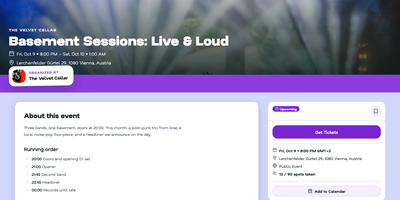
Yoga studios, comedy clubs, choirs, and bands use Revel to sell tickets, memberships, and season passes from their own server with no platform fee. Studios and clubs sell monthly or yearly memberships through Stripe and offer series passes that cover a class pack, a course, or a season, with wallet cards that a door scan verifies. Venues design seat maps with sectors, individual seats, and accessible seats, and buyers pick seats on an interactive map while the seats are held at checkout. Bands and DJs sell their own shows with no promoter in between, set pay-what-you-can tiers, open presales to invitation-link holders, and export every buyer's name and email. Communities that vet who comes screen requests with questionnaires reviewed automatically, manually, or both, and keep private guest lists, invitation-only events, and a fuzzy-matched blacklist. Buyers check out a multi-tier cart without an account, using discount codes and fixed-price, free, or pay-at-the-door tiers. Tickets arrive as QR PDFs or Apple Wallet and Google Wallet passes, and door staff check guests in by scanning. Organizers run waitlists with time-limited offers, announcements, reminders, and a Telegram bot for RSVPs and invitations. Revenue and VAT reports export as XLSX or PDF, and VIES checks buyer VAT IDs. The web app speaks English, German, Italian, French, Spanish, and Portuguese. Running on a dedicated VPS on RepoCloud with guaranteed CPU, RAM, and SSD, full root SSH access, and a browser serial console. MIT licensed.
Admidio
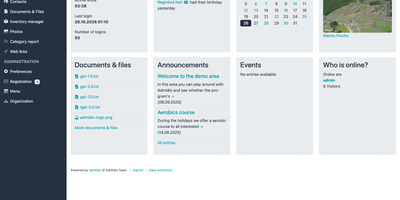
Admidio is membership management software for clubs, associations, and groups, built so that every permission follows from the roles a person holds. Organizers define roles such as board, youth team, or trainers, decide who may email or see each one, and grant module rights like managing events, editing contacts, or uploading photos with simple switches. Contact records use customizable profile fields, record relationships such as parent and child, and can be imported in bulk or exported as vCards. New members register online and administrators review each request. Events carry dates, venues, calendars, and participant lists with sign-up, and the schedule downloads as iCal. Messages go as HTML email to individuals, roles, or groups, and members also find announcements, a categorized forum, document folders with role-based access, and photo albums with e-cards. The inventory manager tracks equipment, who holds it, and its borrowing history. Optional two-factor login protects accounts, a change history can be switched on for every module, and single sign-on lets other applications authenticate against the member database. Twenty-five languages are included, the interface installs as a progressive web app, and sub-organizations can be managed from the same installation. Running on a dedicated VPS on RepoCloud with guaranteed CPU, RAM, and SSD, full root SSH access, and a browser serial console. GPL-2.0 licensed.