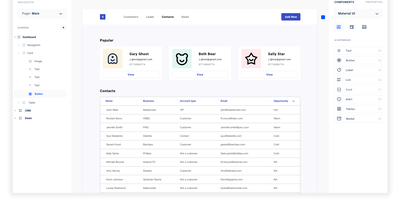
Budibase
Step right up to the magical world of Budibase, the open-source wizardry that turns the grueling task of building internal tools into a walk in the digital park. Imagine crafting mighty tools and formidable forms in less time than it takes to brew a cup of coffee, all without typing a single line of code! With Budibase, you can charm data from an ancient external database, summon information from a Rest API, conjure up figures from a CSV, or create something entirely new with Budibase's own mystical database. Design your digital dominion with a flick of the drag-and-drop, and automate your kingdom's workflows as if by magic. Join the ranks of the 75,000 teams who've harnessed the power of Budibase to accelerate their business quests. Need to safeguard data like a digital fortress, automate tasks like a sorcerer, or streamline operations like a high-speed chariot? Budibase is your trusty steed in the race to operational victory. And with RepoCloud hosting, you'll save a treasure chest of gold compared to those other cloud-dwelling giants!
Open Agent Builder
Open Agent Builder delivers a visual canvas for orchestrating AI agent workflows without writing Python scripts or managing complex codebases. The React Flow-powered drag-and-drop interface supports seven node types — Agent, Scraper, Transform, If/Else, Loop, User Approval, and MCP Tool — each configurable with provider-specific settings for Anthropic Claude (Haiku 4.5 and Sonnet 4.5), OpenAI GPT-5, Groq, or any OpenAI-compatible endpoint. The LangGraph orchestration engine handles state management, conditional routing, and human-in-the-loop approval gates while Firecrawl integration converts any website into structured, LLM-ready data through scrape, crawl, and map operations. E2B sandboxed code execution powers Transform nodes for secure data manipulation without risking host system integrity. Real-time streaming updates show execution progress node-by-node as workflows run, with Convex providing reactive database synchronization for workflow state and execution history. The TypeScript-first architecture (96.8% TypeScript) built on Next.js 16 App Router with Tailwind CSS delivers a responsive interface across devices. Clerk handles multi-user authentication with JWT integration for secure workspace isolation. Deploy via npm install and environment configuration with Firecrawl, Convex, and Clerk API keys. Running on a dedicated VPS on RepoCloud with guaranteed CPU, RAM, and SSD, full root SSH access, and a browser serial console. MIT licensed.
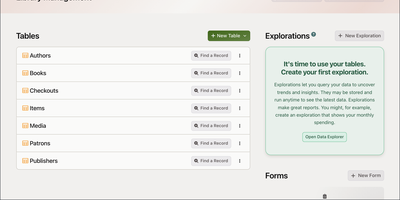
Mathesar
Mathesar puts a spreadsheet in front of your PostgreSQL database, letting anyone on the team browse, edit, filter, sort, and query tables without writing a line of SQL. Connect it to any existing PostgreSQL instance and immediately navigate schemas, tables, and records through an intuitive grid interface with inline editing, grouping, and summarization. The query builder joins tables across foreign key relationships, creates custom views with aggregations, and exports results to CSV. Rather than inventing its own permission layer, Mathesar maps each user or team to a native PostgreSQL role with granular schema-level and table-level privileges enforced at the database engine level, so there is never a gap between what the UI allows and what the database permits. Record summary templates display human-readable representations of linked records, making foreign key relationships immediately understandable instead of showing raw IDs. Import data from CSV files, create new tables and columns with proper PostgreSQL types including arrays, JSON, and custom domains, and modify schema structure through the web interface. Mathesar scales as well as the underlying PostgreSQL instance with no artificial limits on database size or complexity. Maintained by the Mathesar Foundation, a 501(c)(3) nonprofit, with a permanent commitment against vendor lock-in or licensing changes. Docker deployment connects to existing PostgreSQL instances or a bundled database in minutes. 5,000+ GitHub stars. GPL-3.0 licensed.
HeyForm
Typeform's conversational format, self-hosted: HeyForm is the open-source form builder that presents one question at a time. Forms present one question at a time, which measurably improves completion rates compared to long static pages. It supports 40+ field types, from text, email, and phone inputs to picture choices, date pickers, star ratings, signatures, and file uploads. Conditional logic shows or hides questions based on earlier answers, routes respondents to different endings, and redirects to URLs, so a single form can serve multiple flows. Completed submissions land in a results dashboard with drop-off and completion analytics, and connect outward through webhooks or integrations with Zapier, Make, Google Sheets, Notion, Airtable, and Slack. Theming covers fonts, colors, backgrounds, and custom CSS, so embedded forms look native to your site rather than like a third-party widget; the JavaScript embed library renders them inline, as popups, or full-page, with shareable standalone links as the default. Team workspaces and projects with member management let multiple teams share one instance without mixing data. Self-hosting removes per-response pricing entirely - unlimited forms and submissions for flat hosting cost - and keeps lead data, feedback, and quiz answers in your own MongoDB, simplifying GDPR compliance. The stack is a NestJS server and React webapp backed by MongoDB and KeyDB, distributed under GPLv3 as a Docker image.
Botpress
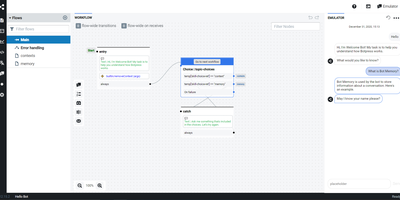
Build, deploy, and monitor chatbots and LLM-powered agents on one open-source conversational AI platform: Botpress. Its Studio is a visual development environment: a drag-and-drop canvas arranges conversation logic with nodes for messages, questions, choices, and actions, while a built-in emulator simulates conversations for debugging before anything goes live. Agents ground their answers in a knowledge base assembled from uploaded documents, ingested websites, and past conversations via retrieval-augmented generation, and the LLM layer connects to multiple model providers - GPT-4, Claude, Mistral - with a configurable model strategy. An autonomous engine handles reasoning, tool orchestration, persistent memory across sessions, and sandboxed code execution, and custom code actions in TypeScript extend agents past prebuilt workflows. Over 100 integrations deploy the same bot to WhatsApp, Telegram, Slack, Microsoft Teams, and web chat, and connect it to HubSpot, Zendesk, Zapier, and arbitrary APIs and webhooks. Human handoff, conversation analytics, and quality monitoring cover production operation. Originating in 2017 from a Montreal team, the community edition is developed openly on GitHub.
Tiledesk
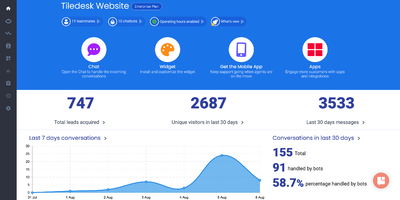
Tiledesk lets you build AI-powered conversational agents with a visual drag-and-drop designer, then deploy them simultaneously across web chat, WhatsApp, Telegram, Facebook Messenger, Instagram, email, and Slack without rebuilding per channel. The no-code Design Studio combines LLM-powered conversations with conditional logic, external API calls, and branching dialogue trees that work identically everywhere. Multi-RAG knowledge management separates content into isolated repositories with hybrid search combining traditional full-text retrieval and semantic understanding via Qdrant vector embeddings, enabling accurate answers even when users phrase queries in unexpected ways. LLM integration supports GPT-4, GPT-4o, Anthropic Claude, and any model exposing an OpenAI-compatible API including locally hosted models via Ollama for complete data sovereignty. The human-in-the-loop system provides seamless escalation from AI agents to live support staff with full conversation context preserved, while multi-agent workflows enable complex orchestration where specialized bots collaborate on different aspects of a customer interaction. REST and MQTT APIs power integration with external systems and webhook-triggered automations, and pre-designed templates accelerate common scenarios. Docker Compose deployment starts the full stack including server, dashboard, messaging engine, and widget. Running on a dedicated VPS on RepoCloud with guaranteed CPU, RAM, and SSD, full root SSH access, and a browser serial console. MIT licensed.
Fynt
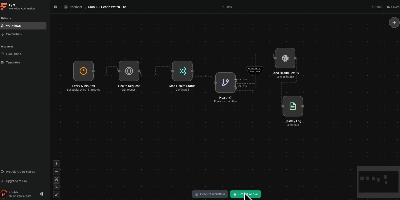
A clean alternative to n8n and Zapier that puts AI-native workflows front and center, Fynt is the MIT-licensed workflow automation platform where you drag nodes onto a React Flow canvas, wire them together with typed connections, and let a distributed BullMQ engine execute them — with every step streamed live to your browser over WebSockets so you never wonder what happened inside a run. The node library spans triggers (manual, webhook, cron scheduling), AI providers (OpenAI, Anthropic, and Gemini with structured output parsing), service integrations (GitHub webhooks, Notion databases, Slack channels, Discord bots, arbitrary HTTP endpoints), logic gates (conditional branching, filtering, data transformation), and utility nodes (delay, logging, payload mapping). The execution architecture separates concerns across three services: a Next.js 16 web application serving the React 19 workflow builder and tRPC API, a BullMQ worker processing jobs with node-level retries and checkpointing for crash-safe execution, and a dedicated WebSocket relay server broadcasting real-time run events via Redis Pub/Sub. All stored credentials are encrypted at rest using AES-256-GCM with per-credential initialization vectors. The full-stack deploys as a single Docker Compose stack (web, worker, realtime, PostgreSQL, Redis) or individually via pnpm workspaces in a Turborepo monorepo. Authentication is handled through better-auth with configurable OAuth providers. Running on a dedicated VPS on RepoCloud with guaranteed CPU, RAM, and SSD, full root SSH access, and a browser serial console. MIT licensed.
Dialoqbase
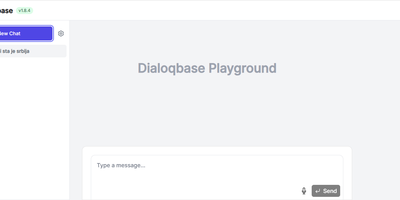
Retrieval-augmented chatbots on your own knowledge base - that is the whole mission of Dialoqbase, an open-source bot-building platform. Feed it content through a broad set of data loaders - web pages and full crawls, sitemaps, PDFs, DOCX, CSV, plain text, GitHub repositories, YouTube videos, and MP3/MP4 audio - and it handles the whole RAG pipeline in one self-contained app: chunking, embedding, vector storage, and LLM querying. The distinguishing architecture choice is PostgreSQL with pgvector for embedding storage and similarity search, which removes the separate vector-database dependency, and Redis-backed Bull queues for ingesting large documents without blocking the API. Model choice is wide open: OpenAI, Anthropic Claude, Google Gemini, Cohere, Fireworks, Hugging Face, local models via Ollama, and any OpenAI-compatible endpoint, with an equally broad list of embedding providers. Finished bots embed on any website with customizable styling or deploy to Telegram, Discord, and WhatsApp, and an API creates and manages bots programmatically. Multi-user support adds registration limits and per-user bot quotas. MIT-licensed and free for commercial use.