Excalidraw
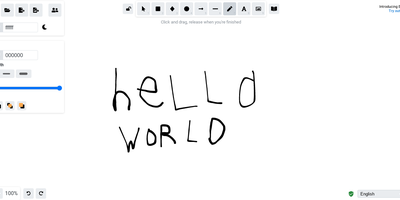
Half the architecture sketches on the internet trace back to Excalidraw - the MIT-licensed virtual whiteboard whose hand-drawn aesthetic made technical diagramming feel approachable, at roughly 85,000 GitHub stars. The infinite canvas offers rectangles, ellipses, diamonds, arrows with smart binding and labels, free-draw, text, images, and an eraser, with full undo/redo, zoom, dark mode, and keyboard-first ergonomics. Community shape libraries add thousands of pre-built elements - AWS architecture icons, flowchart stencils, UI wireframe kits - and everything exports to PNG, SVG, the clipboard, or the open .excalidraw JSON format that keeps drawings diffable and portable. Live collaboration works on a share-a-link model with live cursors and a laser pointer for presenting, and it is end-to-end encrypted by design: the room key travels in the URL hash, which never reaches the server, so the WebSocket relay only ever sees ciphertext. The architecture is remarkably light - the app is a static bundle served by Nginx, drawings persist locally in the browser, and the stateless excalidraw-room relay handles multiplayer - so a self-hosted deployment gives unlimited boards and collaborators with near-zero resource cost, replacing per-editor whiteboard subscriptions.
Carbone
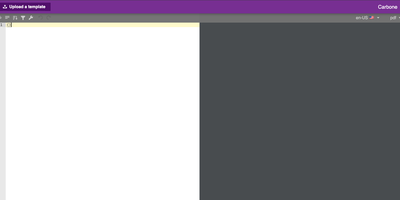
Document-generation code is the worst kind of code in your backlog - Carbone kills it. Its insight is separating design from data - templates are ordinary office documents (DOCX, ODT, XLSX, PPTX, HTML, even custom XML) built in LibreOffice, Microsoft Office, or Google Docs, with mustache-like markers such as {d.companyName} typed directly into the text. Send a template plus JSON from your existing APIs to the HTTP API, and Carbone returns the finished document - exported as-is or converted to PDF, XLSX, CSV, HTML, PNG, EPUB, and more via its integrated LibreOffice converter (Chromium and OnlyOffice engines are also supported for HTML-fidelity and office-format conversions). The template language goes well beyond substitution: loops over arrays render dynamic table rows, filters and aggregations run inside the document, and built-in formatters handle dates, numbers, currencies, timezones, and locales, with custom JavaScript formatters when needed. One template serves multiple languages through translation markers with auto-maintained translation files. The XML-agnostic engine means anything your document editor can design - pagination, headers, footers, nested tables, charts - survives generation intact, and Carbone guarantees no breaking changes in template syntax. Node.js-based, fast via multi-threaded LibreOffice conversion. The invoices, contracts, and reports your product owes its users become template edits, not sprints.
Web-Check
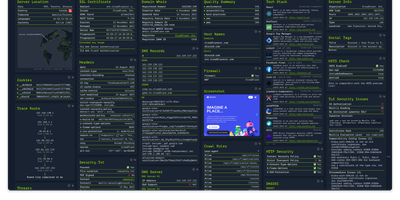
Enter a URL and get a dashboard of everything publicly discoverable about its security posture, server architecture, and technology stack: Web-Check is an all-in-one OSINT tool for analyzing any website. One scan surfaces IP info and server location, the full SSL certificate chain with issuing authority and validity, DNS records (A, MX, NS, CNAME, TXT) with DNSSEC status, HTTP response headers interpreted for security directives like HSTS, CSP, and X-Frame-Options, cookies and their flags, WHOIS domain info, robots.txt crawl rules, a sitemap-derived page map, the redirect ledger, open ports, traceroute, detected technologies, third-party trackers, associated hostnames, site performance, and even carbon footprint. Each card explains what the data means and why it matters, which makes the tool double as a security education resource - junior engineers learn headers and attack surfaces by scanning real sites. Practical uses span pre-deployment security audits (catch missing headers and misconfigurations before they ship), privacy compliance checks (identify trackers and cookie behavior for GDPR work), competitive tech-stack research, and network debugging via DNS and redirect inspection. Built by Lissy93 in TypeScript, it deploys as a single Docker container, and self-hosting keeps your reconnaissance targets and audit activity off third-party services.
Corteza
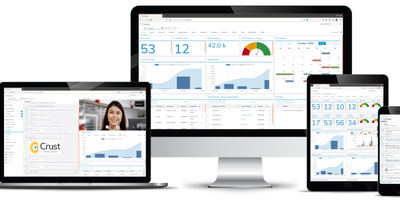
Salesforce's platform model, 100% open-source (Apache 2.0): Corteza is a Go/Vue.js low-code platform developed under a foundation, so there is no open-core bait to grow out of. The heart is Corteza Compose: namespaces contain applications, modules define record structures the way Salesforce objects do, and a drag-and-drop page builder assembles record pages, list pages, dashboards, and charts from configurable blocks. Automation comes from a visual, BPMN-style workflow engine plus JavaScript automation scripts, so cross-application business logic - approval chains, field updates, notifications - is configured rather than programmed. Granular role-based permissions reach down to individual modules, fields, and records, mirroring real organizational hierarchies. Corteza CRM ships as the flagship application built entirely on Compose: leads, accounts, opportunities, campaigns, and cases with a 360-degree customer view, covering most Salesforce standard objects - and because it is just a Compose app, adding or reshaping modules is configuration, not a fork. Everything is reachable over REST APIs, deliberately familiar tooling eases Salesforce admin migration, and a CLI can even generate synthetic records for load-testing what you build.
KeeWeb
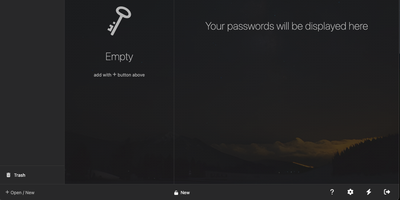
Your KeePass vaults, opened from any browser: KeeWeb reads, edits, and creates standard KDBX files, so it works with the same databases as KeePass and KeePassXC without conversion or lock-in. Self-hosting the web app gives you a password manager reachable from any modern browser, including mobile, with no client installation and no third-party cloud in the loop. All KDBX cryptography runs client-side; the server just serves the static app. Open multiple vault files simultaneously and search them all from one box, with advanced options covering specific fields, password history, and regular expressions. Vaults load from local files, your own server (WebDAV), or Dropbox, Google Drive, and OneDrive, with automatic sync - and files are cached for offline use, so a dropped connection never locks you out; changes resync once you're back online. Day-to-day niceties include a configurable password generator, protected fields that stay masked and are held in memory more defensively, entry history, tags with easy input, drag-and-drop attachments, and per-entry icons with favicon fetching. The optional KeeWeb Connect extension (Chrome, Firefox, Edge, Safari) autofills credentials using the keepassxc-protocol. MIT-licensed with matching desktop apps for macOS, Windows, and Linux.
Element
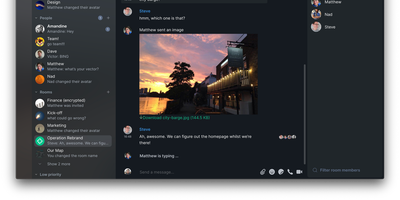
Matrix's flagship client, built by the protocol's creators: Element brings the decentralized open standard for real-time communication to web, desktop, iOS, and Android. Paired with a Matrix homeserver, it delivers Slack-quality team messaging where you own every message, file, encryption key, and byte of metadata. End-to-end encryption is on by default, built on Olm and Megolm - the Double Ratchet algorithm family Signal popularized, extended for large-room scalability and publicly audited by NCC Group. Messages encrypt per-device with cross-signed device verification, so even a compromised server yields nothing readable. Federation is the defining capability: like email, users on different homeservers converse seamlessly, and 30+ bridges connect Matrix rooms to Slack, Discord, WhatsApp, and Telegram, so moving to sovereign infrastructure doesn't sever contact with anyone. Rooms support threads, reactions, file sharing, and voice and video calls via Element Call. The result is digital sovereignty chosen by governments and enterprises across Europe: your data sits on your server in your jurisdiction, portable to any other Matrix host because the protocol is an open standard. Apache-2.0 licensed, with no per-user fees at any scale.
UptimeKuma
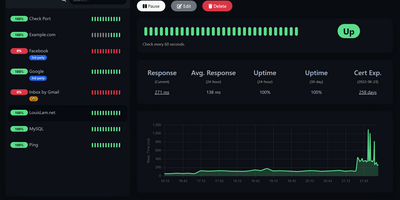
Sixty-thousand-plus GitHub stars make Uptime Kuma the most popular self-hosted monitoring tool - MIT-licensed, Node.js, and the standard replacement for UptimeRobot, Pingdom, and Freshping. It watches a dozen monitor types: HTTP(S) endpoints with keyword and JSON-query content validation, TCP ports, ICMP ping, DNS records, WebSockets, Docker containers via the socket, Steam game servers, MQTT brokers, gRPC services, and push-based heartbeats for cron jobs and internal workers. Checks run at intervals as tight as 20 seconds - versus UptimeRobot's 5-minute free tier - with unlimited monitors and unlimited data retention. When something fails, alerts fan out through 90+ notification channels: Slack, Discord, Telegram, email with LiquidJS templating, PagerDuty, OpsGenie, ntfy, Gotify, Matrix, and dozens more via native providers plus the Apprise library. Unlimited public or password-protected status pages - mappable to specific domains and organized into monitor groups - communicate health to customers, with maintenance windows that suppress alerts during planned work. The reactive dashboard graphs response times, tracks SSL certificate expiry with advance warnings, supports proxies and 2FA, and ships in dozens of languages. One Docker container with a SQLite volume covers an entire infrastructure.
Mealie
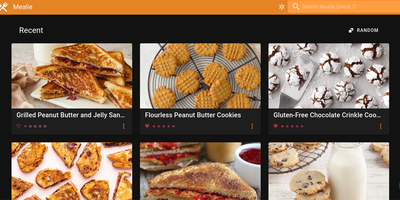
A recipe manager that feels like a consumer product rather than a homelab experiment: Mealie pairs a FastAPI backend with a reactive Vue frontend for the most polished self-hosted meal planning around. The killer feature is the recipe scraper: paste a URL from hundreds of supported cooking sites and Mealie imports the ingredients, steps, times, and photos automatically. Structured HTML/JSON paste, a Markdown-capable manual editor, and imports from other recipe apps (like Tandoor) cover everything else. Meal planning uses a drag-and-drop calendar with breakfast, lunch, dinner, and snack slots, plus rule-based random recipe insertion - constrain the pool by tags or categories per meal type or weekday. Shopping lists link recipes so all ingredients land in one place, organized into supermarket sections, and update in real time for everyone in the household. The multi-tenancy model is genuinely thought through: isolated Groups can host multiple tenants, and Households within a group share recipes and organizers while keeping meal plans and shopping lists private. Cookbooks group recipes by your own criteria, a cooking mode stays readable on a phone propped against the backsplash, and 35+ language translations ship built-in. A fully documented REST API and scheduled webhooks (e.g., today's meal plan to Home Assistant) make it automatable, with SQLite or PostgreSQL storage and automatic backups.

PeerTube
The fediverse's answer to YouTube comes from French non-profit Framasoft: PeerTube is a TypeScript/Angular video platform where hundreds of independently operated instances federate over ActivityPub into one network. Videos you publish are discoverable across the whole video fediverse, and viewers can follow your channels from Mastodon or any ActivityPub platform - or plain RSS - without needing an account on your instance. The namesake innovation attacks video hosting's core cost problem: alongside HLS delivery, an optional WebRTC-based P2P layer lets concurrent viewers' browsers share video segments with each other, so a video going viral distributes its own bandwidth demand instead of crushing your server; instance redundancy extends this by letting friendly instances cache each other's videos. Livestreaming is first-class - stream via OBS or any RTMP software, host permanent streams, enable replays, and interact through live chat. Creators get channels, playlists, analytics, built-in video editing (trim, watermark), and an embeddable player for any website. There are no ads, no data mining, and no recommendation algorithm engineered for watch-time - the project's explicit design stance. Admins control federation policy, P2P settings, and theming; a plugin system extends the rest. AGPL-licensed, 300+ contributors, in active development since 2015.
Apprise-API
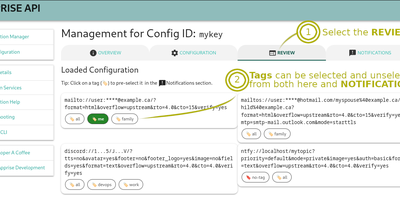
One REST call, 130+ notification services: Apprise API wraps the well-known Apprise library in a lightweight Django/Gunicorn microservice, so "send an alert" works the same whether it goes to Slack, Discord, Telegram, Teams, email, SMS, Pushover, or PagerDuty - each addressed by a simple URL scheme. It solves the credential-sprawl problem cleanly: instead of embedding provider tokens in every app, cron job, and CI pipeline, you centralize them here and everything else just POSTs a body and title. Two modes cover every workflow. Stateless calls to /notify carry target URLs in the payload (or fall back to a default set via APPRISE_STATELESS_URLS); stateful mode stores named configurations server-side under keys, so /notify/{KEY} fans out to everything registered - with tag-based routing (comma for OR, space for AND) selecting which endpoints fire per message. Messages take info, success, warning, or failure types in text, Markdown, or HTML, with attachments up to a configurable size. A built-in web UI manages and tests configurations, APPRISE_CONFIG_LOCK makes the store read-only, service allow/deny lists restrict which schemes work, webhook remapping adapts third-party payloads, and a Prometheus /metrics endpoint watches the gateway itself.
Flatnotes
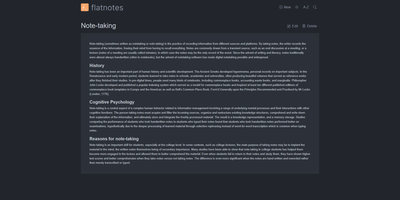
A web interface for a folder of Markdown files - Flatnotes is exactly that, and the discipline of that design is why people love it. Every note is a plain .md file in a single flat directory: no database, no proprietary format, no hierarchy to maintain, no export step if you ever leave. Edit notes in the browser or open the same files in VS Code or Obsidian, sync them with Syncthing or rsync while the app is running - the Whoosh-powered search index synchronizes incrementally, so external edits just show up. The interface is a clean Vue.js app with both WYSIWYG and raw Markdown editing modes (TOAST UI Editor), instant full-text search behind the "/" shortcut with partial-match support, wikilinks for cross-note references, and automatic tag extraction from #hashtags in note bodies. Light and dark themes and a mobile-responsive layout make it pleasant everywhere. Authentication is flexible for a personal tool: none, read-only, username/password, or TOTP two-factor. A documented REST API covers create/read/update/delete for automation. The operational story is the quiet selling point - the only state is the notes folder and a rebuildable index, so backup is copying a directory. For a personal notepad that respects your data, Flatnotes nails minimal.
Gotify
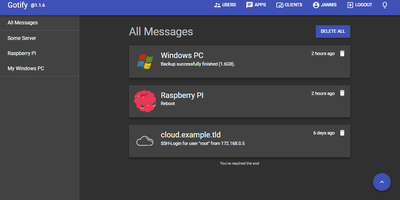
Real-time alerts from your own infrastructure to your phone, with no Firebase, Pushover, or third-party push service in the path: Gotify is a simple, self-hosted notification server written in Go. The model is deliberately minimal: senders push messages with a single HTTP POST to the REST API, receivers subscribe over a WebSocket stream, and a clean React web UI manages the pieces. Senders are namespaced as "applications," each with its own token, so your backup script, Uptime Kuma, CI pipeline, and cron jobs each get an identity, an icon, and independently revocable credentials - centralized alerting from many services with per-source management. Messages carry a title, body, and priority level that maps to notification importance on the client. The official Android app (on both F-Droid and Google Play, notable for working entirely without Google Play Services) shows push notifications for new messages; the web UI itself supports Web Push in the browser; and gotify/cli pushes messages from shell scripts with one command. A server-side plugin system adds custom behavior, and the whole thing runs as a single small binary with SQLite by default - near-zero resource footprint. Because dozens of tools (and Apprise) speak Gotify natively, it slots in as the notification hub for an entire homelab or ops stack.

LubeLogger
Vehicle maintenance records shouldn't live in a homemade spreadsheet and a shoebox of receipts - LubeLogger exists because of exactly that. It's a self-hosted .NET web application (from Hargata Softworks) that gives every vehicle in your garage a complete digital history: service, repair, and upgrade records categorized and searchable, with invoices and receipts attached as documents; fuel fill-ups that compute economy in MPG, UK MPG, L/100KM, or KM/L without spreadsheet tedium; taxes, odometer logs, inspections, equipment, and supplies inventory for tracking the parts and fluids on your shelf. The reminder system is what saves engines: recurring reminders trigger by date, odometer reading, or whichever comes first - exactly how real service intervals work - so oil changes and timing belts stop relying on memory. A dashboard summarizes expenses by year, month, and category, a planner tracks to-dos by type, priority, and progress, and professional vehicle reports print a full history - genuinely useful when selling a car. Collaboration is built in: invite household members as collaborators on shared vehicles, with single sign-on support. Custom fields adapt records to your needs, CSV import/export moves data freely, an API enables automation, and the mobile-tested UI installs as a PWA on iOS and Android. MIT-licensed.
Change Detection
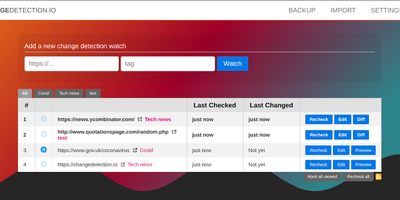
Price drops, restocks, job postings, government announcements, competitor edits - changedetection.io watches web pages and alerts you the moment anything changes, down to PDF text and checksums. Point it at a URL, set a check interval, and precise filters decide what counts as a change: a Visual Selector targets page elements by pointing and clicking, CSS selectors and XPath narrow scope, trigger-text and ignore-text rules (with regex support) cut noise, and JSONPath or jq handles API responses. A dedicated re-stock and price detection mode extracts product metadata and fires on thresholds - alert only when the price drops below your target or the percentage change exceeds a limit. JavaScript-heavy sites render through a real Chrome browser via Playwright, with the ability to execute JS steps first (log in, click, scroll) before extracting text. Notifications reach 85+ services through Apprise - Discord, Slack, Telegram, email, webhooks - optionally with a screenshot of the changed page, and AI-powered summaries (any OpenAI-compatible endpoint, including local Ollama) describe what changed. Per-watch proxies, custom headers, and POST/GET control cover hostile targets. Apache-2.0 licensed with local file-based storage: the URLs you monitor and why stay entirely your business.
Whiteboard
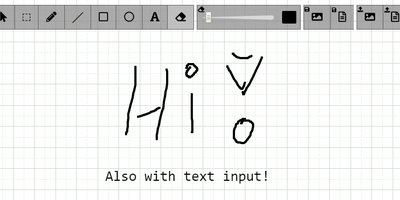
The drawing surface inside WebRTC conference tools like Meetzi and the LAMS online-learning platform is Whiteboard (by cracker0dks) - a lightweight Node.js collaborative sketchboard built to be embedded and customized, which also slots into Nextcloud via the External Sites app. Everyone opening the same whiteboardid URL parameter draws on the same board, with remote user cursors visible live, per-user undo/redo, and an indicator showing the smallest participating screen so nobody draws outside a colleague's view. Content handling goes beyond pen strokes: drag-and-drop or paste images and PDFs from any PC or browser, then resize, rotate, and draw over them on canvas or background; add text and sticky notes; hold Shift for angle-snapped lines and perfect squares. Every function has a keybinding - deliberately friendly to pen displays like Wacom and XP-Pen whose hardware buttons map to shortcuts. Boards save to image or JSON (with reload), export directly to Nextcloud via WebDAV, and persist across restarts with the file-database option. A REST API with bundled interactive docs allows full programmatic control, an optional access token locks down uploads, and YAML configuration tunes behavior and performance. MIT-licensed and reverse-proxy friendly.
Radarr
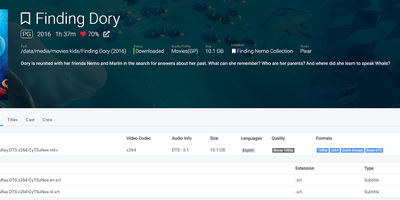
The movie half of the *arr stack: Radarr is a .NET collection manager that automates acquiring films for Usenet and BitTorrent users the way Sonarr does for TV. Add a movie once and Radarr handles the rest: it monitors indexers and RSS feeds, grabs a matching release the moment one appears, sends it to SABnzbd, NZBGet, qBittorrent, Deluge, Transmission, rTorrent, or another connected download client, then imports, sorts, and renames the file into your library structure. Quality profiles are the control surface - define allowed resolutions and a cutoff, and Radarr keeps upgrading files automatically, replacing a DVD rip when a Blu-ray release lands. Custom formats go further, scoring releases by codec, HDR metadata, release group, streaming source, or arbitrary regex so the copy you want always wins the pick. Failed downloads retry with another release automatically; a manual search shows every candidate and explains why one was skipped. Release parsing recognizes director's cuts, special editions, AKA titles, and hardcoded subs. Plex and Kodi integration handles notifications, library refreshes, and metadata like posters, trailers, and subtitles, and a calendar view tracks upcoming releases. It pairs naturally with Jellyseerr for request management and shares its API conventions with the whole *arr ecosystem.
It Tools
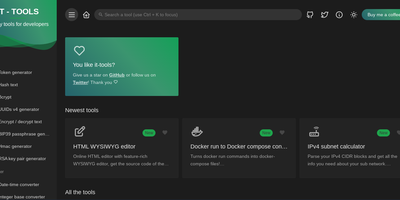
The utilities engineers otherwise scatter across a dozen ad-laden websites - 80+ of them - live together in IT-Tools, one fast, polished web app. Crypto covers JWT decoding, MD5 through SHA-512 hashing, HMAC and bcrypt generation, RSA key pairs, and password strength analysis. Converters handle JSON to CSV, YAML, and TOML, Base64 files, URL encoding, HTML entities, color formats, and Docker run commands to Compose files. Generators produce UUIDv4, ULID, BIP39 mnemonics, QR codes (including Wi-Fi QR), and tokens; text tools include a regex tester, diff viewer, slug and case converters; web utilities parse URLs and user agents, look up HTTP status codes and MIME types, and inspect Open Graph metadata; plus a cron parser, chmod calculator, and more. The privacy argument is the point: JWTs contain user IDs, hashes derive from passwords, JSON dumps hold PII - exactly the inputs you least want a third-party utility site to log. IT-Tools is a frontend-only static bundle (Vue/TypeScript, GPL-3.0, 39k+ GitHub stars) served by Nginx in one container, so everything runs client-side on your infrastructure with nothing transmitted anywhere. New tools ship roughly monthly, and a scaffolding script makes adding custom ones straightforward.
Milvus
With over 45,000 GitHub stars and 100 million Docker pulls, Milvus is the most widely adopted open-source vector database, powering production AI systems at NVIDIA, Salesforce, eBay, Airbnb, and DoorDash. The distributed architecture separates compute and storage with stateless microservices on Kubernetes, horizontally scaling query nodes for read-heavy workloads and data nodes for write-heavy ingestion independently. Milvus 3.0 introduces lake-native retrieval that builds and serves indexes directly over vector data in object storage and open formats including Parquet, Lance, Iceberg, and Vortex without maintaining separate copies. Native hybrid search unifies lexical BM25 full-text retrieval and semantic vector search in a single engine with metadata filtering, eliminating the need for separate search infrastructure. Hardware-accelerated ANN indexing supports IVF, HNSW, DiskANN, and GPU-based indexes with BitQ 1-bit quantization cutting memory usage by 72 percent. SDKs for Python, Go, Node.js, and Java provide programmatic access, while Milvus Lite offers lightweight embedding for local development via pip install. Server-side aggregation, sorting, faceted search, StructArray for nested document structures, and ColBERT multi-vector scoring move ranking and result processing into the engine. The Path Index enables 100x faster JSON filtering with support for 100,000+ collections per cluster for multi-tenant deployments. Self-hosting deploys via Docker Standalone or Kubernetes with Helm charts using S3-compatible, GCS, or Azure Blob storage backends. Running on a dedicated VPS on RepoCloud with guaranteed CPU, RAM, and SSD, full root SSH access, and a browser serial console. Apache 2.0 licensed.