
OpenSquilla
Claiming 60-80% token cost reduction compared to flat single-model deployments and backed by 6,500+ GitHub stars, OpenSquilla delivers an intelligent AI agent runtime where a local ML classifier evaluates every turn on message length, code blocks, keyword patterns, and semantic embeddings before routing it to the optimal model tier from C0 through C3. The pluggable provider layer connects natively to TokenRhythm, OpenRouter, OpenAI, Anthropic, Ollama, DeepSeek, Gemini, DashScope, Moonshot, Mistral, Groq, Zhipu, SiliconFlow, vLLM, LM Studio, and additional compatible backends with primary-plus-fallback selection. The four-tier cognitive memory architecture spans working, episodic, semantic, and raw layers with vector-semantic and BM25 retrieval powered by on-device ONNX embeddings that never leave your infrastructure. Security isolation operates at the syscall level via Bubblewrap on Linux and Seatbelt on macOS, complemented by policy-based execution controls and prompt injection protections. The unified TurnRunner executes identically across the Vue-based control console Web UI, terminal CLI, and chat channel integrations including Slack and Discord, ensuring consistent tool dispatch, retry logic, and decision logging regardless of entry point. Built-in skills cover deep research, multi-search-engine queries, document generation for DOCX, PPTX, XLSX, and PDF formats, GitHub integration, cron scheduling, and bounded subagent delegation. Per-agent workspaces with durable session storage provide transcript replay, context state management, and per-call cost tracking with automatic quota enforcement. Running on a dedicated VPS on RepoCloud with guaranteed CPU, RAM, and SSD, full root SSH access, and a browser serial console. Apache-2.0 licensed.
Elmo
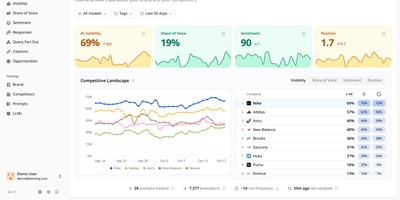
Tracking how ChatGPT, Claude, Gemini, Perplexity, and Google's AI answers talk about your brand, Elmo gives you a self-hosted dashboard for measuring and improving your AI search visibility. A setup wizard reads your website and suggests keywords, competitors, buyer personas, and tracking prompts. Behind the scenes, a worker reruns every tracked prompt on a schedule against the engines you connect, using scraping providers such as BrightData, Oxylabs, or SearchApi for real consumer experiences, or direct OpenAI, Anthropic, Mistral, and OpenRouter APIs. Each run feeds visibility scores per prompt and per model, mention tracking across names, aliases, and domains, sentiment from positive to negative, and each company's position in the answer. The Responses page filters answers by model, tag, prompt, or sentiment and highlights the passage behind each judgment. Citation analysis sorts cited URLs into your domains, competitors, social media, Google properties, and institutional sources. A share-of-voice leaderboard ranks competitors against you over time. Query fan-out shows the web searches engines ran before answering. Opportunities turns the numbers into a prioritized list of content to create, pitch, and seed. Shareable reports reach stakeholders without an account, and a REST API with TypeScript and Python SDKs plus an MCP server lets coding agents query the data. Raw engine output stays in your own database for later audit. Running on a dedicated VPS on RepoCloud with guaranteed CPU, RAM, and SSD, full root SSH access, and a browser serial console. MIT licensed.
OneGlanse
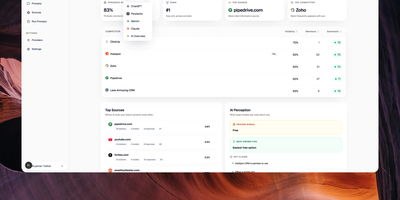
OneGlanse tracks how ChatGPT, Perplexity, Gemini, Claude, and Google AI Overview mention, rank, and recommend your brand, using the same product interfaces your customers actually see. You add your brand, competitors, and the questions buyers ask, then start prompt runs against one AI product or all five in a single pass. Every run stores the complete answer text together with the citations and source domains the answer relied on, so you can open any response later and read exactly what was said. A model you connect with your own OpenAI or Anthropic key reads each saved answer and records mentions, ranking position, sentiment, and recommendation strength. The dashboard rolls those readings up into presence rate, average rank, top source, and top competitor views that update as new runs land. Competitor tables show which rival brands appear beside you, how often they show up, and how their sentiment compares across providers. Source reports rank the publishers and pages that AI answers cite most, down to citation share per domain. Perception panels collect the claims, pricing language, and strengths that answers repeat about your brand. Self-hosted deployments schedule recurring runs, transfer your signed-in provider sessions to the server, and keep prompts, answers, and scores in your own database. Running on a dedicated VPS on RepoCloud with guaranteed CPU, RAM, and SSD, full root SSH access, and a browser serial console. MIT licensed.
LiteLLM
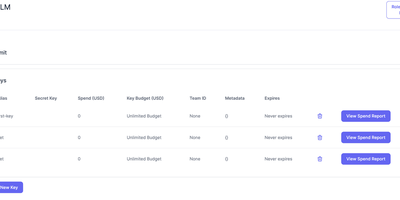
Backed by 56,000+ GitHub stars and over 240 million Docker pulls, LiteLLM delivers the open-source AI gateway trusted by Netflix, Lemonade, Rocket Money, and thousands of engineering teams to route every LLM request through one unified API. The Rust-core gateway adds sub-millisecond overhead per request with 8ms P95 latency at 1,000 RPS, 15x throughput improvement and 11x lower memory footprint compared to Python-only proxies. A single OpenAI-compatible endpoint connects to 100+ providers and 1,800+ models spanning OpenAI, Anthropic, Google Gemini, AWS Bedrock, Azure OpenAI, Vertex AI, Hugging Face, vLLM, Nvidia NIM, Ollama, and Mistral with day-zero support for new model releases. The Auto Router V2 classifies request complexity across four tiers using rule-based scoring, semantic keyword matching, and adaptive Thompson sampling to route each request to the most cost-effective model without API calls or training data. Virtual API keys enable multi-tenant governance with per-team, per-user, and per-project cost tracking, budget caps with automatic fallback rerouting, and role-based access control. Built-in guardrails provide PII masking, prompt injection detection, and model-graded evaluation before requests reach providers. The Agent Gateway extends routing from model calls to agent workflows with MCP server integration. Observability integrates with Langfuse, Arize Phoenix, OpenTelemetry, and MLflow for complete request tracing. Running on a dedicated VPS on RepoCloud with guaranteed CPU, RAM, and SSD, full root SSH access, and a browser serial console. MIT licensed.
OpenOps
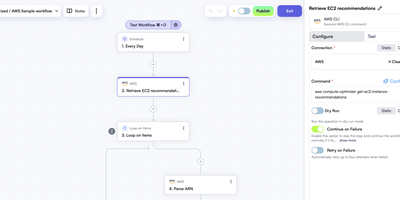
Cloud cost dashboards show what is being wasted; OpenOps is the no-code FinOps platform that acts on it, finding idle resources, asking the right owner for approval, and cleaning up once someone clicks yes. A visual editor starts each workflow from a schedule, cron expression, webhook, new Jira or Linear issue, or incoming email, and chains 120+ actions covering AWS, Azure, and Google Cloud operations, loops, conditions, delays, and code steps. Approval requests arrive as buttons in Slack or Microsoft Teams, or as approve and reject links by email, and the workflow waits for the answer before branching. Connectors for CloudHealth, Cloudability, Vantage, Finout, Flexera, and Umbrella feed in recommendations and anomalies. The template catalog ships with workflows for idle resource cleanup and rightsizing across AWS, Azure, and Google Cloud, and a free OpenOps Cloud account extends it. Findings land in built-in Tables where they can be approved, dismissed, marked as false positives, or snoozed. Analytics turns those tables, CSV files, Google Sheets, or Postgres data into dashboards. Test any step against live systems or sample data, inspect every run, and track changes in version history. Bring your own LLM key to generate CLI commands, SQL queries, and code right in the editor. Running on a dedicated VPS on RepoCloud with guaranteed CPU, RAM, and SSD, full root SSH access, and a browser serial console. Apache-2.0 licensed.
Immich Upload Optimizer
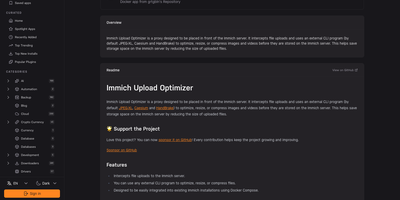
Immich Upload Optimizer shrinks every photo and video at the moment of upload, so a self-hosted Immich library stops growing faster than the disk beneath it. The proxy sits in front of your Immich server and receives uploads first, matching each file by extension against a task list you define in a YAML file. Images pass through JPEG-XL or Caesium command line tools for lossless optimization by default, preserving every pixel of the original capture. Owners who prefer smaller files can switch a task to lossy settings that cut image size dramatically at the same perceived quality. Video conversion ships disabled because lossless transcoding rarely wins space, and owners can enable HandBrake profiles for lossy conversion with strong savings. Tasks run in sequence with fallback: the first matching command that succeeds supplies the stored file, and an upload with no matching task is refused rather than stored unprocessed. Long conversions keep working in the background after a client disconnects, and the processed file still reaches Immich. Deployment adds one service to an existing Docker Compose stack, points clients at the proxy port, and removes the direct public port from the Immich server itself. Running on a dedicated VPS on RepoCloud with guaranteed CPU, RAM, and SSD, full root SSH access, and a browser serial console. MIT licensed.
Flyimg
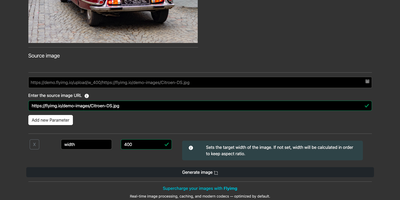
Flyimg generates every image size a website needs at request time, turning one original into resized, cropped, and compressed variants through a simple URL. Append options like width, height, crop, and quality to a request, and the service fetches the source image, transforms it, and serves the result, storing it in cache so the next request is answered instantly. Output defaults to AVIF for browsers that support it, with WebP and MozJPEG compression available for lean JPEG delivery, plus PNG and GIF when the source calls for them. Signed URLs keep strangers from using your server as a free image proxy, and domain restrictions limit which sources the service will fetch from. One Docker container gives a website or application a complete image pipeline: originals stay in whatever storage already holds them, and every thumbnail, banner, and product shot is produced at request time in exactly the dimensions the layout needs. Cache headers and repeat serving keep bandwidth costs predictable as traffic grows. Running on a dedicated VPS on RepoCloud with guaranteed CPU, RAM, and SSD, full root SSH access, and a browser serial console. AGPL-3.0 licensed.
AsoBeast
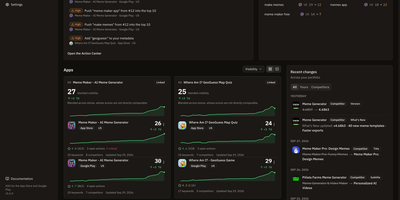
AsoBeast keeps score of your app in the App Store and Google Play, so you always know which keywords you rank for, which ones moved, and what to fix next. Paste a store URL and tracking starts on import: rankings are checked daily in your home storefront and any other market you add, and every keyword is scored for popularity, difficulty, and opportunity so you can tell a winnable term from a vanity one. The dashboard leads with your keywords in the top 10, this week's movement, and an Action Center that turns the data into specific moves, like defending a keyword where two new rivals just entered the top 10, with the reason and the fix spelled out beside each item. Competitor listings are diffed over time, so a rival's new title, subtitle, version, or release notes show up as a before-and-after entry instead of a surprise. Metadata snapshots keep the raw store payload, localization and keyword field analysis shows wasted words, reviews feed the audit score, and the same data is exposed to your AI tools through the built-in MCP server. Registration closes itself once your owner account exists, and store requests run from your own server. Running on a dedicated VPS on RepoCloud with guaranteed CPU, RAM, and SSD, full root SSH access, and a browser serial console. AGPL-3.0 licensed.
Openinary
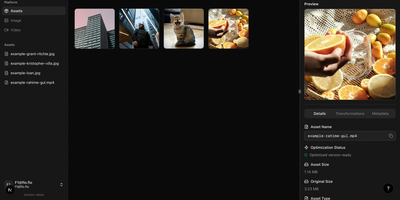
Your product photos, tutorial clips, and user uploads can live on your own server with Openinary, a media platform that resizes, crops, converts, and delivers images and videos through simple URL parameters. Request a variant by editing the address: set width and height, fill-crop around a detected face, convert to AVIF or WebP, trim a video between two timestamps, or pull a thumbnail from the fifth second. Uploads land in S3-compatible storage you control, from AWS S3 and Cloudflare R2 to MinIO, and repeat requests are served from automatic caching instead of reprocessing the original. The admin dashboard keeps assets organized for browsing, searching, and reviewing what your applications actually serve. API keys gate programmatic uploads, so a web app, mobile backend, or build script can publish media without sharing storage credentials. Setup runs through a scaffolding command that writes the Compose file and environment, then walks you through creating the first admin account. Teams escaping per-transformation pricing keep the same URL workflow their code already uses and move the bill to a fixed server. Running on a dedicated VPS on RepoCloud with guaranteed CPU, RAM, and SSD, full root SSH access, and a browser serial console. AGPL-3.0 licensed.
GeoLook
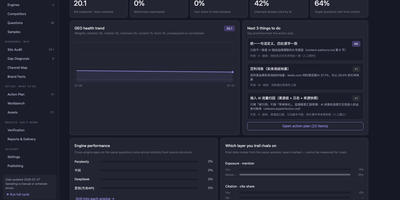
GeoLook shows you what AI search engines actually say about your brand, then turns that uncomfortable answer into a fix list you can work through and verify. You sample real answers across a wide matrix of AI engines and watch mention rate, ranking, and citation share appear per engine, with raw answer replay when a number looks suspicious. Competitor tables reveal which rival each engine prefers and which citation sources they rely on that you do not. A structured question bank sorts buyer, education, and probing questions, flagging the ones where you are absent, outranked, or described negatively. The site audit checks whether crawlers can reach, understand, and quote your pages, in the order those failures actually block visibility. Findings become tickets with an owner, effort estimate, risk grade, and acceptance check, and later sampling rounds confirm whether a fix worked or reopen the ticket when results slip. A content workbench ranks the topics most worth writing, checks drafts for citability, and prepares assets such as llms.txt and structured data snippets for publishing. Running on a dedicated VPS on RepoCloud with guaranteed CPU, RAM, and SSD, full root SSH access, and a browser serial console. MIT licensed.