Apache EventMesh
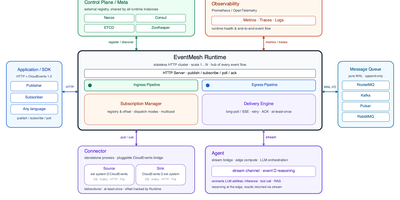
Applications publish an event once and stop caring who needs it next: Apache EventMesh receives CloudEvents over plain HTTP, stores them durably, and delivers each one to every subscription that matches. Producers call publish, consumers call subscribe or unsubscribe, and the runtime owns the registry, offsets, acknowledgements, and redelivery that messaging clients usually force you to build yourself. Subscribers choose load-balanced delivery for competing workers, broadcast delivery for every listener, or multicast for selected groups, and they receive events by HTTP long polling, Server-Sent Events, or WebSocket push. Filters drop irrelevant events before they leave the mesh, while transformers reshape payloads so a producer and consumer can disagree about format without either one changing code. Kafka and RocketMQ act as pluggable write-ahead storage, with an in-memory backend for development, and stateless runtime instances scale horizontally without consumer-group rebalancing. Twenty-three connectors move events into and out of RabbitMQ, Pulsar, MongoDB, MySQL change data capture, Redis, S3, Prometheus, Slack, DingTalk, Lark, WeChat, and AI services, each checkpointing offsets so failures replay instead of silently losing data. Agent-to-Agent protocol support and MCP connectors let AI agents exchange asynchronous events alongside synchronous tool calls, and event-triggered agents can publish decisions back into the mesh for downstream delivery. Running on a dedicated VPS on RepoCloud with guaranteed CPU, RAM, and SSD, full root SSH access, and a browser serial console. Apache-2.0 licensed.
Apache RocketMQ
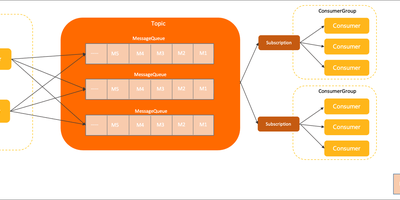
When your services need to talk without waiting on each other, Apache RocketMQ carries the conversation: a distributed messaging platform where producers publish to topics and consumers process at their own pace, with delivery guarantees you can build money movement on. Send ordinary messages for fire-and-forget events, transactional messages that commit or roll back with your local database transaction, ordered and FIFO messages for sequences that must not shuffle, and delayed messages that arrive seconds or days later on schedule. Consumers pull with long polling, filter by tag or SQL expression at the broker, and retry failures through built-in retry queues and dead letter queues instead of losing work. Clusters scale by adding brokers, while Controller mode elects broker replicas automatically so a failed node stops being a page. The Proxy component speaks gRPC with modern multi-language clients and adds POP consumption, where messages become invisible while processed and reappear if the consumer never acknowledges. Tiered storage offloads cold messages to cheaper object storage while hot data stays on local disk, and RocketMQ Streams, Connect, and an MQTT bridge extend the same cluster into stream processing, data integration, and device messaging. Lite Mode trims subscription overhead for AI workloads, and the separate RocketMQ Dashboard gives operators a web console for topics, consumers, and message tracing. Running on a dedicated VPS on RepoCloud with guaranteed CPU, RAM, and SSD, full root SSH access, and a browser serial console. Apache-2.0 licensed.
AnyCable
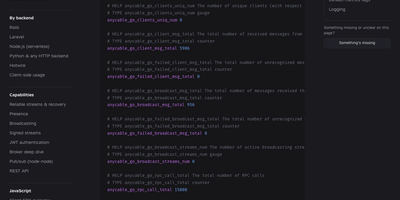
AnyCable moves your WebSocket connections out of your application process and into a dedicated realtime server, so live chat, presence, and notifications keep flowing while your app code focuses on business logic. Rails teams feel it first: the Action Cable channels, subscriptions, and broadcasts already in production keep working unchanged once the endpoint points at AnyCable, which handles authentication, subscriptions, and connection churn by calling back into your application over RPC only when channel code needs to run. Anything that can send an HTTP request can publish to connected clients, and teams outside Rails use standalone mode from Node, Python, Go, or PHP services, including Laravel applications looking for a Reverb or Pusher replacement. Broadcast traffic arrives through Redis Pub/Sub, durable Redis Streams, or the HTTP API, so background jobs and other services push messages without holding a single socket open. Operators watch connected clients, broadcast volume, and RPC failures through Prometheus metrics, and can disconnect remote clients or inspect active streams without a restart. Signed-in users stay safe because every connection request passes through your existing authentication before the server accepts it. Running on a dedicated VPS on RepoCloud with guaranteed CPU, RAM, and SSD, full root SSH access, and a browser serial console. MIT licensed.