Answer
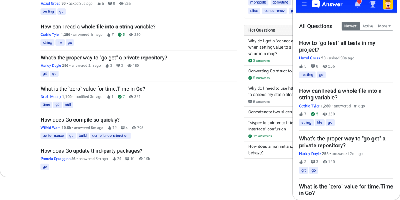
Run a Stack Overflow of your own: Apache Answer brings the question-and-answer format in-house, maintained under the Apache Software Foundation with an Apache-2.0 license. You use it to run a community forum, product help center, or internal knowledge base where content lives as questions and answers rather than wiki pages. It ships the mechanics that make that format work: voting, accepted answers, a reputation system with privilege levels, tagging, full-text search with filters, revision history on every edit, and admin/moderator/user roles. Content is written in Markdown with real-time preview and code syntax highlighting. A plugin system covers OAuth login (Google, GitHub), S3 storage, external search backends like Algolia, and Akismet anti-spam, and a REST API exposes platform data for integration. The backend is Go, the frontend React, and it runs against SQLite, MySQL, or PostgreSQL. Self-hosting replaces per-seat tools like Stack Overflow for Teams with a flat-cost instance where you own all the content.
Apache Answer
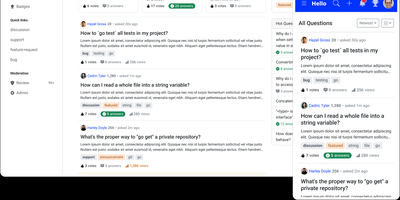
Graduated as an Apache Software Foundation Top-Level Project with over 15,500 GitHub stars and 100,000+ Docker Hub downloads, Apache Answer delivers the structured Q&A platform that Stack Overflow and Discourse popularized — fully self-hosted under Apache 2.0 with zero vendor lock-in. The Go backend with React frontend serves questions, answers, and knowledge articles with real-time Markdown preview using CommonMark syntax, inline @mentions to ping domain experts, and transparent revision history tracking every edit. Version 2.0 introduced AI workflows including an integrated AI assistant that helps draft and improve answers, a Model Context Protocol server for connecting AI agents to your knowledge base, API key management, and editor plugin support for extending the writing experience. Advanced search filters by tags, usernames, scores, and date ranges, while real-time suggestions surface relevant existing questions as users type to reduce duplicates. The reputation system rewards quality contributions with configurable privilege thresholds, and admin/moderator/user roles control access across the platform. A plugin architecture enables community-built extensions for third-party OAuth login, caching backends, search engines, and storage providers. Theming supports custom layouts, dark mode, and responsive design across devices, with content available in 15+ languages translated by the community. Bulk user import, email domain restrictions, and content access controls secure the platform for enterprise deployment. Running on a dedicated VPS on RepoCloud with guaranteed CPU, RAM, and SSD, full root SSH access, and a browser serial console. Apache 2.0 licensed.
Talkyard
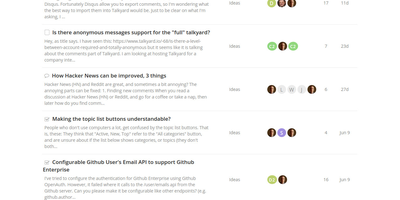
Talkyard combines five discussion formats in one platform: StackOverflow-style Q&A with accepted answers, Reddit-like upvote sorting for ideas, threaded forums, real-time chat channels, and embeddable blog comments. Running separate tools for each conversation type fragments community knowledge across disconnected systems, but Talkyard keeps it all searchable in one place. Question askers mark accepted answers, and community voting surfaces the best solutions for future visitors. Idea topics sort by upvotes for crowdsourced feedback prioritization and product decisions. Chat channels handle real-time day-to-day conversation, while forum threads preserve important discussions that need to remain findable months later. The embedding capability goes beyond blog comments: entire Talkyard forums can live inside iframes on your existing website with automatic deep-linking and iframe auto-resizing, adding community discussion to any page without rebuilding your site. Docker Compose containers run with dropped capabilities, no-new-privileges enforcement, non-root processes, health checks, and automatic log rotation. Multi-site hosting serves multiple communities from one installation with isolated databases and separate domains. Automated upgrades pull new images and restart services without intervention. ElasticSearch indexes every discussion format for instant full-text search. The Scala backend with TypeScript frontend stores data in PostgreSQL with automatic Let's Encrypt HTTPS. Runs on a RepoCloud VPS with guaranteed CPU, RAM, SSD, root SSH, and browser console. AGPL licensed.