Carbon ERP
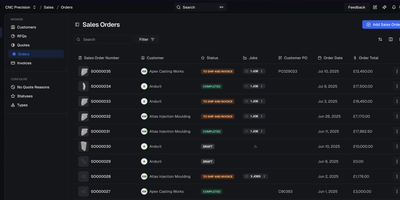
Carbon delivers a unified manufacturing operating system that eliminates the integration tax of running separate ERP, MES, and QMS platforms. The Remix and TypeScript frontend paired with Supabase PostgreSQL backend provides full-stack type safety from database schema to React components, with real-time subscriptions pushing production floor updates to every connected client. The built-in MCP server exposes 1,374 operations across 15 modules through three discovery tools, enabling AI agents to interact with manufacturing data while respecting attribute-based access control. Nested bill of materials with unlimited depth supports complex assemblies, while the MRP engine calculates material requirements across multi-level structures with configurable lead times and safety stock. The configurator handles configure-to-order scenarios with rule-based variant generation. Full lot and serial traceability from receiving through shipping satisfies AS9100, ISO 13485, CFR Part 11, and ITAR compliance requirements. Custom fields extend any entity without schema modification, and the app framework lets integrators build domain-specific modules that plug into the core navigation, permissions, and data layer. Typed API clients for TypeScript, Python, C#, and cURL enable programmatic access to every manufacturing operation. Docker-based local development boots Postgres, Redis, Inngest, and the application stack with a single CLI command. Running on a dedicated VPS on RepoCloud with guaranteed CPU, RAM, and SSD, full root SSH access, and a browser serial console. AGPL-3.0 licensed.
OpenMES
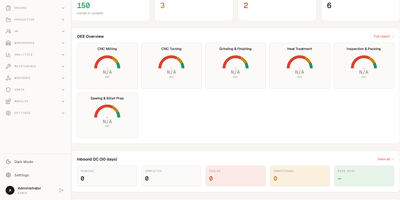
Admins, supervisors, and operators each get their own screens in OpenMES, a free self-hosted manufacturing execution system for small factories. Drag work orders across weekly, daily, hourly, and monthly planner views, and any order that stock cannot cover gets flagged. Automatic scheduling drafts a feasible plan from shift calendars, maintenance, and material shortages, and nothing changes until a supervisor applies it, with undo. Work orders carry partial batches, reusable process templates, and priority scores built from customer tier, planned quantity, and hours until due, and CSV or Excel imports bulk-load orders, materials, and recipes. Operators work from touch-optimized tablet queues, where one tap starts, completes, or reports an issue, even offline, and a critical issue halts production automatically. When a machine stops, MQTT, Modbus TCP, or OPC UA signals record the downtime automatically, and the same signals drive good and reject counters and OEE. At goods-in, an inbound inspection records pass or fail criteria and a disposition such as accept, rework, scrap, or quarantine. Material lots track received and available quantities with hold and release status, and the production cost report splits each finished order into material, labor, and additional costs, with CSV export. Supervisors follow the shift on a live monitor. Webhooks, a REST API, and hook-based modules connect OpenMES to ERP systems and custom code. Running on a dedicated VPS on RepoCloud with guaranteed CPU, RAM, and SSD, full root SSH access, and a browser serial console. AGPL-3.0 licensed.