Briefer
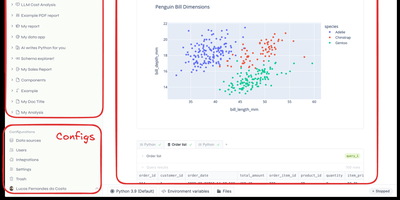
Backed by Y Combinator with 4,300 GitHub stars and growing rapidly since its September 2024 launch, Briefer delivers the first truly unified notebook-and-dashboard platform that eliminates the fragmented workflow of juggling Jupyter for analysis, Tableau for visualization, and Notion for documentation — combining all three in a single Notion-like workspace where SQL query results automatically become Python DataFrames accessible in subsequent code blocks. The built-in AI analyst understands your database schema and notebook context to generate SQL queries, write Python transformations, create visualizations, and fix errors on demand using configurable OpenAI or private LLM backends. Connect directly to PostgreSQL, MySQL, BigQuery, Redshift, Snowflake, and Amazon Athena as data sources, or upload CSV files for immediate analysis. Native point-and-click visualizations produce charts, tables, and dashboards without writing code, while interactive data apps use inputs, dropdowns, and date pickers to create parameterized reports for non-technical stakeholders. Scheduled execution runs notebooks and dashboards periodically with results delivered via Slack integration or public shareable links. Write-back queries modify production data directly from notebooks for ad-hoc pipeline testing. The architecture runs as three Docker containers — web frontend, API server, and optional AI service — backed by PostgreSQL and a Jupyter server for Python execution, deployable via single Docker command, Docker Compose, or Helm charts for Kubernetes. Running on a dedicated VPS on RepoCloud with guaranteed CPU, RAM, and SSD, full root SSH access, and a browser serial console. AGPLv3 licensed.
Metabase
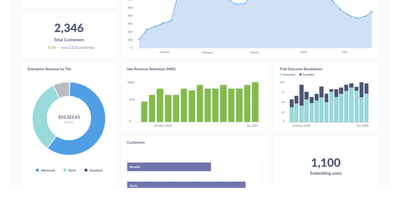
The most widely deployed open-source BI tool, Metabase is a visualization and query layer that sits on top of your existing databases without ingesting or copying data. Non-technical users ask questions through a visual query builder with drill-through menus that answer follow-ups like "broken down by month" without writing a new query, while analysts use the native SQL editor with variables and templates for complex work. Questions assemble into interactive dashboards with filters, auto-refresh, fullscreen mode, and custom click behavior, and dashboard subscriptions email or Slack scheduled reports to stakeholders. It connects to 20+ data sources including PostgreSQL, MySQL, MongoDB, SQL Server, BigQuery, Snowflake, Redshift, and ClickHouse - always querying in place, so there is no second data store to secure, sync, or pay for, and results are always current. Models and metrics let a data team define official, reusable starting points so self-service stays consistent, collections with permissions organize content, and alerts fire when a metric crosses a threshold. The practical effect is cutting the ad-hoc query queue that lands on the data team, since non-technical staff can answer their own questions. Written in Clojure, licensed AGPL, and shipped as a single JAR or Docker image with an embedded application database - a working BI instance runs before most tools finish their installer - the open-source edition has no limits on users, dashboards, or connected databases, where commercial BI platforms price per viewer as well as per creator.
libSQL
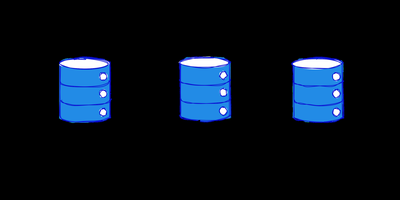
libSQL bridges the gap between SQLite's legendary simplicity and the server-accessible database model developers expect from PostgreSQL and MySQL, adding network access, replication, and vector search while maintaining full file format and API compatibility. The sqld (SQL daemon) component transforms SQLite into a network-accessible database server accepting queries via HTTP with JSON payloads, WebSocket connections, and a Hrana protocol optimized for low-latency edge access. Client libraries for TypeScript, JavaScript, Rust, Go, and Python connect to sqld identically to any traditional client-server database, while the LD_PRELOAD compatibility layer enables switching existing SQLite applications from local to remote mode without code changes. Embedded replicas synchronize a local SQLite copy inside your application process with the primary server, delivering sub-millisecond read latency while maintaining consistency through streaming replication. Bottomless replication continuously backs up database state to S3-compatible object storage with generation-based snapshots and WAL page shipping, providing point-in-time recovery without manual backup scheduling. Native vector search enables semantic similarity queries directly within SQL using cosine distance functions, eliminating the need for external vector database infrastructure. Read replica support distributes query load across multiple sqld instances, and integration with mvSQLite adds multi-version concurrency for high-availability deployments. Created by Turso with 17,100+ stars and active production deployment. Running on a dedicated VPS on RepoCloud with guaranteed CPU, RAM, and SSD, full root SSH access, and a browser serial console. MIT licensed.
ChartDB
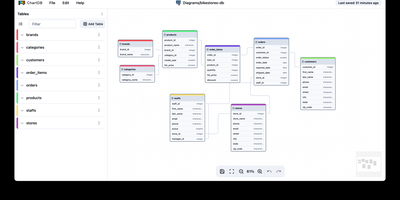
Paste one SQL query result into a browser and get an interactive entity-relationship diagram instantly, with no installations, no credentials, and no account required. ChartDB's "Smart Query" runs a single statement in your existing database client that exports table definitions, relationships, indexes, and column types as JSON metadata, meaning the application never touches your database passwords. The canvas renders draggable entities with cardinality markers, collapsible grouping areas, and sticky notes for documentation. AI-powered DDL export generates migration scripts between dialect pairs like PostgreSQL to MySQL or SQLite to CockroachDB, analyzing your schema to produce target-specific DDL with correct type mappings and constraint translations. Import paths cover Smart Query JSON, raw DDL scripts, and DBML files from tools like dbdiagram.io. The AI layer connects to OpenAI or any compatible inference server including local vLLM instances running models like Qwen2.5-32B. Database coverage includes PostgreSQL (with Supabase and Timescale extensions), MySQL, SQL Server, MariaDB, SQLite (with Cloudflare D1), CockroachDB, ClickHouse, and Oracle. Exports to SVG with inline styles or SQL DDL in any target dialect. Ships as a React/Vite frontend behind Nginx in Docker, deployable on RepoCloud with dedicated VPS resources under the AGPL-3.0 license.
PostgreSQL
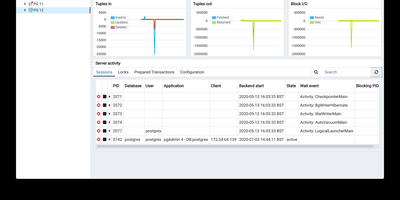
Consistently ranked the most loved and most wanted database in developer surveys, PostgreSQL powers mission-critical workloads at Apple, Instagram, Spotify, and the U.S. Federal Aviation Administration with an architecture refined over nearly four decades since its origins at UC Berkeley. Its native JSONB type stores JSON in an indexed binary format with GIN and GiST index support, enabling document-store capabilities that eliminate the need for a separate NoSQL database in many architectures. The extension ecosystem exceeds 1,000 add-ons: PostGIS provides ISO-compliant geospatial queries, pgvector enables AI embedding similarity search, TimescaleDB adds time-series hypertable compression, and Citus distributes tables across nodes for horizontal scaling. PostgreSQL supports declarative partitioning by range, list, or hash, parallel query execution across multiple CPU cores, and four transaction isolation levels including full Serializable. Streaming replication provides physical standby servers with synchronous or asynchronous modes, while logical replication enables selective table-level change data capture through the Write-Ahead Log. Stored procedures run in PL/pgSQL, PL/Python, PL/Perl, and PL/V8 JavaScript, and advanced indexing includes B-tree, GIN, GiST, SP-GiST, BRIN, and hash types. Full-text search is built in with tsvector and tsquery, and row-level security policies enforce fine-grained access control. Running on a dedicated VPS on RepoCloud with guaranteed CPU, RAM, and SSD, full root SSH access, and a browser serial console. PostgreSQL License (MIT-like permissive) licensed.
ParadeDB
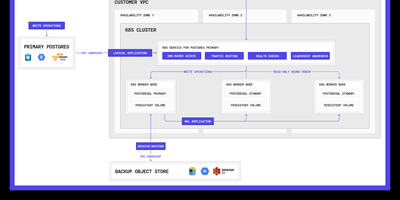
ParadeDB turns the Postgres you already run into a full search and analytics engine, so your application data, full-text search, vector retrieval, and aggregations all live in one database. Create one ParadeDB index over a table and you can run relevance-ranked BM25 queries with tokenizers, phrase matching, highlighting, and Top-K retrieval using plain SQL. The same index stores pgvector embeddings, so similarity search composes with text predicates and filters, and hybrid queries fuse both rankings when a question needs keywords and meaning at once. Aggregations push into the index too: ordinary GROUP BY queries accelerate, and Elasticsearch-style JSON aggregations return facets, histograms, percentiles, and cardinality for filterable search interfaces. Because the index updates in the same transaction as your writes, search results are never stale and there is no ETL pipeline, sync job, or second system to babysit. JOINs against the rest of your schema keep working, since search is just another index inside your system of record. Teams typically retire a separate search cluster while keeping sub-second relevance search, semantic retrieval for AI features, and faceted analytics on the data they already store. Running on a dedicated VPS on RepoCloud with guaranteed CPU, RAM, and SSD, full root SSH access, and a browser serial console. AGPL-3.0 licensed.
RushDB
RushDB is a database your AI agents can actually understand, because it remembers the shape of everything you write. Send nested JSON and each object becomes a record, automatically linked to its parent, while field names, types, and values are cataloged on every write. Agents introspect that catalog before querying, so they ask questions the data can answer instead of hallucinating tables that never existed. The same records answer five query styles: a JSON query language, SQL over the PostgreSQL wire protocol, Cypher over HTTP or Bolt, Gremlin, and Mongo-style document queries. Vector, full-text, and hybrid search run against the same store, so an agent can find the record that mentions a phrase and the records merely similar to it. Everything ships as one binary with one data directory, speaking HTTP on port 3000, PostgreSQL on 5432, and Bolt on 7687 to the drivers and tools you already use. Point your SDKs, SQL clients, BI tools, or local MCP-connected agents at it, and back it up, replicate it, or restore to a point in time with the engine's own tooling. Running on a dedicated VPS on RepoCloud with guaranteed CPU, RAM, and SSD, full root SSH access, and a browser serial console. Apache-2.0 licensed.
CloudBeaver
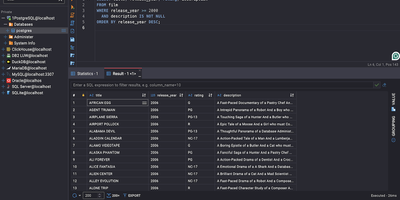
CloudBeaver puts a full-featured database management environment in your browser, connecting to PostgreSQL, MySQL, SQL Server, Oracle, ClickHouse, and over 100 additional engines through one unified interface that requires no desktop client installation. The Java server exposes a TypeScript/React frontend through a GraphQL API where teams can browse schemas, edit data, visualize relationships, and execute queries across all connected databases in a single workspace. The SQL Editor provides syntax highlighting, auto-completion with fuzzy search, AI-assisted SQL generation from natural language prompts, script management with save/download/upload capabilities, execution plan visualization, and multi-tab result display. The Data Editor enables direct cell editing, filtering, sorting, and bulk data modification with support for spatial GIS data rendering. Database administrators access a Navigator panel for browsing schemas, tables, views, foreign tables, triggers, dependencies, and stored procedures across all connected databases. ER Diagrams visualize table relationships and schema structure, while the Visual Query Builder constructs queries without hand-writing SQL. Multi-user administration provides role-based access control, connection sharing with configurable permissions, and session management. SSH tunneling secures remote database connections, and data can be exported or imported in multiple formats. Query History tracks all executed statements with timestamps and execution statistics. Running on a dedicated VPS on RepoCloud with guaranteed CPU, RAM, and SSD, full root SSH access, and a browser serial console. Apache 2.0 licensed.
prest
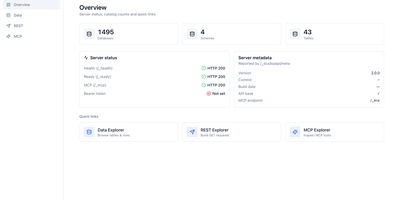
pRESTd points at your PostgreSQL or MySQL database and instantly serves every table as a REST API, so the CRUD backend you were about to spend a week writing already exists. Every table answers at its own address with filtering, ordering, pagination, and column selection in the query string, and batch endpoints group several operations into one call. When a table endpoint is not enough, drop a SQL file into the queries folder and it becomes a named route with bound parameters, or store the scripts in the database and manage them through the admin API. Turn on the auth module and the server issues JWTs from your own users table, checks them on every route, and enforces table-level permissions so public tables stay open while payroll stays shut. The same database also appears as a read-only MCP endpoint, which lets Claude, Cursor, and other AI clients discover your tables and query them with your permissions instead of a copied export. One process can front several databases at once, Postgres and MySQL side by side, each under its own alias for tenants or reporting replicas. An embedded Studio in the same binary browses the catalog and rows, builds GET requests, and invokes MCP tools, so you can inspect everything from the browser before writing a line of client code. Running on a dedicated VPS on RepoCloud with guaranteed CPU, RAM, and SSD, full root SSH access, and a browser serial console. MIT licensed.
REI3
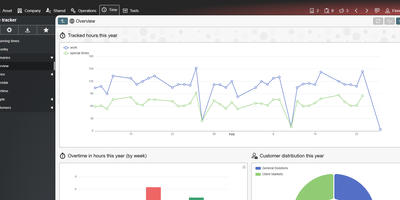
Replace the spreadsheet that quietly runs your department with a proper multi-user application that you design in a browser with REI3, a self-hosted low-code platform. Authors define their data model once, then assemble forms, lists, calendars, Gantt plans, Kanban boards, and charts around it, with form states that show, hide, or require inputs as a record moves through its workflow. Calendars create records from a drag-selected time range, Kanban cards change state by drag and drop, and bulk-update forms edit hundreds of records at once. Phones scan barcodes and QR codes through the camera, and signature pads capture drawings. Roles and record-level access policies decide who sees what, sign-in runs through LDAP, OpenID Connect, or multi-factor authentication, and end-to-end encryption keeps selected fields unreadable even to administrators. REST endpoints work in both directions, ICS feeds publish calendars, CSV moves data in bulk, and IMAP and SMTP accounts connect applications to email. A drag-and-drop PDF editor produces letterheads, labels, and documents with signatures and barcodes. More than a dozen free ready-made applications, including tickets, time tracking, IT assets, a password safe, and a CRM, install from the admin panel. Running on a dedicated VPS on RepoCloud with guaranteed CPU, RAM, and SSD, full root SSH access, and a browser serial console. MIT licensed.
db-ui
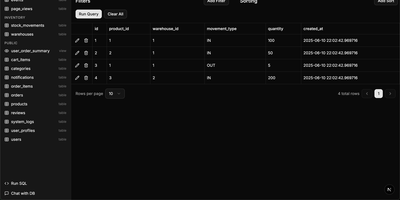
Traditional database management tools like pgAdmin and phpMyAdmin were built for DBAs, not for the rest of the team that just needs to look up a record or run a quick query. db-ui strips away the complexity and gives you a clean, modern interface that anyone can use. Browse tables in a paginated grid view with inline editing, filtering, and sorting built right into the column headers. The sidebar lists every table and view across all schemas with fuzzy search (Cmd+K to focus) that filters results as you type. Click any table to see its data, or switch to the schema introspection view to visualize columns, types, constraints, and relationships without writing a single query. The SQL editor provides syntax highlighting, result visualization in tabular format, and one-click CSV export for downstream analysis. For questions about your data model, the integrated AI chat assistant has full access to your database schema and can help you understand table relationships, write complex queries, suggest indexes, and provide optimization recommendations with streaming responses. Connect to PostgreSQL, MySQL, or Microsoft SQL Server through environment variables and deploy the whole application as a single Docker container. On RepoCloud, deploy db-ui on a dedicated VPS with root SSH access and direct connectivity to your database servers under the MIT license.