OpenBot
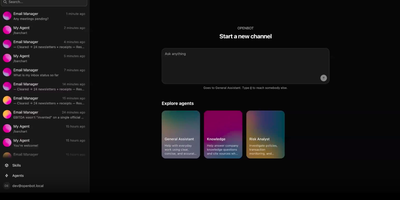
Open source GrokBot, built by the team behind the AG-UI protocol. OpenBot is the open-source enterprise agent platform that gives every AI coworker its own sandboxed computer — a real Chromium browser with its own login sessions, a private filesystem, and only the MCP tools you explicitly grant. The centralized gateway evaluates CEL policy rules against tool name, intent, bot identity, page URL, element attributes, and file paths before any action executes, writing an immutable audit row for every call and outcome. Any agent that speaks AG-UI — LangGraph, Mastra, CrewAI, Pydantic AI, Google ADK, or hand-written endpoints — registers as a Bot and receives its own channel with persistent conversation history. The take-the-wheel system lets humans assume control when an agent encounters login walls or two-factor prompts, recording control transfers as structured audit events. Knowledge documents from Google Drive and OneDrive carry source-based permissions where deny principals always win and ambiguous mappings refuse retrieval entirely. The React and Vite frontend provides live screen viewing of each agent's browser, channel-based chat, admin settings, and component galleries. The Hono API server on port 3001 handles authentication, role-based access, tenant packaging, and credential management backed by PostgreSQL with pgvector. Deploy via Docker Compose with the included supervisor that manages per-bot computer containers. Running on a dedicated VPS on RepoCloud with guaranteed CPU, RAM, and SSD, full root SSH access, and a browser serial console. MIT licensed.
NanoClaw
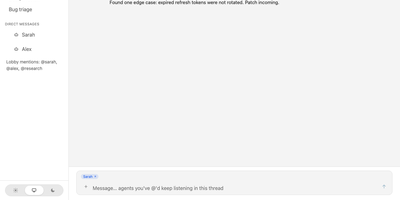
NanoClaw delivers a radically simple alternative to OpenClaw — a single Node.js process and a handful of files that provide the same core functionality with true container-level security isolation. Agents execute inside Docker containers on Linux or Apple Containers on macOS, where even root access inside the sandbox cannot reach the host filesystem. The platform natively runs Claude Code via Anthropic's official Claude Agent SDK, with drop-in alternatives including OpenAI Codex, OpenRouter via OpenCode, Google, DeepSeek, and local open-weight models via Ollama — configurable per agent group. Multi-channel messaging connects WhatsApp, Telegram, Discord, Slack, Microsoft Teams, iMessage, Matrix, Google Chat, Webex, Linear, GitHub, WeChat, and email via Resend, installed on demand through skill commands. Each agent group receives its own CLAUDE.md memory file, isolated filesystem, container sandbox, and session state — a prompt injection in one group cannot exfiltrate data from another. The OneCLI Agent Vault handles credentials so agents never hold raw API keys, while approval-gated self-modification allows agents to request new packages or MCP servers that administrators must authorize. Scheduled tasks run recurring jobs inside containers with message delivery back to users. The setup script handles dependencies, authentication, and container configuration through Claude Code conversation. Deploy on any Docker-capable Linux server. Running on a dedicated VPS on RepoCloud with guaranteed CPU, RAM, and SSD, full root SSH access, and a browser serial console. MIT licensed.
PentaGI
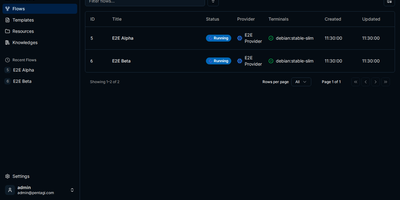
Autonomous red team execution without manual script coordination is what PentaGI delivers through a multi-agent penetration testing platform engineered for automated security assessments. Security engineers configure testing scopes, target IP ranges, domain lists, and rules of engagement through an interactive web console with real-time execution graphs. Autonomous agent personas break down high-level assessment goals into discrete tactical phases, orchestrating network port discovery, service banner fingerprinting, web application crawling, and CVE verification. Specialized agents query integrated Graphiti knowledge graphs and local vulnerability repositories to synthesize attack paths, validate exploitability, and confirm finding veracity before issuing alerts. Operators monitor live agent terminal streams, inspect sandboxed tool executions, and adjust active LLM provider routes across OpenAI, Anthropic, or local Ollama endpoints. The template editor allows red teams to compose reusable testing playbooks with customizable security prompt chains, safety constraints, and automated remediation reporting. Audit logs capture full command histories, raw tool outputs, and LLM reasoning steps to generate compliance-ready technical documentation. Running on a dedicated VPS on RepoCloud with guaranteed CPU, RAM, and SSD, full root SSH access, and a browser serial console. MIT licensed.
SearXNG
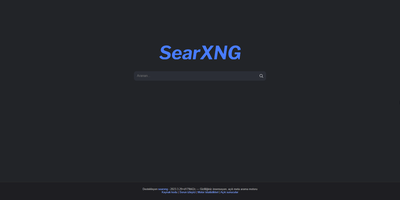
Up to 280 search services - Google, Bing, DuckDuckGo, Brave, Qwant, Startpage - aggregated without tracking or profiling: SearXNG is a privacy-respecting metasearch engine (AGPL-3.0, successor to Searx). Your instance queries the upstream engines on your behalf: your IP address, cookies, and search history never reach them, tracker parameters are stripped from result URLs, and an optional image proxy fetches thumbnails server-side so result pages leak nothing. It can even route outbound queries through Tor for full anonymity. Search is organized into categories - general, images, videos, news, maps, music, IT, science, files - with bang shortcuts for targeting specific engines, and every source can be enabled, disabled, or weighted per category in settings.yml. A plugin system adds calculators, hash tools, tracker removal, and unit conversions inline, and preferences (themes, safe search, languages, engine selection) persist in cookies rather than server-side accounts. The real argument for running your own instance rather than trusting a public one is control: you decide the logging policy (none), the engine mix, rate limiting, and who gets access - making it the default search backend for browsers, families, and teams that want Google-quality results without the profile.
Xalgorix
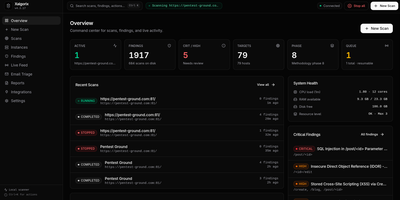
Xalgorix delivers AI-driven penetration testing that proves vulnerabilities exist rather than guessing, pairing an autonomous LLM agent with an independent exploit verifier that re-exploits every finding before it reaches your report. The 22-phase methodology mirrors how a skilled human pentester works through an engagement, covering reconnaissance, subdomain enumeration, port scanning, web crawling, parameter fuzzing, SQL injection testing, XSS detection, authentication bypass, API testing, and more. Select all phases or pick specific ones per target. The platform ships with 85+ offensive security tools preinstalled (nmap, nuclei, httpx, subfinder, katana, ffuf, gobuster, sqlmap, masscan, dalfox, feroxbuster) plus 14 built-in agent tools for browser automation, terminal execution, and note-taking. Connect your own LLM provider (OpenAI, Anthropic, DeepSeek, Gemini, Groq, Ollama, or MiniMax) so no scan data or target information leaves your infrastructure. The web dashboard on port 9137 provides live WebSocket telemetry showing tool calls, agent reasoning, and findings as scans progress. A findings index with CVSS scoring and severity filters organizes results, and branded PDF reports include your company name and logo. Wildcard and multi-target scans handle red team attack-surface mapping, while source-code scanning audits repositories directly without requiring a deployed target. A REST API enables scripted scans and SIEM pipeline integration, and webhooks push notifications to Discord or Telegram. Running on a dedicated VPS on RepoCloud with guaranteed CPU, RAM, and SSD, full root SSH access, and a browser serial console. Apache 2.0 licensed.
Infisical
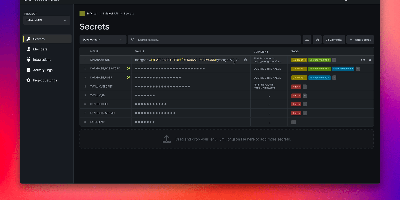
API keys hardcoded in repos, database passwords pasted into CI variables, .env files emailed between developers - Infisical, the open-source platform for secrets, certificates, and privileged access management, is the answer to all three. Secrets live in versioned stores scoped by project, environment, and path, with fine-grained identity-aware access control and full audit logging on every read and change. Delivery covers every consumption pattern: CLI injection into local dev, SDKs for Go, Node.js, and Python, an HTTP API, agents, a Kubernetes Operator, and secret syncs that push to GitHub, GitLab, AWS Secrets Manager, and Vercel. Automatic rotation replaces credentials for PostgreSQL, MySQL, MSSQL, LDAP, AWS IAM, and Azure on a rolling schedule - new credentials issue while old ones stay temporarily valid, so nothing breaks mid-rotation. Dynamic secrets go further, generating ephemeral, time-bound database credentials on demand, and SSH access replaces static keys with short-lived CA-signed certificates that expire automatically. Secrets scanning catches hardcoded credentials in code and pipelines, certificate management automates X.509 issuance and renewal, and a built-in KMS handles encrypt/decrypt with central key control. Self-hosting keeps the keys to everything else on your own infrastructure.
Fleet
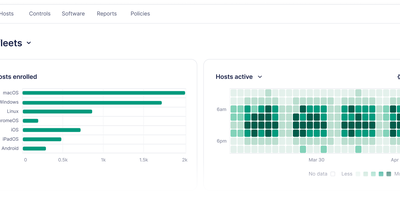
Fleet lets IT and security teams query every device in their organization like a SQL database, using osquery to surface installed software, running processes, configurations, and vulnerabilities within seconds across macOS, Windows, Linux, iOS, Android, and ChromeOS. The Go-based server exposes a web console and REST API for centralized device management, with MDM capabilities built on nanoMDM for Apple device enrollment, configuration profiles, and remote lock or wipe. Vulnerability management cross-references installed software inventories against NVD and OVAL CVE databases, automatically flagging known vulnerabilities with severity scores and remediation guidance. Software deployment handles OS updates using Apple Declarative Device Management, Windows Update, and custom installer packages distributed through S3-compatible storage. A GitOps workflow enables infrastructure-as-code management where device policies, osquery queries, and configuration profiles live as YAML files in Git repositories, with CI/CD pipelines pushing changes through the fleetctl CLI. The fleetd agent bundle includes osquery for telemetry, Orbit for version management, and Fleet Desktop providing end users a menu bar status indicator. Integrations connect to Snowflake, Splunk, Elastic, Jira, Zendesk, Vanta, and GitHub Actions for automated compliance reporting. CIS benchmark policies verify security baselines across operating systems. Deployment requires MySQL for persistence and Redis for caching, running as Docker containers or on Kubernetes. Running on a dedicated VPS on RepoCloud with guaranteed CPU, RAM, and SSD, full root SSH access, and a browser serial console. MIT licensed.
Open Code Review
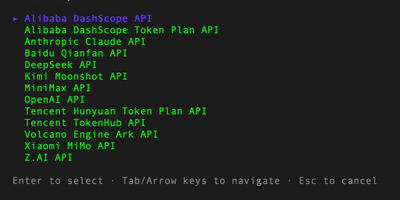
Originated as Alibaba Group's official internal AI code review assistant serving tens of thousands of developers and identifying millions of code defects over two years before open-sourcing in May 2026 — now at 21,000+ GitHub stars — Open Code Review is the production-hardened platform that proves enterprise-grade code review can be fully open-source under Apache 2.0. The hybrid architecture separates deterministic engineering pipelines (file selection, diff parsing, rule matching for NPE, thread-safety, XSS, and SQL injection across 10+ languages) from LLM-powered agent reasoning with tool-use capabilities including FileRead, CodeSearch, and cross-file context inspection, consuming approximately one-ninth the tokens of general-purpose coding agents while delivering line-level precise comments with severity and confidence scoring. The bundled web dashboard (port 4173) provides review management, findings triage, result browsing, and direct GitHub posting without external dependencies, while the session viewer (port 5483) renders full LLM request/response traces for debugging and auditing. Integration spans GitHub Actions, GitLab CI, GitFlic CI, and Gerrit with delegation mode enabling Claude Code, Cursor, and other AI agents to leverage OCR's engineering logic alongside their own LLM reasoning. Supports OpenAI, Anthropic, Google Gemini, DeepSeek via built-in providers plus Ollama and vLLM for air-gapped deployments. Running on a dedicated VPS on RepoCloud with guaranteed CPU, RAM, and SSD, full root SSH access, and a browser serial console. Apache 2.0 licensed.
CubeSandbox
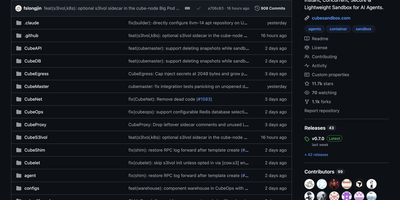
CubeSandbox gives every AI agent its own hardware-isolated MicroVM with a dedicated Linux kernel — not a shared-kernel container but a true KVM virtual machine — booting in under 60ms with less than 5MB of memory overhead per instance, enabling thousands of concurrent sandboxes on a single server via kernel sharing and Copy-on-Write memory. The Rust-built CubeProxy exposes an E2B SDK-compatible REST API on Axum, so existing E2B Cloud applications switch by changing one environment variable with zero client code changes. CubeMaster orchestrates cluster-level scheduling in Go while Cubelet manages node-local sandbox lifecycles including create, run, pause, resume, snapshot, and destroy operations. CubeVS, the eBPF-powered network layer, enforces per-sandbox isolation with LPM trie-based egress policies entirely in kernel space — no userspace context switches — while CubeEgress provides an L7 security proxy with per-domain, per-path, and per-method allowlists plus automatic credential injection that keeps secrets invisible to sandbox code. Hundred-millisecond-granularity snapshots enable checkpoint, rollback, and parallel fork from any saved state. The volume framework supports E2B-compatible pluggable storage with independent lifecycle and cross-sandbox sharing. Production deployment uses Terraform on Tencent Cloud or Helm charts on Kubernetes, K3s, or TKE, with full ARM64 support alongside x86_64 and AutoPause/AutoResume for cost optimization. Running on a dedicated VPS on RepoCloud with guaranteed CPU, RAM, and SSD, full root SSH access, and a browser serial console. Apache 2.0 licensed.
BentoPDF
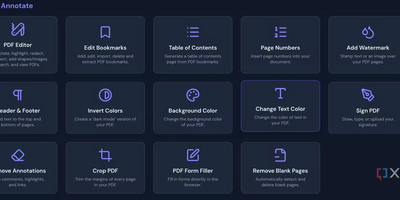
Merge, split, compress, convert, edit, annotate, redact, OCR, and sign PDFs - BentoPDF packs over 130 tools into a privacy-first toolkit that runs entirely in the browser through WebAssembly. Files are never uploaded - processing happens in browser memory on the user's machine and disappears when the tab closes, which makes the tool GDPR-clean by architecture and safe for financial, legal, and internal documents. The engine combines WASM builds of PyMuPDF, Ghostscript, and CoherentPDF; Tesseract handles OCR with searchable text-layer output; Office conversions cover Word, Excel, and PowerPoint; and digital signatures use X.509 certificates (PFX/PEM) with the private key staying on the client. Because there is no server-side processing, deployment is a static-file exercise: a single Docker container, or any static host. A dedicated self-hosted build strips the marketing pages while keeping every tool, and air-gapped deployments are first-class - an automated script bundles the WASM modules, OCR language data, and fonts for fully offline networks. No accounts, no limits, no watermarks; TypeScript and Vite under the hood.
SpiderFoot
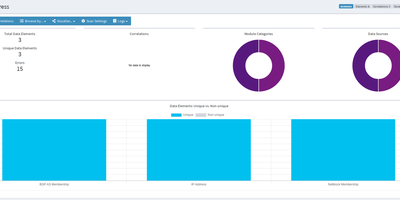
SpiderFoot is an open-source OSINT automation platform, replacing hours of manual reconnaissance with automated intelligence gathering across more than 200 data collection modules. The platform accepts ten distinct target types including IP addresses, domains, hostnames, network subnets, ASNs, email addresses, phone numbers, usernames, person names, and Bitcoin addresses, then feeds them through a publisher-subscriber event bus where each module's findings trigger downstream analysis automatically. SpiderFoot queries Shodan, VirusTotal, HaveIBeenPwned, AlienVault OTX, Censys, crt.sh, WHOIS databases, social media platforms, breach databases, and dozens more sources, with most modules requiring no API keys and many offering free tiers for those that do. The YAML-configurable correlation engine applies 37 pre-defined rules to identify relationships between discovered data points, flagging patterns like shared infrastructure, credential exposure, and domain reputation anomalies. Results export in CSV, JSON, and GEXF graph formats for integration with external analysis tools. TOR integration enables dark web searching, and SpiderFoot can invoke external tools including DNSTwist, Whatweb, Nmap, and CMSeeK for deeper technical assessment. The embedded web server delivers an intuitive dashboard for scan management, data visualization, and result exploration alongside a full command-line interface for scripted automation. Running on a dedicated VPS on RepoCloud with guaranteed CPU, RAM, and SSD, full root SSH access, and a browser serial console. MIT licensed.
Graylog
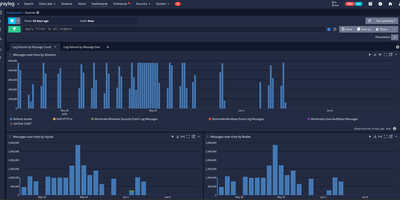
Trusted by over 60,000 organizations worldwide with more than 8,100 GitHub stars since 2010, Graylog has established itself as one of the fastest paths from raw log data to operational visibility, delivering centralized log management, security analytics, and compliance auditing through a purpose-built web interface with sub-second search at scale. The platform ingests logs from virtually any source via syslog, GELF, Beats, raw TCP/UDP, HTTP, CEF, IPFIX, and Netflow protocols, processing each message through configurable pipelines that parse fields, apply transformations, enrich events with GeoIP data from MaxMind or IPinfo lookup tables, and route messages to appropriate streams based on content rules. OpenSearch handles full-text indexing and storage with dynamic shard sizing that automatically calculates appropriate sizes from available node memory, while MongoDB stores configuration metadata including user accounts, roles, dashboards, alert rules, and pipeline definitions. The alerting system integrates with Slack, PagerDuty, and email with customizable notification templates and Replay Search links for immediate investigation context. Version 7.0 introduced MCP server integration for connecting preferred LLMs to perform AI-assisted log analysis and automation, while version 7.1 added Sigma detection rule import from private GitHub, GitLab, and Bitbucket repositories for detection-as-code workflows. The Sidecar agent management system centrally configures and deploys Filebeat, Winlogbeat, and nxlog collectors across infrastructure from the Graylog web interface. Running on a dedicated VPS on RepoCloud with guaranteed CPU, RAM, and SSD, full root SSH access, and a browser serial console. SSPL licensed.
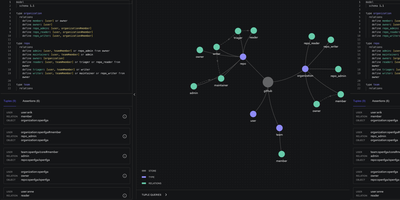
OpenFGA
OpenFGA answers the question 'can this user perform this action on this resource?' in single-digit milliseconds, implementing Google's Zanzibar paper as a production-ready authorization engine adopted by Auth0, Grafana Labs, Canonical, Docker, Agicap, and Read.AI. The server exposes both gRPC and HTTP APIs for authorization queries including Check, ListObjects, ListUsers, Expand, and the high-throughput BatchCheck endpoint that deduplicates and processes multiple authorization decisions in a single request. Authorization models combine relationship-based access control with role-based and attribute-based patterns through a purpose-built DSL that supports contextual tuples, conditional relationship tuples with CEL expressions, and time-based filtering via the ReadChanges API. Storage backends include PostgreSQL 14+, MySQL 8, and SQLite in beta, with an in-memory adapter for development and testing. Official SDKs for Java, .NET, Node.js, Go, and Python provide type-safe client integration, while a Terraform provider enables infrastructure-as-code management of authorization stores and models. The built-in browser playground at port 3000 lets developers visually model authorization schemas, write relationship tuples, and test access control queries interactively before deployment. OpenTelemetry instrumentation integrates with existing monitoring infrastructure, and Helm charts simplify Kubernetes deployment. A VS Code extension provides syntax highlighting and validation for FGA model files, and GitHub Actions automate model testing in CI/CD pipelines. A CNCF incubating project with transparent governance. Running on a dedicated VPS on RepoCloud with guaranteed CPU, RAM, and SSD, full root SSH access, and a browser serial console. Apache 2.0 licensed.
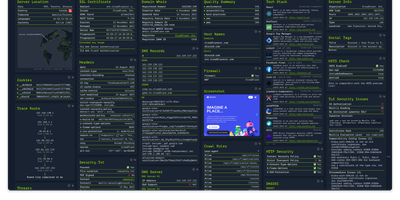
Web-Check
Enter a URL and get a dashboard of everything publicly discoverable about its security posture, server architecture, and technology stack: Web-Check is an all-in-one OSINT tool for analyzing any website. One scan surfaces IP info and server location, the full SSL certificate chain with issuing authority and validity, DNS records (A, MX, NS, CNAME, TXT) with DNSSEC status, HTTP response headers interpreted for security directives like HSTS, CSP, and X-Frame-Options, cookies and their flags, WHOIS domain info, robots.txt crawl rules, a sitemap-derived page map, the redirect ledger, open ports, traceroute, detected technologies, third-party trackers, associated hostnames, site performance, and even carbon footprint. Each card explains what the data means and why it matters, which makes the tool double as a security education resource - junior engineers learn headers and attack surfaces by scanning real sites. Practical uses span pre-deployment security audits (catch missing headers and misconfigurations before they ship), privacy compliance checks (identify trackers and cookie behavior for GDPR work), competitive tech-stack research, and network debugging via DNS and redirect inspection. Built by Lissy93 in TypeScript, it deploys as a single Docker container, and self-hosting keeps your reconnaissance targets and audit activity off third-party services.
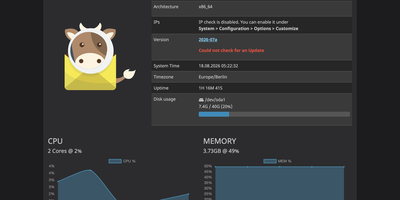
Mailcow
With over 13,000 GitHub stars and active monthly releases, Mailcow delivers a production-ready mail server infrastructure through Docker Compose orchestration of twelve integrated containers. The stack pairs Postfix as the MTA handling SMTP traffic with Dovecot for IMAP and POP3 retrieval featuring the Flatcurve full-text search engine, while Rspamd provides machine-learning-powered spam filtering with Bayesian classification, DKIM signing, and ARC support. ClamAV scans attachments for malware including Office document macro analysis via Olefy, and SOGo serves as a responsive webmail client with CalDAV, CardDAV, and Microsoft ActiveSync synchronization. The admin panel manages multiple domains, per-user spam score thresholds, quarantine review, black and whitelists, temporary spam aliases, mailbox quotas, and TLS enforcement policies for both inbound and outbound messages. Security features include two-factor authentication via TOTP, WebAuthn, and Yubikey OTP, a Fail2ban-like Netfilter integration for brute-force protection, and automatic SPF, DKIM, and DMARC configuration. The ACME container handles Let's Encrypt certificate generation with DNS-01 challenge support, while Postfix TLS-Pol provides MTA-STS and DANE/TLSA resolution for encrypted transport. Built-in imapsync enables periodic migration from remote mailboxes, and the REST API allows programmatic management of all server resources. MariaDB stores user data, Redis caches configuration and sessions, and Unbound provides local DNSSEC-validating DNS resolution. Running on a dedicated VPS on RepoCloud with guaranteed CPU, RAM, and SSD, full root SSH access, and a browser serial console. GPL-3.0 licensed.
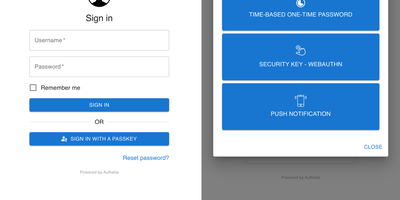
Authelia
Authelia is the leading open-source SSO and multi-factor authentication server for self-hosted infrastructure. The Go backend compiles to a single binary or Docker container image, serving a TypeScript React web portal that handles first-factor username and password login, second-factor authentication via TOTP, WebAuthn FIDO2 security keys, passwordless passkeys, and Duo mobile push notifications, and an OpenID Connect 1.0 and OAuth 2.0 identity provider with device code flow, JWE encrypted ID tokens, custom claims policies, and network-scoped authorization criteria. The forward authentication model integrates with Nginx auth_request, Traefik ForwardAuth, HAProxy, Caddy, Envoy, SWAG, and Skipper reverse proxies, injecting Remote-User, Remote-Groups, and Remote-Email headers into authorized requests. Granular access control rules match subject, groups, request URI, HTTP method, and network to enforce one-factor and two-factor policies per route. The user backend supports LDAP with attribute mapping, connection pooling, and bind mode, or YAML file-based authentication with Argon2id hashed passwords. Session state stores in Redis for high availability across clustered deployments, while persistent data lives in SQLite, MySQL and MariaDB, or PostgreSQL. Brute force protection locks accounts after configurable failed attempts, and email-based identity verification handles password resets and device registration. Dark, light, and OLED themes with i18n localization customize the portal appearance. On RepoCloud, deploy Authelia on a dedicated VPS with Docker, root SSH access, and complete control over your authentication infrastructure, all under the Apache-2.0 license.
KeeWeb
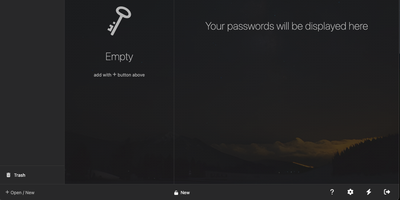
Your KeePass vaults, opened from any browser: KeeWeb reads, edits, and creates standard KDBX files, so it works with the same databases as KeePass and KeePassXC without conversion or lock-in. Self-hosting the web app gives you a password manager reachable from any modern browser, including mobile, with no client installation and no third-party cloud in the loop. All KDBX cryptography runs client-side; the server just serves the static app. Open multiple vault files simultaneously and search them all from one box, with advanced options covering specific fields, password history, and regular expressions. Vaults load from local files, your own server (WebDAV), or Dropbox, Google Drive, and OneDrive, with automatic sync - and files are cached for offline use, so a dropped connection never locks you out; changes resync once you're back online. Day-to-day niceties include a configurable password generator, protected fields that stay masked and are held in memory more defensively, entry history, tags with easy input, drag-and-drop attachments, and per-entry icons with favicon fetching. The optional KeeWeb Connect extension (Chrome, Firefox, Edge, Safari) autofills credentials using the keepassxc-protocol. MIT-licensed with matching desktop apps for macOS, Windows, and Linux.
Element
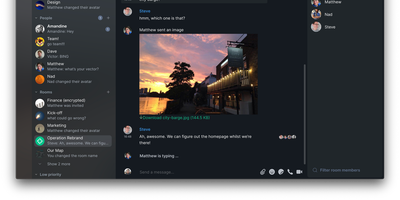
Matrix's flagship client, built by the protocol's creators: Element brings the decentralized open standard for real-time communication to web, desktop, iOS, and Android. Paired with a Matrix homeserver, it delivers Slack-quality team messaging where you own every message, file, encryption key, and byte of metadata. End-to-end encryption is on by default, built on Olm and Megolm - the Double Ratchet algorithm family Signal popularized, extended for large-room scalability and publicly audited by NCC Group. Messages encrypt per-device with cross-signed device verification, so even a compromised server yields nothing readable. Federation is the defining capability: like email, users on different homeservers converse seamlessly, and 30+ bridges connect Matrix rooms to Slack, Discord, WhatsApp, and Telegram, so moving to sovereign infrastructure doesn't sever contact with anyone. Rooms support threads, reactions, file sharing, and voice and video calls via Element Call. The result is digital sovereignty chosen by governments and enterprises across Europe: your data sits on your server in your jurisdiction, portable to any other Matrix host because the protocol is an open standard. Apache-2.0 licensed, with no per-user fees at any scale.