Ties
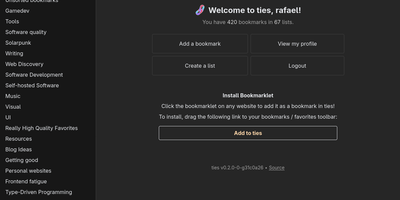
A federated bookmark manager written in Rust: Ties (formerly linkblocks) is your own small corner of the web for saving, organizing, and sharing good pages, connected to the fediverse over ActivityPub. Instead of rigid folders, bookmarks live in arbitrarily nested lists that link together into a knowledge graph. Saved pages are fetched, converted to a readable archived version, and stored in the database, so full-text search covers titles, URLs, and the actual page text - and the content survives if the original disappears. The federation model is deliberately anti-viral: there is no global timeline and no algorithmic feed. You publish public lists for anyone, follow users whose taste you trust, and mark trusted users whose bookmarks become part of your search range - extendable to trusted-users-of-trusted-users for a wider net. Public bookmarks post to Mastodon timelines, and WebFinger lookup makes your handle discoverable across fediverse platforms. Operationally it is about as light as web software gets: a single binary with all assets baked in, integrated TLS so it can run without a reverse proxy, PostgreSQL as the only dependency, OIDC single sign-on, and a bookmarklet for one-click saves. Note the project is alpha: single-user instances only, and all data should be considered public. AGPL-3.0 licensed, built with Rust and htmx.
Castopod
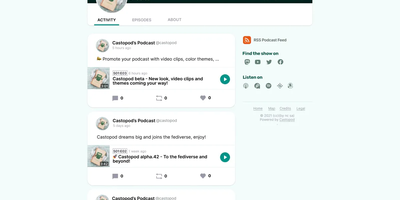
Every podcast you publish through Castopod automatically becomes a Fediverse social account that Mastodon, Pleroma, and Pixelfed users can follow, boost, and comment on from their own timelines. This ActivityPub integration transforms podcast distribution from a one-way broadcast into a two-way conversation where listeners interact with episodes through the social platforms they already use. Beyond federation, the platform manages the complete lifecycle: upload an episode, and auto-generated RSS feeds distribute it to Apple Podcasts, Spotify, Deezer, Podcast Addict, and every compatible directory. IABv2-compliant analytics measure downloads, geographic distribution, and listening apps while maintaining GDPR, CCPA, and LGPD compliance through anonymized data collection. Podcasting 2.0 namespace support unlocks chapters with images, SRT/VTT transcripts, location tags, and person credits that modern podcast apps surface to listeners. Video episodes publish alongside audio, and auto-generated clips feed social media sharing workflows. Monetization tools span Value4Value micropayments, premium subscriptions, funding links, and cookieless advertising. Multi-user roles operate per-podcast: contributors, editors, and admins each work within defined permission boundaries. The PHP application runs behind nginx with MariaDB and Redis on a RepoCloud VPS with dedicated CPU, RAM, and SSD. AGPL-3.0 licensed.
GoToSocial
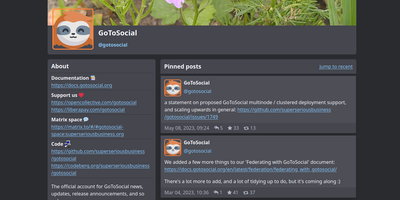
Mastodon serves single-user and small-community instances poorly; GoToSocial, an ActivityPub server written in Go, was built precisely for them. Where Mastodon demands Ruby, PostgreSQL, Redis, and Sidekiq, GoToSocial is one binary using roughly 250-350 MiB of RAM with SQLite as the default database (PostgreSQL optional) - it runs comfortably on a $5 VPS or a repurposed laptop. The deliberate design choice is having no built-in web client: the server exposes profile pages, a settings panel, and a faithful implementation of the Mastodon API, and you post through the client app you already like - Tusky on Android, Feditext on iOS, Pinafore or Phanpy in the browser. Federation is the point: your instance follows, boosts, and replies across Mastodon, Misskey, Pixelfed, and the rest of the Fediverse, with your identity anchored to your own domain. Safety is a stated focus, with granular per-post visibility and interaction controls, content warnings, custom emoji, hashtag following, domain allow/blocklists, and OIDC login support. Built-in Let's Encrypt provisioning simplifies the mandatory TLS. AGPL-3.0 licensed and in active beta, federating cleanly with the ecosystem's major servers.
Zusam
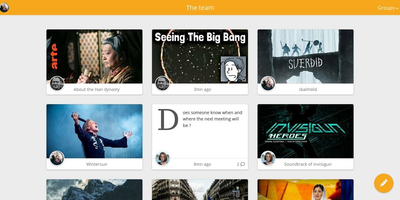
From the German "zusammen," together: Zusam is a private social space for a group of friends - a self-hosted alternative to the family WhatsApp group or the friends Facebook group, with no ads, algorithms, or data harvesting in between. The AGPLv3 project is deliberately modest in scope and stack: a Symfony PHP backend exposing a REST API over SQLite, with a lightweight Preact single-page frontend, designed for a low server footprint that runs comfortably on small hardware. Groups post messages into shared feeds that handle real life well: video and image uploads (with FFmpeg processing), photo albums for trips and events, and rich link previews with inline embeds for YouTube, Vimeo, Imgur, SoundCloud, Twitch, and Bandcamp - so sharing a song or a clip looks the way it should. When something needs to leave the circle, public link generation exposes a single message to non-members without opening the group. The interface is fully responsive and mobile-friendly, targeting Firefox ESR and recent Chrome. It is the small-web answer to a real question: where does a group chat's shared history live when you want it owned by the group instead of a platform?
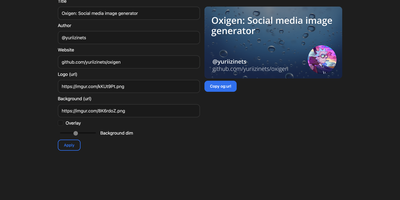
Oxigen
The social preview cards shown when links hit Twitter, LinkedIn, Slack, or Discord, generated on the fly: Oxigen is a small Go service for dynamic Open Graph images, no designer required per page. Instead of exporting static images per page, you compose a card once and drive it with parameters: title, author, website, logo, background image, and background dimming all arrive as URL query arguments, so your og:image meta tag simply points at the Oxigen endpoint with the page's own values substituted in. Every blog post, product page, and doc gets a branded, correctly sized preview generated on the fly. A built-in web UI covers interactive composition - tweak the text and imagery, watch the preview update, copy the resulting URL - while the same rendering path serves programmatic API use from static site generators, CMS templates, or build pipelines. Rendering is pure Go using the gg 2D graphics library, freetype fonts, and the imaging package, built on the kyoto framework by that project's author. Deployment is one stateless container on port 80 with no database and no external dependencies, so instances scale and restart freely.