ScribeCrate
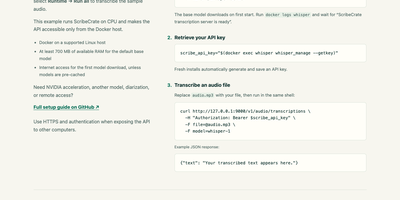
ScribeCrate is a self-hosted speech-to-text API that turns recordings into transcripts, subtitles, and English translations on your own server. It speaks the OpenAI Whisper API fluently: point any compatible client at your server's address, swap in your API key, and uploads come back as text. Ask for plain text, JSON with timestamps, or ready-to-publish SRT and WebVTT subtitle files, and for long recordings the segments can stream back over SSE as they are decoded. Turn on speaker diarization and every segment is labeled with who is speaking, which makes interview and meeting transcripts readable at a glance. Choose the model that fits the job, from tiny for quick drafts to large-v3 for maximum accuracy, and run it on a modest CPU, a Raspberry Pi class ARM board, or an NVIDIA GPU. Almost any recording works: MP3, M4A, WAV, WebM, OGG, and FLAC are all accepted, and with models cached in advance the server keeps transcribing with no internet connection at all. Running on a dedicated VPS on RepoCloud with guaranteed CPU, RAM, and SSD, full root SSH access, and a browser serial console. MIT licensed.
Bazarr
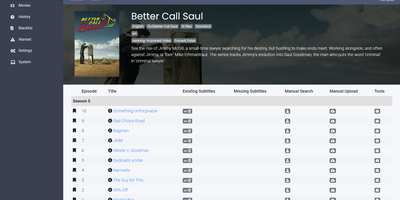
Subtitles are the one chore Sonarr and Radarr leave behind - Bazarr finishes the *arr media stack by automating them. It connects to both via their APIs and mirrors their libraries - it doesn't scan disk itself, it manages exactly what your *arr apps index. For every monitored episode and movie it checks existing internal and external subtitles against your language profiles, then hunts missing ones across dozens of providers - OpenSubtitles.com, Podnapisi, Addic7ed, Subscene, and many regional sources - covering 184 subtitle languages including forced/foreign-dialogue tracks. Matching is smarter than filename guessing: releases are compared by release group and source, some providers support exact file-hash matching, and every downloaded subtitle gets a percentage score. Set a minimum score per Sonarr/Radarr connection and Bazarr rejects weak matches; enable upgrades and it replaces previously downloaded subtitles when better ones surface. Out-of-sync files get fixed too - automatic subtitle synchronization realigns timing after download, triggered only below a configurable score threshold so good subs aren't touched. Per-show and per-movie language configuration, download history, manual on-demand search, and adaptive searching that throttles provider API calls round it out, all behind a clean Sonarr-style web UI written in Python. If your library serves multilingual viewers, this removes the last manual step.
Cinephage
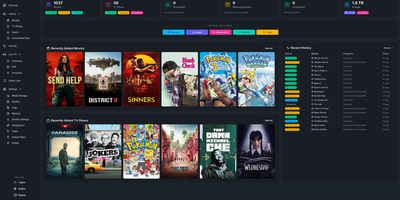
Cinephage puts your movies, series, live TV, subtitles, indexers, and download clients into one self-hosted media command center instead of a stack of separate automation services. Browse and organize libraries from a responsive interface that works on desktop and mobile, with file scanning and metadata matching keeping titles identified correctly. Search across configured indexers, compare releases with quality profiles and custom scoring rules, and send chosen downloads to your client without repeating setup for each media type. Let monitoring tasks watch for missing episodes, upgraded releases, and newly aired content, while the blocklist stops failed releases from coming back. Pull subtitles from multiple providers with language profiles, create dynamic smart lists from list sources or custom queries, and add matching titles automatically. Generate streaming links as .strm files for players such as Jellyfin, Emby, and Kodi, try live TV channels with guide data where configured, and receive library update notifications in your media server. Running on a dedicated VPS on RepoCloud with guaranteed CPU, RAM, and SSD, full root SSH access, and a browser serial console. GPL-3.0 licensed.