Pixelle Video
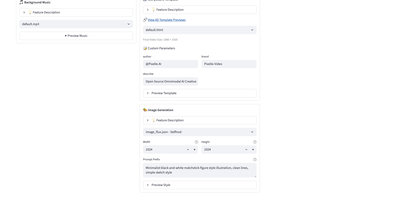
Backed by Alibaba's AIDC team and carrying over 27,700 GitHub stars, Pixelle-Video turns a single text prompt into a publish-ready short video in approximately three minutes — handling scriptwriting, image generation, voice narration, music selection, subtitle overlay, and final MP4 export in one automated pipeline. The engine supports multiple LLM backends for script generation including GPT-4, Qwen, DeepSeek, and local Ollama deployments, while image and video creation routes through either self-hosted ComfyUI workflows, cloud-based RunningHub pipelines, or direct API connections to DashScope Wan, OpenAI, Seedream, Seedance, and Kling AI. Text-to-speech synthesis uses Edge-TTS, Index-TTS, and other mainstream engines with multi-language voice profiles. Five distinct pipelines cover Quick Create, Standard, Digital Human Avatar broadcasting, Image-to-Video transformation, and Motion Transfer from reference video. The Streamlit web UI on port 8501 provides a visual workflow builder with template selection across portrait (1080x1920), landscape (1920x1080), and square formats, while the FastAPI server on port 8000 exposes a REST API with endpoints for async video generation, task polling, content scripting, TTS and image generation, template listing, and health checks. History persistence tracks all completed generations. HTML-based visual templates support static, image-overlay, and AI-video styles with customizable prompt prefixes. The modular architecture lets operators swap any atomic capability — image model, video model, TTS engine, or VLM — by editing a workflow JSON file without touching Python code. Running on a dedicated VPS on RepoCloud with guaranteed CPU, RAM, and SSD, full root SSH access, and a browser serial console. Apache 2.0 licensed.
ComfyUI
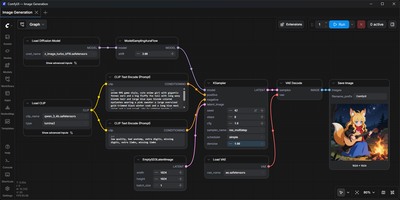
With over 126,000 GitHub stars and adoption across professional studios, research labs, and independent creators, ComfyUI has become the most widely used node-based interface for generative AI workflows — supporting image, video, audio, and 3D content creation through a single visual canvas. The graph editor natively supports Stable Diffusion 1.5, SDXL, SD3.5, Flux.1, Flux.2, HunyuanDiT, Lumina Image 2.0, HiDream, Qwen Image, and Pixart for image generation, plus Wan 2.1 and 2.2, LTX-Video, HunyuanVideo 1.5, CogVideoX, and Mochi for video, ACE-Step and Stable Audio for audio, and Hunyuan3D 2.0 for 3D models. Built-in tools handle inpainting, outpainting, ControlNet conditioning, LoRA and Hypernetwork loading, ESRGAN upscaling, area composition, model merging, and GLIGEN spatial control without writing code. The execution engine implements asynchronous queue processing with partial graph re-execution, running only changed nodes between iterations, and smart VRAM management that offloads models on GPUs with as little as 1 GB of memory. API nodes optionally connect to closed-source models through Comfy API while the core runs fully offline. Reusable subgraphs and App Mode expose complex workflows as simplified interfaces for non-technical users. The V3 custom node schema enables stateless execution with async support and process isolation. The TypeScript and Vue frontend ships as a PyPI package with stable releases every two weeks. Workflows save as JSON and embed in generated PNG, WebP, and FLAC files for reproducibility. Running on a dedicated VPS on RepoCloud with guaranteed CPU, RAM, and SSD, full root SSH access, and a browser serial console. GPL v3.0 licensed.