Jentic One
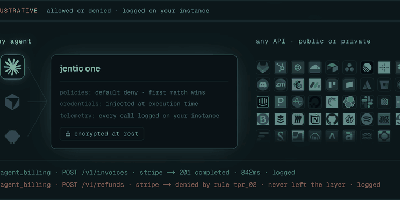
Jentic One is a self-hosted execution layer that lets AI agents call real APIs through a broker that checks permissions and injects stored credentials, so agents do useful work without ever holding your API keys. You register the APIs an agent may use, store each credential once on your own infrastructure, and approve which agents can connect. Every call the agent makes passes the permission check first, and denied requests stop at the broker with a 403 instead of reaching the outside service. Allowed calls go out with the credential attached, and each one lands in an execution record you can review later. Cutting off a single agent takes one change in the control plane, with no key rotation across your other tools. Agents connect through the jentic CLI, a generated skill, an MCP server, or plain HTTP, so coding assistants and in-house agents share the same gate. The stack runs as two units over one database: the control plane on port 8000 for administration, and the broker data plane that agents call. Quickstart runs on SQLite for trials, and production setups move to Postgres with pinned images and TLS. Running on a dedicated VPS on RepoCloud with guaranteed CPU, RAM, and SSD, full root SSH access, and a browser serial console. Apache-2.0 licensed.
Olla
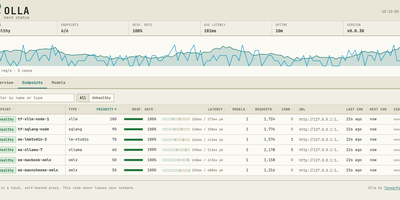
One endpoint for every inference box you own: Olla is a proxy and load balancer that fronts your self-hosted LLM backends and routes each request to a healthy node. Your apps keep calling a single OpenAI-compatible address on port 40114, and Olla picks the backend by priority, response rate, and live health. When a node drops, requests retry on the next endpoint automatically and the failed node rejoins after recovery, with circuit breakers keeping bad nodes out of rotation. Multi-turn conversations stick to one backend so its KV cache stays warm across the chat. Model lists from every provider merge into one catalogue, and the same model served by several nodes appears once, ready to route anywhere. Backends with native Anthropic support receive Messages API calls untouched, and other backends get automatic translation, so Claude Code and similar tools can drive your local models. Text embeddings and rerank requests route to the host that serves them, and outbound authentication covers backends that expect API keys. The embedded Herd Dashboard shows fleet health, per-endpoint latency, and the discovered model inventory from the binary itself. The whole proxy runs in under 50 MB of RAM. Running on a dedicated VPS on RepoCloud with guaranteed CPU, RAM, and SSD, full root SSH access, and a browser serial console. Apache-2.0 licensed.