
ReadMeABook
Instead of manually hunting through indexers and stitching chapter files together, ReadMeABook automates the entire audiobook request, download, and M4B library organization pipeline for Audiobookshelf and Plex. Users search an Audible-backed catalog by title, author, narrator, or series, inspect full book summaries with runtime and publisher metadata, and submit one-click requests from a clean browser portal. Once approved, the engine queries Prowlarr across torrent and Usenet indexers, dispatches releases to qBittorrent or SABnzbd, and monitors download progress until completion. Multi-file MP3 downloads merge automatically into a single chapterized M4B audiobook via FFmpeg, complete with embedded cover art, narrator tags, and series ordering metadata before triggering a media server library scan. Not sure what to listen to next? BookDate pairs OpenAI, Anthropic Claude, or local LLM endpoints with a swipeable card deck that learns your reading tastes and queues new titles with a single swipe right. Optional e-book sidecar fetching grabs companion EPUB or PDF files alongside audio releases, while multi-user approval queues, OIDC single sign-on, Goodreads shelf syncing, and Discord, Pushover, Apprise, or ntfy notifications keep household libraries running smoothly. Running on a dedicated VPS on RepoCloud with guaranteed CPU, RAM, and SSD, full root SSH access, and a browser serial console. AGPL-3.0 licensed.

MinusPod
Eliminating repetitive sponsor reads and dynamic mid-roll commercials before an episode even reaches your headphones, MinusPod operates as a self-hosted podcast ad-removal server and RSS feed manager. You subscribe to shows inside the web dashboard using PodcastIndex search or OPML import, and the server generates clean replacement RSS feeds compatible with Pocket Casts, Overcast, Apple Podcasts, and Audiobookshelf. When a new episode drops via scheduled polling or instant Podping notifications, the pipeline transcribes the audio locally with faster-whisper or Parakeet, or routes it through a remote transcription API. Your choice of LLM provider, including Ollama, Anthropic Claude, OpenRouter, or any OpenAI-compatible endpoint, scans overlapping transcript windows to pinpoint sponsor reads, cross-promotions, and intros. Programmatic audio analysis reinforces AI detection by measuring EBU R128 loudness jumps, Chromaprint acoustic fingerprints, show jingles, and dynamically inserted ad transitions before FFmpeg splices the audio or marks segments as skippable Podcasting 2.0 chapters. A browser-based Ad Editor lets you audition pre-cut and post-cut audio, nudge start and end timestamps, and confirm detections that train global, network, and show-specific sponsor patterns. Running on a dedicated VPS on RepoCloud with guaranteed CPU, RAM, and SSD, full root SSH access, and a browser serial console. MIT licensed.
Maintainerr
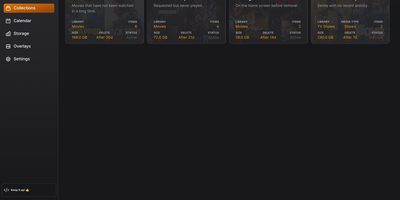
Automating media server storage reclamation, Maintainerr is an open-source library maintenance platform that identifies unwatched, abandoned, or stale movies and shows across Plex, Jellyfin, and Emby and clears them on a schedule. Storage drives fill up rapidly when household members request four-season series or high-bitrate films, watch a single episode, and abandon the rest indefinitely. Instead of forcing administrators to audit disks by hand, the rule engine evaluates metadata from your media server alongside Tautulli watch histories, Seerr and Ombi request records, and Radarr, Sonarr, or Sportarr profiles every eight hours. Matching items enter a staging collection that syncs back to your media server home screen as a Leaving Soon row, complete with dynamic poster overlays displaying the exact removal date so viewers have a grace period to finish watching. Before enabling any destructive workflow, you can run the Test Media inspector against any movie or episode to preview rule evaluations and protect favorites with global or per-collection exclusions. Once the countdown expires, the collection handler deletes or unmonitors files, updates import-list exclusions so automated lists never re-download removed titles, clears orphaned requests in Seerr and Ombi, removes leftover sidecar folders, and dispatches alerts through Discord, Slack, Telegram, Pushover, Gotify, Email, or webhooks. Running on a dedicated VPS on RepoCloud with guaranteed CPU, RAM, and SSD, full root SSH access, and a browser serial console. MIT licensed.
Z-Wave JS UI
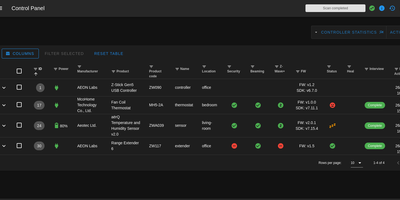
Managing dozens of smart locks, dimmers, thermostats, and sensors across a Z-Wave mesh often leaves homeowners blind to routing hops, sleepy battery devices, and firmware bugs; Z-Wave JS UI solves this by delivering a comprehensive browser control panel and MQTT gateway for your USB or network Z-Wave controller. Provision new devices with SmartStart QR scanning or S2 authenticated inclusion, inspect every Command Class parameter, and push over-the-air manufacturer firmware updates straight to switches and sensors. Interactive network topology graphs map live routing neighbors, link quality, and background RSSI signal strength, while built-in health checks and an integrated Zniffer packet analyzer pinpoint RF interference before automations fail. Operators can configure direct node-to-node association groups and multicast broadcast groups so wall switches trigger lights even when the central hub is offline. Scheduled Non-Volatile Memory controller backups and pre-inclusion restore points protect your mesh against hardware failure, and the configurable MQTT Discovery and WebSocket server bridges every entity seamlessly into Home Assistant, OpenHAB, Domoticz, Jeedom, and ioBroker. Running on a dedicated VPS on RepoCloud with guaranteed CPU, RAM, and SSD, full root SSH access, and a browser serial console. MIT licensed.
SuggestArr
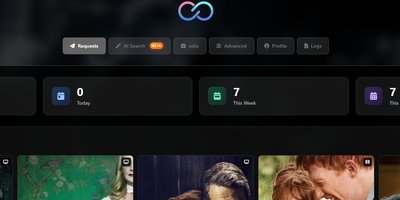
Instead of manually hunting for what to watch next after finishing a series on Plex, Jellyfin, or Emby, let SuggestArr turn your household's recent viewing history into automated media discovery and download requests. The platform analyzes recently watched movies, shows, and anime, queries TMDb or any OpenAI-compatible LLM (including Ollama, OpenRouter, and LiteLLM) for tailored recommendations with plain-language explanations, and dispatches requests straight to Seer, Jellyseerr, or Overseerr. Built-in AI Search lets users describe a mood or plot in natural language and request matching titles in a single click. Administrators can schedule recurring discovery jobs, import public watchlists from Trakt and MDBList, and enforce granular filters for minimum ratings, release years, genres, and regional streaming service availability so you never download content you already pay to stream. Smart request controls pause jobs when Seer queues are full, require optional human approval before submission, auto-decline stale requests, and clean up unwatched suggestions automatically. Running on a dedicated VPS on RepoCloud with guaranteed CPU, RAM, and SSD, full root SSH access, and a browser serial console. MIT licensed.
Donetick
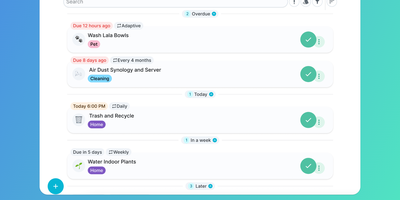
Recurring household chores and shared team checklists stay on schedule when Donetick coordinates assignments, reminders, and completion tracking from one self-hosted hub. Type a phrase like "change water filter every 6 months" and the natural-language parser extracts the due date and cadence automatically. Adaptive scheduling even adjusts future intervals from your actual completion history. Rotation rules distribute tasks fairly across family members or roommates via round-robin, random, or least-completed logic. Nested subtasks reset themselves each cycle. Finished chores earn points in the built-in gamification engine that members redeem in an admin-approved reward store. Stateful "Things" track numerical, boolean, or text metrics to trigger tasks automatically when values change. Tap physical NFC tags to check off chores on the spot, or mount a dedicated kiosk dashboard on a wall tablet for one-tap account switching. Real-time updates sync across devices alongside iCal calendar feeds, Home Assistant cards, OIDC single sign-on, and Pushover or Telegram notifications. Running on a dedicated VPS on RepoCloud with guaranteed CPU, RAM, and SSD, full root SSH access, and a browser serial console. AGPL-3.0 licensed.
What's Up Docker
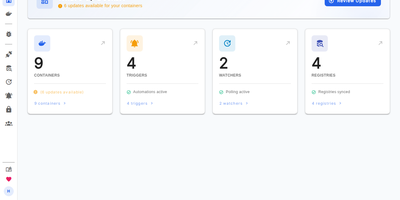
Does your container fleet silently fall behind on upstream patches until a critical vulnerability advisory forces an emergency audit? What's Up Docker continuously watches standalone Docker daemons, Compose stacks, Swarm services, Kubernetes workloads, and Nomad jobs to detect new image tags across public and private registries before sending alerts or rolling out updates automatically. Watchers connect over local sockets, TLS-secured TCP endpoints, kubeconfigs, or Nomad APIs to inventory active workloads without invasive sidecars. From there, registry connectors authenticate against Docker Hub, GitHub Container Registry, AWS ECR, Google Artifact Registry, Azure Container Registry, Quay, GitLab, Gitea, Forgejo, and self-hosted OCI registries to compare digests and tags. Flexible filtering rules let you restrict alerts to major, minor, or patch semantic version increments, match custom regular expressions, or pin specific tag patterns per container label. Once an eligible release appears, over thirty built-in triggers can dispatch notifications to Discord, Slack, Telegram, Matrix, Mattermost, Gotify, Ntfy, Pushover, Apprise, PagerDuty, or SMTP, publish events to MQTT, Kafka, RabbitMQ, or NATS, or recreate containers directly on demand. A responsive web dashboard and REST API provide manual update controls, OpenID Connect single sign-on with role-based access control, and Prometheus metrics for Grafana observability. Running on a dedicated VPS on RepoCloud with guaranteed CPU, RAM, and SSD, full root SSH access, and a browser serial console. MIT licensed.

Viseron
Homeowners and facility operators deploy Viseron to turn standard RTSP and ONVIF security cameras into a self-hosted network video recorder with local AI object detection, face recognition, and license plate reading. Instead of uploading private camera feeds to subscription cloud services, you monitor low-latency WebRTC live streams, scrub through an interactive event timeline, and review 24/7 continuous recordings directly from a responsive web dashboard. You can draw custom detection zones and privacy masks in the visual camera tuning editor to filter out street traffic, while lookback buffering captures footage several seconds before motion or an object triggers an event. Pluggable computer vision pipelines connect your cameras to YOLOv7 Darknet, Google Coral EdgeTPU, CompreFace, dlib, and CodeProject.AI to classify people, vehicles, known faces, and license plates in real time. Tiered storage policies automatically migrate older video segments from fast NVMe drives to high-capacity archival disks based on age and quota rules. Bidirectional MQTT integration and Home Assistant auto-discovery let you toggle cameras on demand, ingest external motion sensors, and dispatch instant snapshot alerts to Telegram or Discord. Running on a dedicated VPS on RepoCloud with guaranteed CPU, RAM, and SSD, full root SSH access, and a browser serial console. MIT licensed.
Pinchflat
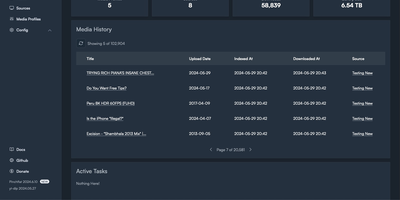
Archiving YouTube channels and playlists into a local media server becomes effortless with Pinchflat, a self-hosted media manager that automates downloading, naming, and organizing online video and audio libraries on disk. Instead of manually copying links into command-line downloaders, you define reusable Media Profiles with presets tailored for Plex, Jellyfin, Kodi, or raw archival storage, and then attach any number of YouTube channels or playlists as monitored sources. Fast Indexing polls RSS feeds or the YouTube API to detect newly published uploads within minutes while falling back to scheduled full scans so back-catalog videos are never missed. Granular source rules let you include or exclude YouTube Shorts and livestreams, filter titles by keyword patterns, enforce earliest upload cutoff dates, and set automatic retention windows that prune older files after a configured number of days. Built-in SponsorBlock integration marks or strips sponsor segments and embeds chapters alongside thumbnails, subtitles, and NFO metadata files so episodes appear cleanly inside your home theater library. You can also schedule Delayed Redownloads a few days after initial publication to capture higher-bitrate transcodes or crowd-sourced SponsorBlock tags, supply browser cookies for private playlists, and subscribe to any archived source in mobile podcast players through generated RSS feeds. Running on a dedicated VPS on RepoCloud with guaranteed CPU, RAM, and SSD, full root SSH access, and a browser serial console. AGPL-3.0 licensed.
Gitea Mirror
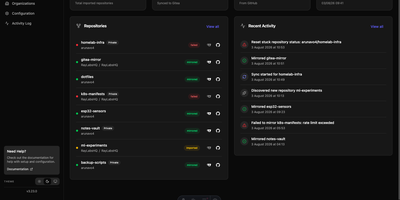
Gitea Mirror is an automated Git repository synchronization platform that mirrors your personal, starred, and organizational GitHub repositories directly to a self-hosted Gitea or Forgejo server. Through the web dashboard, you can connect standard GitHub accounts or GitHub Enterprise environments, discover newly created repositories automatically, and schedule recurring background sync intervals so your self-hosted forge always holds an up-to-date backup. Beyond raw Git commits and branches, the application transfers full repository metadata including issues, pull requests, labels, milestones, releases with attached assets, and project wikis. Teams managing large binary assets such as machine learning weights, media files, or game textures can enable Git LFS mirroring to replicate large objects alongside source code. Organization administrators can map entire GitHub organizations to custom destination namespaces, apply configurable fork handling strategies, preserve source visibility settings, and mark specific repositories to ignore. Built-in force-push protection detects destructive upstream history rewrites and offers backup-on-demand or block-and-approve workflows, while automatic cleanup rules prune deleted upstream repositories and expired activity logs. Access to the management console is secured with local accounts, reverse-proxy header authentication, or external SAML 2.0 and OpenID Connect identity providers. Running on a dedicated VPS on RepoCloud with guaranteed CPU, RAM, and SSD, full root SSH access, and a browser serial console. AGPL-3.0 licensed.
Spoolman
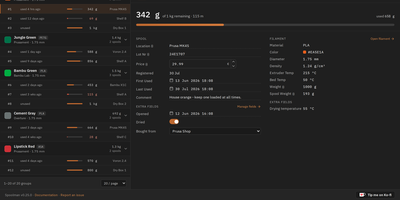
Running out of filament mid-print ruins multi-hour 3D printing jobs, and Spoolman solves this by tracking every gram of plastic across your entire workshop in a centralized, self-hosted inventory database. Connected directly to Klipper, Moonraker, Mainsail, Fluidd, OctoPrint, and OctoEverywhere, the service deducts filament weight automatically over live WebSockets as your extruders run. You can import manufacturer specifications from the community SpoolmanDB catalog, filter your library by color similarity or material type, and organize spools on a drag-and-drop board grouped by storage location or custom fields. A built-in label designer generates printable QR code sheets containing spool metadata, while NFC and RFID tag scanning lets you tap a physical roll against an ESPHome reader or Android phone to pull up its record immediately. Multi-printer workshops can monitor concurrent consumption from several machines simultaneously, expose inventory metrics to Prometheus and Home Assistant, and query stock levels through a Model Context Protocol (MCP) server. Running on a dedicated VPS on RepoCloud with guaranteed CPU, RAM, and SSD, full root SSH access, and a browser serial console. MIT licensed.
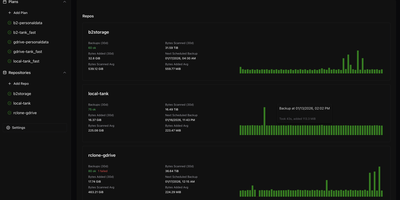
Backrest
Backrest turns the command-line restic backup engine into a visual, browser-managed disaster recovery platform that schedules encrypted snapshots, orchestrates repository maintenance, and restores individual files from a unified web dashboard. Import existing restic repositories or initialize new encrypted backup stores across Amazon S3, Backblaze B2, Google Cloud Storage, Azure Blob Storage, SFTP servers, local directories, and any storage provider supported by rclone. Define granular backup plans with directory inclusion lists, glob exclusion rules, and flexible schedules driven by cron expressions, hourly intervals, or last-run-time clocks that prevent missed backups after server downtime. Automated retention policies handle snapshot forgetting, repository pruning, and cryptographic integrity checks in the background without manual intervention. When a file is accidentally deleted or corrupted, open the interactive snapshot tree browser to inspect historical directory structures and download or restore specific files directly to disk. Pre-backup and post-backup shell command hooks let administrators dump databases or pause containers before snapshots start, while configurable alerts dispatch status reports to Discord, Slack, Gotify, Healthchecks, and Shoutrrr endpoints whenever an operation succeeds or fails. Running on a dedicated VPS on RepoCloud with guaranteed CPU, RAM, and SSD, full root SSH access, and a browser serial console. GPL-3.0 licensed.
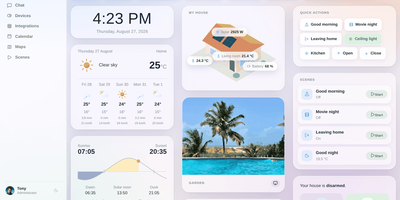
Gladys Assistant
If cloud-dependent smart home hubs and YAML-heavy configuration files leave your household at the mercy of vendor outages and broken scripts, Gladys Assistant puts your entire home under clean, point-and-click local control. Zero YAML required. Pair thousands of lights, thermostats, smart plugs, locks, and sensors directly through native Zigbee2MQTT, Matter, Z-Wave, and MQTT support, or install hundreds of sandboxed community integrations for Philips Hue, Shelly, Sonos, TP-Link Tapo, Netatmo, and Reolink cameras in a single click. Visual scenes make automation effortless. Trigger multi-step routines from motion sensors, sunrise schedules, house presence, calendar events, or electricity tariff changes, and chain conditional actions with delays, HTTP webhooks, and Telegram alerts. Customizable room dashboards display live RTSP camera streams, climate charts, weather forecasts, and interactive dimmer controls. Built-in energy monitoring tracks real-time wattage, historical kWh consumption, and utility contract costs across every circuit. Running on a dedicated VPS on RepoCloud with guaranteed CPU, RAM, and SSD, full root SSH access, and a browser serial console. Apache-2.0 licensed.
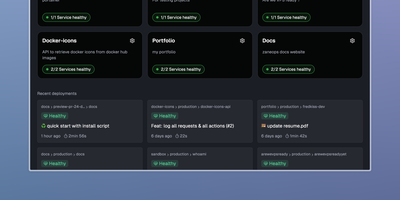
ZaneOps
Shipping a Git repository to a live HTTPS URL takes one dashboard and one server with ZaneOps, an open-source alternative to Heroku, Railway, and Render. Linked GitHub or GitLab repositories build with a Dockerfile, Nixpacks, Railpack, or a static directory builder. Deploys start by hand, on git push, or from a CI webhook. Blue/green releases keep the previous version serving traffic while the new one starts. Each pull request or merge request can open its own preview environment, and the API can create one on demand. Configuration edits queue up as changes that you review before a new version deploys. A pasted docker-compose.yml or a ready-made template (Postgres, Redis, WordPress) deploys a whole stack with blue/green rollouts. Every domain gets a free SSL certificate that renews itself. Wildcard hosts, permanent or temporary redirects, and several services under one domain all work. Runtime logs, request logs, metrics, and health checks gather in the dashboard. Services get CPU and memory limits and volumes, and environment variables import or export as .env files. Viewer, Member, Admin, and Owner roles decide who can see and change what; the free tier allows one workspace and three users. A web terminal opens a shell inside any running deployment, and a second one reaches the server itself over SSH. Running on a dedicated VPS on RepoCloud with guaranteed CPU, RAM, and SSD, full root SSH access, and a browser serial console. MIT licensed.
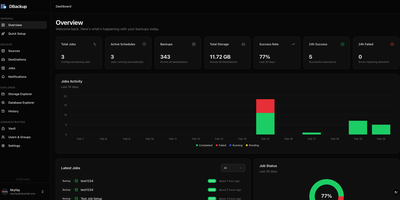
DBackup
When a bad migration or disk failure strikes at 3 AM, DBackup guarantees that your PostgreSQL, MySQL, MariaDB, MongoDB, SQL Server, Redis, Valkey, SQLite, and Firebird databases, along with the application directories that belong to them, are encrypted, verified, and ready to restore in a few clicks. Connect directly over TCP or tunnel through SSH with zero agents installed on your target servers. Bundle database dumps and Docker volumes or remote SFTP directories into a single atomic job so your schema and uploaded assets always share the exact same recovery point. Every archive is compressed with Brotli or GZIP, sealed with AES-256-GCM encryption before leaving the host, and pushed simultaneously to up to 14 storage backends including Amazon S3, Cloudflare R2, Hetzner, Google Drive, Dropbox, OneDrive, SMB, and WebDAV. Reusable Grandfather-Father-Son retention policies prune daily, weekly, monthly, and yearly snapshots automatically. Need to inspect live tables or recover a single file? Use the built-in Database Explorer, remap a dump into a staging schema, or extract individual files over HTTP byte ranges without downloading the entire archive. Even if your backup server goes offline, the downloadable Recovery Kit decrypts standard SQL dumps and plain TAR archives using a standalone script. Running on a dedicated VPS on RepoCloud with guaranteed CPU, RAM, and SSD, full root SSH access, and a browser serial console. GPL-3.0 licensed.
Cronmaster
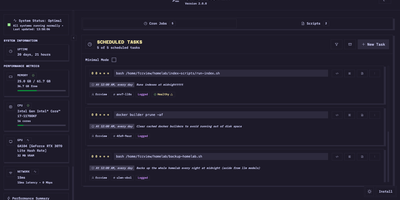
Silent background task failures and scattered crontab files across Linux hosts make routine maintenance risky, which Cronmaster solves with a visual scheduling dashboard and live execution log viewer. Five-field cron expressions translate automatically into plain English alongside one-click schedule presets. Operators can create, comment, clone, pause, or delete scheduled jobs across single or multiple Linux users in seconds. A built-in script manager lets you write, duplicate, and organize reusable Bash scripts from starter templates right inside the browser. Turning on per-job execution logging wraps commands automatically to record standard output, standard error, start and finish timestamps, duration, and exit codes. Log retention policies keep disk usage bounded automatically. Long-running tasks stream their console output live over Server-Sent Events, and any job can be triggered on demand with a single click. Across the top of the workspace, real-time hardware telemetry cards report system uptime, CPU load, memory consumption, network throughput, and GPU utilization. Administrators can protect the interface with local password authentication, OpenID Connect single sign-on with group and role rules, or Bearer API keys for the full REST API. Running on a dedicated VPS on RepoCloud with guaranteed CPU, RAM, and SSD, full root SSH access, and a browser serial console. AGPL-3.0 licensed.
OwnPilot
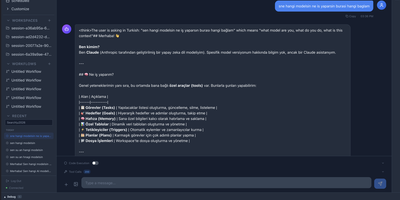
Bridging local hardware and cloud intelligence, OwnPilot orchestrates autonomous multi-channel agent swarms and visual workflow pipelines while keeping sensitive personal records strictly on private infrastructure. Users can trigger autonomous task runs that browse websites using headless browser automation, extract data tables, and summarize research directly into encrypted markdown notebooks. The built-in workflow canvas allows individuals to construct branching automation sequences combining large language models, conditional logic gates, iterative data loops, and human-in-the-loop approvals. Users delegate calendar scheduling, task tracking, expense budgeting, and contact lookups through conversational chats conducted over web portals, Telegram bots, or WhatsApp numbers. Operators can dispatch coding agents to inspect local repositories, execute shell commands in sandboxed environments, and stream live terminal logs as automated patches develop. The platform also enables home automation enthusiasts to monitor MQTT telemetric feeds from microcontrollers, queue device commands, and receive instant alert notifications when sensor thresholds trigger. Advanced security layers inspect all incoming prompts for personal data patterns, enforce strict permission boundaries across file directories, and generate tamper-evident audit logs for every autonomous tool call. Running on a dedicated VPS on RepoCloud with guaranteed CPU, RAM, and SSD, full root SSH access, and a browser serial console. MIT licensed.
VoucherVault
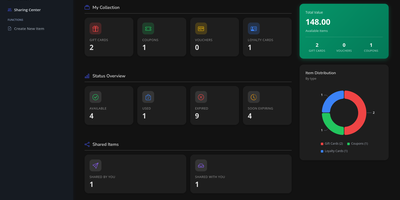
Stop losing money to forgotten paper gift cards and expired retail coupons by centralizing every voucher, loyalty barcode, and store credit inside VoucherVault, a self-hosted digital wallet accessible from any browser or mobile device. Point your phone camera at physical cards during item creation to scan 1D barcodes and 2D QR codes with automatic format detection, or upload original PDF receipts and image attachments directly to each entry. At the checkout register, pull up high-contrast QR codes and scannable barcodes instantly, even inside underground stores without cellular reception thanks to the manual 48-hour offline caching mode. Gift card balances update automatically as you log individual partial redemptions in the per-item transaction ledger. Configurable Apprise notification rules alert you 30 days and 7 days before any voucher expires across Telegram, Discord, Gotify, Ntfy, or email. Households and teams can share specific cards between accounts while keeping personal items private, and administrators can enable OpenID Connect single sign-on for frictionless login. Multi-currency conversion automatically calculates portfolio totals across international vouchers. A built-in REST API endpoint even exposes live portfolio counts and value statistics directly to Home Assistant dashboards. Running on a dedicated VPS on RepoCloud with guaranteed CPU, RAM, and SSD, full root SSH access, and a browser serial console. GPL-3.0 licensed.