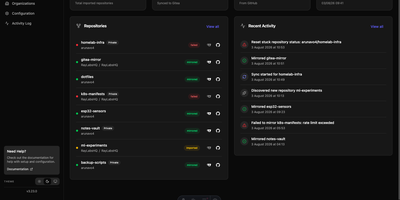
Gitea Mirror
Gitea Mirror is an automated Git repository synchronization platform that mirrors your personal, starred, and organizational GitHub repositories directly to a self-hosted Gitea or Forgejo server. Through the web dashboard, you can connect standard GitHub accounts or GitHub Enterprise environments, discover newly created repositories automatically, and schedule recurring background sync intervals so your self-hosted forge always holds an up-to-date backup. Beyond raw Git commits and branches, the application transfers full repository metadata including issues, pull requests, labels, milestones, releases with attached assets, and project wikis. Teams managing large binary assets such as machine learning weights, media files, or game textures can enable Git LFS mirroring to replicate large objects alongside source code. Organization administrators can map entire GitHub organizations to custom destination namespaces, apply configurable fork handling strategies, preserve source visibility settings, and mark specific repositories to ignore. Built-in force-push protection detects destructive upstream history rewrites and offers backup-on-demand or block-and-approve workflows, while automatic cleanup rules prune deleted upstream repositories and expired activity logs. Access to the management console is secured with local accounts, reverse-proxy header authentication, or external SAML 2.0 and OpenID Connect identity providers. Running on a dedicated VPS on RepoCloud with guaranteed CPU, RAM, and SSD, full root SSH access, and a browser serial console. AGPL-3.0 licensed.
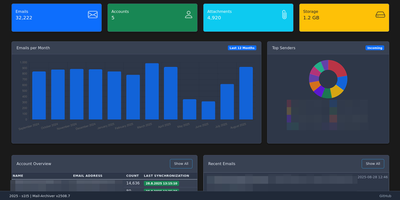
Mail-Archiver
Across personal mailboxes and business domains alike, Mail-Archiver captures, indexes, and preserves every incoming and outgoing email from multiple IMAP and Microsoft 365 accounts in a tamper-resistant archive. Connect standard IMAP servers, Microsoft 365 business tenants via Microsoft Graph, or personal Outlook and Hotmail accounts using OAuth2 device code flow without creating custom cloud app registrations. Scheduled background synchronization mirrors complete folder hierarchies automatically, while bulk tenant onboarding lets administrators import every active mailbox from a Microsoft 365 organization through a single configuration screen. When an important contract, invoice, or correspondence thread goes missing, the advanced search interface filters archived messages by sender, recipient, subject, date range, folder, and body text with instant HTML preview and direct attachment downloads. Users can import legacy MBox files or zipped EML archives, export selected messages or entire accounts, and run direct mailbox-to-mailbox migrations that copy folder trees between providers. Granular retention rules optionally purge aged messages from upstream mail servers to free quota while keeping local archive copies locked against manual deletion for compliance auditing. Multi-user access controls, OpenID Connect single sign-on, detailed activity audit logs, a scoped read-only REST API, and a Model Context Protocol endpoint allow both teams and AI assistants to query historical mail safely. Running on a dedicated VPS on RepoCloud with guaranteed CPU, RAM, and SSD, full root SSH access, and a browser serial console. GPL-3.0 licensed.
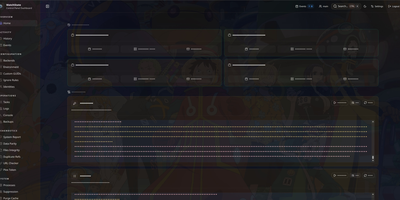
WatchState
Instead of relying on third-party cloud trackers to keep watched history aligned across Plex, Jellyfin, and Emby, WatchState synchronizes playback state and watch progress directly between your own self-hosted media servers. Household administrators can map multiple family members across independent backend accounts using isolated user identities, configuring either one-way mirroring from a primary server or full many-to-many synchronization across every connected instance. A unified generic webhook endpoint captures play, pause, stop, and watched events from Plex, Tautulli, Jellyfin, and Emby for near-instant state propagation, while scheduled background import and export tasks reconcile any missed updates automatically. When libraries grow across multiple servers, the built-in Media Health diagnostic engine audits the database for external GUID conflicts, duplicate file references, metadata disagreements, weak matches, and missing local files, complete with exportable reports and per-record action hints. Users can also search backend metadata, inspect detailed item event logs, and export portable JSON backups of their entire watch history for safe server migrations. Running on a dedicated VPS on RepoCloud with guaranteed CPU, RAM, and SSD, full root SSH access, and a browser serial console. MIT licensed.
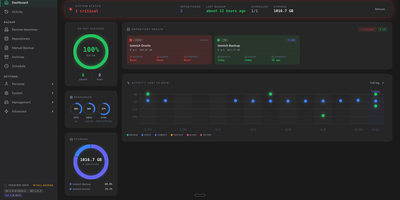
Borg UI
Borg UI is a self-hosted web management interface for BorgBackup that eliminates complex command-line syntax by organizing deduplicated backups, automated pruning schedules, and interactive file restorations into an intuitive graphical control center. System administrators connect local drives, remote SSH hosts, and SFTP endpoints to establish resilient storage repositories guarded by client-side encryption and cryptographic authentication. The centralized dashboard visualizes storage capacity, compression ratios, deduplication savings, and the health status of active backup jobs in real time. Configurable backup plans schedule automated cron jobs with granular retention rules, executing pre-backup database dumps and filesystem snapshots before running incremental syncs and background integrity checks. Users browse multi-version archive filesystems directly from the web browser, searching file trees and extracting individual files or entire folders without manual command line extraction. The platform orchestrates remote fleet backups by deploying SSH keys across client machines, tracking connection health, and executing non-disruptive background operations. Comprehensive alert routing dispatches real-time job status notifications, failure warnings, and storage alerts across Discord, Telegram, Slack, and email using integrated multi-channel messaging services. Running on a dedicated VPS on RepoCloud with guaranteed CPU, RAM, and SSD, full root SSH access, and a browser serial console. GNU AGPLv3 licensed.
Backrest
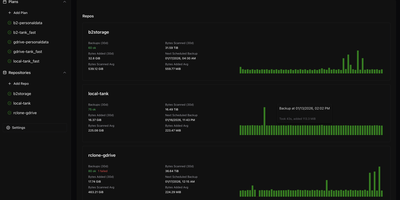
Backrest turns the command-line restic backup engine into a visual, browser-managed disaster recovery platform that schedules encrypted snapshots, orchestrates repository maintenance, and restores individual files from a unified web dashboard. Import existing restic repositories or initialize new encrypted backup stores across Amazon S3, Backblaze B2, Google Cloud Storage, Azure Blob Storage, SFTP servers, local directories, and any storage provider supported by rclone. Define granular backup plans with directory inclusion lists, glob exclusion rules, and flexible schedules driven by cron expressions, hourly intervals, or last-run-time clocks that prevent missed backups after server downtime. Automated retention policies handle snapshot forgetting, repository pruning, and cryptographic integrity checks in the background without manual intervention. When a file is accidentally deleted or corrupted, open the interactive snapshot tree browser to inspect historical directory structures and download or restore specific files directly to disk. Pre-backup and post-backup shell command hooks let administrators dump databases or pause containers before snapshots start, while configurable alerts dispatch status reports to Discord, Slack, Gotify, Healthchecks, and Shoutrrr endpoints whenever an operation succeeds or fails. Running on a dedicated VPS on RepoCloud with guaranteed CPU, RAM, and SSD, full root SSH access, and a browser serial console. GPL-3.0 licensed.
PG Back Web
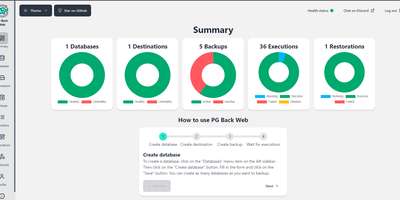
Automating PostgreSQL backup lifecycles across local volumes and S3-compatible object storage, PG Back Web gives database administrators and developers a self-hosted web console to schedule, encrypt, monitor, download, and restore database dumps without writing manual shell scripts. Instead of maintaining fragile crontab entries across individual database servers, you register PostgreSQL 13, 14, 15, 16, 17, or 18 instances in one dashboard and define recurring backup schedules with custom retention policies and timezone-aware timestamps. Each backup execution can target local directories or multiple S3 buckets across providers like AWS S3, MinIO, Backblaze B2, and Cloudflare R2, with built-in connection testing and presigned download links for rapid archive retrieval. To protect sensitive production records at rest and in transit, the platform applies PGP encryption to dump files while encrypting stored database connection strings and bucket credentials. Real-time execution logs record exact archive sizes, durations, and output streams, and the web interface lets operators trigger on-demand dumps, duplicate existing backup jobs, or run direct browser-based restorations when disaster recovery is required. Automated background health checks continuously verify connectivity to every registered PostgreSQL database and storage destination, firing configurable HTTP webhooks to Slack, Discord, or incident pipelines whenever a backup completes, fails, or changes health status. Running on a dedicated VPS on RepoCloud with guaranteed CPU, RAM, and SSD, full root SSH access, and a browser serial console. AGPL-3.0 licensed.
Open Archiver
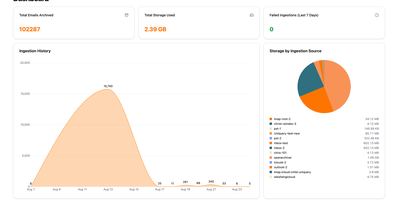
When a regulatory audit, legal discovery request, or employee offboarding requires years of verifiable email records, Open Archiver provides a tamper-evident, self-hosted vault for every message across your organization. Connect Google Workspace domains, Microsoft 365 tenants, personal Outlook OAuth accounts, or standard IMAP servers for continuous background synchronization, or upload historical PST, MBOX, and zipped EML archives in bulk. Every ingested message is deduplicated, compressed, and stored in standard EML format on local disks or S3-compatible object storage while SHA-256 cryptographic hashes verify file authenticity on demand through built-in Integrity Reports. Instant full-text search scans both message bodies and attached PDF or DOCX documents, letting compliance teams reconstruct complete conversation threads and enforce automated retention policies. Granular access control backed by an AWS IAM style policy engine, TOTP two-factor authentication, and an immutable audit trail keeps sensitive correspondence locked down. Running on a dedicated VPS on RepoCloud with guaranteed CPU, RAM, and SSD, full root SSH access, and a browser serial console. AGPL-3.0 licensed.
Garage
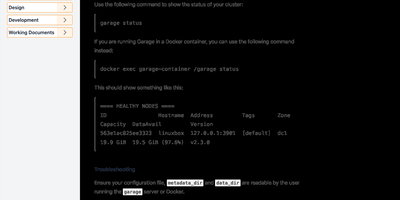
Picture your object storage scattered across a home server, a friend's rack, and a cheap VPS in another country, still answering S3 requests like nothing happened: that is exactly the deployment Garage was built for. Every object is replicated to three zones, so losing a node, a disk, or an entire site degrades the cluster instead of destroying your data. Applications talk to it with the standard S3 API: create buckets, upload objects in multiple parts, list and copy them, and hand out access keys that are scoped per bucket. A separate web endpoint serves static websites straight from buckets with CORS support, which covers personal sites, documentation, and release downloads without another server in the chain. The whole system ships as one dependency-free binary that asks for about a gigabyte of RAM and any x86-64 or ARM CPU from the last decade, second-hand hardware very much included. There is deliberately no consensus protocol to babysit: nodes gossip their cluster layout, tolerate 200-millisecond links, and keep serving reads while parts of the fleet are unreachable. Deuxfleurs runs it in production for their own hosting, and common pairings include restic or rclone backup targets, Matrix media storage, and Nix binary caches. Running on a dedicated VPS on RepoCloud with guaranteed CPU, RAM, and SSD, full root SSH access, and a browser serial console. AGPL-3.0 licensed.
DBackup
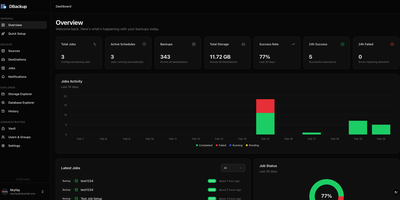
When a bad migration or disk failure strikes at 3 AM, DBackup guarantees that your PostgreSQL, MySQL, MariaDB, MongoDB, SQL Server, Redis, Valkey, SQLite, and Firebird databases, along with the application directories that belong to them, are encrypted, verified, and ready to restore in a few clicks. Connect directly over TCP or tunnel through SSH with zero agents installed on your target servers. Bundle database dumps and Docker volumes or remote SFTP directories into a single atomic job so your schema and uploaded assets always share the exact same recovery point. Every archive is compressed with Brotli or GZIP, sealed with AES-256-GCM encryption before leaving the host, and pushed simultaneously to up to 14 storage backends including Amazon S3, Cloudflare R2, Hetzner, Google Drive, Dropbox, OneDrive, SMB, and WebDAV. Reusable Grandfather-Father-Son retention policies prune daily, weekly, monthly, and yearly snapshots automatically. Need to inspect live tables or recover a single file? Use the built-in Database Explorer, remap a dump into a staging schema, or extract individual files over HTTP byte ranges without downloading the entire archive. Even if your backup server goes offline, the downloadable Recovery Kit decrypts standard SQL dumps and plain TAR archives using a standalone script. Running on a dedicated VPS on RepoCloud with guaranteed CPU, RAM, and SSD, full root SSH access, and a browser serial console. GPL-3.0 licensed.
Borg Backup Server
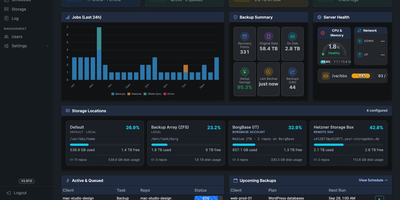
Every connection starts at the endpoint, never at the server, so Borg Backup Server can back up Linux, Mac, and Windows machines behind NAT and firewalls without opening a single inbound port. A lightweight agent on each machine polls for tasks over HTTPS, pushes deduplicated archives over SSH, and reports live progress. Append-only SSH access means an endpoint can add and restore archives but never prune or delete them. The dashboard shows backup charts, server stats, and active jobs at a glance. Plans run from hourly to monthly, several per client, built from reusable directory templates for common server roles, with per-plan retention from hourly to yearly. Lost a file? Browse the archive tree in your browser, tick what you need, and restore it to the client or download a .tar.gz. MySQL and PostgreSQL dumps run before each backup and restore as a copy or a replacement. Repositories can live on the server, on BorgBase, Hetzner, or rsync.net, and mirror to S3-compatible storage such as AWS, Wasabi, or Backblaze B2. Apprise alerts reach more than 100 services, and a nightly report lands in your inbox. Two-factor login and role-based access guard the console. Upgrades roll out to the server and every agent together, and the server backs itself up daily. Running on a dedicated VPS on RepoCloud with guaranteed CPU, RAM, and SSD, full root SSH access, and a browser serial console. MIT licensed.
Velld
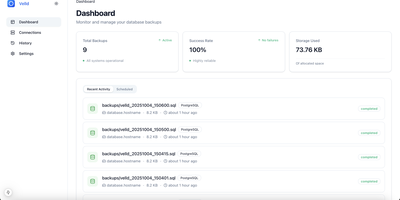
Database administrators and backend engineers managing production PostgreSQL, MySQL, MariaDB, MongoDB, and Redis instances use Velld to centralize scheduled backups, storage retention, and disaster recovery in a single self-hosted control plane. You can register multiple database connections across staging and production environments, test connectivity with one click, and route traffic through encrypted SSH bastion tunnels using password or private-key authentication to reach isolated private subnets. Flexible cron schedules and preset hourly, daily, weekly, or monthly intervals automate snapshot creation, while configurable retention policies purge expired archives from local volumes or S3-compatible object storage buckets after seven, fourteen, thirty, or ninety days. An integrated backup comparison tool renders split or unified line-by-line diffs between any two snapshots so you can inspect schema changes or data drift before triggering a guided database restore or downloading compressed dump files. The real-time monitoring dashboard tracks backup completion rates, total storage consumption, and execution histories alongside automated email and webhook alerts that notify your team immediately if a scheduled job fails. Running on a dedicated VPS on RepoCloud with guaranteed CPU, RAM, and SSD, full root SSH access, and a browser serial console. MIT licensed.