Quantum
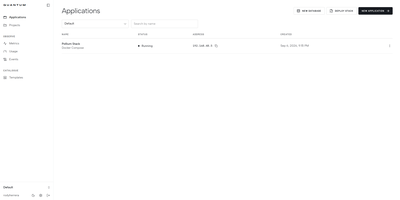
From a bare Linux server, Quantum builds and runs GitHub repositories, multi-service Docker Compose stacks, and managed databases through a self-hosted PaaS dashboard with automated webhook deployments and live container telemetry. Connect a GitHub account, pick a branch, and let the build engine compile from a Dockerfile or custom install, build, and start commands on every git push or release tag. Multi-service Compose files can be pulled from a repository or pasted into the editor, with automatic `${VAR}` placeholder detection and isolated internal networks so containers communicate by service name. Provision PostgreSQL, MySQL, MariaDB, MongoDB, and Redis instances with one-click backups, or deploy pre-configured templates for n8n, Directus, WordPress, Uptime Kuma, and Ollama. Live log streams, an interactive browser terminal, `.env` secret management, persistent volume mounts, and private registry credentials come built into every service view. Need to patch a file quickly? Clicking Open in VS Code launches a sidecar `code-server` instance mounted directly to the container filesystem. Organization and project roles enforce granular access while real-time CPU, memory, and network charts track health across 15-minute to 24-hour windows. Running on a dedicated VPS on RepoCloud with guaranteed CPU, RAM, and SSD, full root SSH access, and a browser serial console. MIT licensed.
What's Up Docker
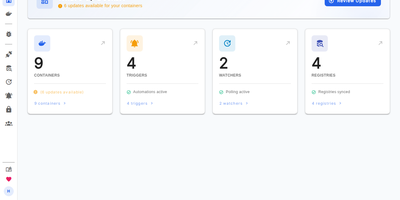
Does your container fleet silently fall behind on upstream patches until a critical vulnerability advisory forces an emergency audit? What's Up Docker continuously watches standalone Docker daemons, Compose stacks, Swarm services, Kubernetes workloads, and Nomad jobs to detect new image tags across public and private registries before sending alerts or rolling out updates automatically. Watchers connect over local sockets, TLS-secured TCP endpoints, kubeconfigs, or Nomad APIs to inventory active workloads without invasive sidecars. From there, registry connectors authenticate against Docker Hub, GitHub Container Registry, AWS ECR, Google Artifact Registry, Azure Container Registry, Quay, GitLab, Gitea, Forgejo, and self-hosted OCI registries to compare digests and tags. Flexible filtering rules let you restrict alerts to major, minor, or patch semantic version increments, match custom regular expressions, or pin specific tag patterns per container label. Once an eligible release appears, over thirty built-in triggers can dispatch notifications to Discord, Slack, Telegram, Matrix, Mattermost, Gotify, Ntfy, Pushover, Apprise, PagerDuty, or SMTP, publish events to MQTT, Kafka, RabbitMQ, or NATS, or recreate containers directly on demand. A responsive web dashboard and REST API provide manual update controls, OpenID Connect single sign-on with role-based access control, and Prometheus metrics for Grafana observability. Running on a dedicated VPS on RepoCloud with guaranteed CPU, RAM, and SSD, full root SSH access, and a browser serial console. MIT licensed.
Dock-Dploy
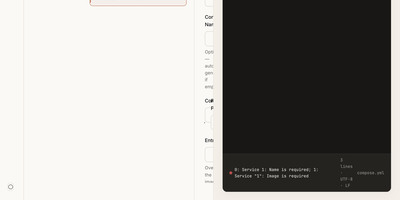
Visual drag-and-drop assembly replaces manual text editing in Dock-Dploy, a Docker Compose builder and configuration management suite that turns complex multi-service container topologies into validated YAML manifests. DevOps engineers and self-hosters can visually assemble application stacks by selecting container base images, defining healthcheck probes, mapping bridge networks, and assigning persistent volume mounts through a reactive web interface. An integrated marketplace catalog allows teams to search, preview, and import battle-tested templates for services like PostgreSQL, Redis, and Nginx with one click. Real-time Zod schema validation inspects every service parameter as you type, flagging port collisions, missing environment variables, and malformed volume syntax before deployment. A split-screen CodeMirror editor provides continuous synchronization between graphic form fields and generated YAML definitions with automatic code sanitization and clipboard exports. Beyond Compose stacks, operators can design blueprint templates, generate reverse proxy routing profiles, and assemble recurring cron schedules for automated backup and maintenance routines. Running on a dedicated VPS on RepoCloud with guaranteed CPU, RAM, and SSD, full root SSH access, and a browser serial console. AGPL-3.0 licensed.