Bknd
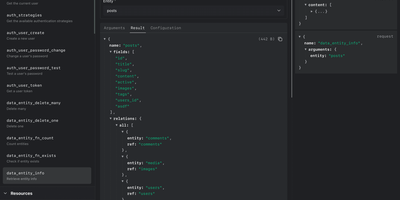
For developers who want a complete visual backend without stitching together separate database, auth, and storage services, Bknd delivers an all-in-one self-hosted Backend-as-a-Service platform with a built-in administrative dashboard. Data schemas evolve visually. Authentication strategies plug in cleanly. Media uploads route straight to object storage. Inside the interactive Admin UI, you can create relational entities, define field validation rules, inspect records, and test generated REST and OpenAPI endpoints on the fly. User management comes ready out of the box with configurable password and OAuth authentication flows, role-based access permissions, and row-level security policies for multi-tenant SaaS products. A unified media manager connects local filesystems, S3 buckets, Cloudflare R2, MinIO, or Cloudinary so applications can handle user avatars, document attachments, and galleries without custom upload pipelines. Visual workflow automation lets you chain triggers, HTTP tasks, and data mutations into repeatable backend flows, while an integrated Model Context Protocol server allows AI agents to query and manage application state directly. You can operate entirely through the visual dashboard, lock down production schemas in code-only or hybrid modes, and connect frontend interfaces using pre-configured login and upload elements. Running on a dedicated VPS on RepoCloud with guaranteed CPU, RAM, and SSD, full root SSH access, and a browser serial console. Apache-2.0 licensed.
Floci
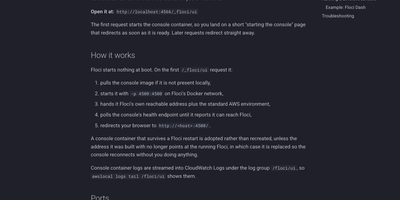
Floci is a local AWS emulator you run on your own server so your code can use S3, queues, Lambdas, and dozens of other AWS services without an AWS account, an auth token, or a bill quietly growing in another tab. Point the AWS CLI, SDKs, Terraform, CDK, or OpenTofu at port 4566 and keep the workflows you already have; every emulated service answers on that one endpoint, in any AWS region or partition. Existing LocalStack projects can swap the container image and keep going, because Floci accepts the same endpoint style and many of the same environment variables. Where emulation is not enough, real services come along too: RDS, ElastiCache, MSK, Neptune, DocumentDB, ECS, EC2, EKS, and CodeBuild run through actual Docker execution rather than a shallow stub, so tests meet behavior closer to production. A browser console starts on demand and lets you inspect the buckets, queues, tables, and other resources your emulator holds, without another tool to install. There is no telemetry, no credit meter, and no CI restriction; the whole feature set is the free set, ready for a developer laptop, a shared test host, or a pipeline runner. Running on a dedicated VPS on RepoCloud with guaranteed CPU, RAM, and SSD, full root SSH access, and a browser serial console. MIT licensed.
Atheos
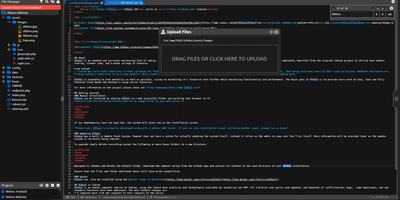
Open a browser anywhere and your development environment is already there: Atheos is a full code editor that runs on your server instead of your laptop, complete with projects, plugins, and multi-user accounts. The three-panel layout keeps the file and project manager on the left, a split-able editing area in the center, and system and plugin controls tucked on the right. Syntax highlighting covers more than 40 languages with over 20 color themes, smart auto-complete speeds up the typing, and error checking flags problems as you work. Multiple users get their own accounts, and real-time collaborative editing puts several cursors in the same file without merge chaos later. Advanced search tools sweep across project files, LocalStorage redundancy protects unsaved work against a dropped connection, and quick-download backups package a project in one click. A plugin library and marketplace extend the editor, from terminal access to Git tooling, and internationalization translates the interface for the rest of the team. There is no database to run: Apache and PHP on your server are the entire stack. Running on a dedicated VPS on RepoCloud with guaranteed CPU, RAM, and SSD, full root SSH access, and a browser serial console. MIT licensed.