Botpress
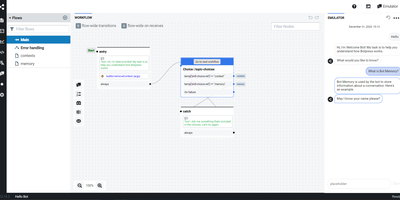
Build, deploy, and monitor chatbots and LLM-powered agents on one open-source conversational AI platform: Botpress. Its Studio is a visual development environment: a drag-and-drop canvas arranges conversation logic with nodes for messages, questions, choices, and actions, while a built-in emulator simulates conversations for debugging before anything goes live. Agents ground their answers in a knowledge base assembled from uploaded documents, ingested websites, and past conversations via retrieval-augmented generation, and the LLM layer connects to multiple model providers - GPT-4, Claude, Mistral - with a configurable model strategy. An autonomous engine handles reasoning, tool orchestration, persistent memory across sessions, and sandboxed code execution, and custom code actions in TypeScript extend agents past prebuilt workflows. Over 100 integrations deploy the same bot to WhatsApp, Telegram, Slack, Microsoft Teams, and web chat, and connect it to HubSpot, Zendesk, Zapier, and arbitrary APIs and webhooks. Human handoff, conversation analytics, and quality monitoring cover production operation. Originating in 2017 from a Montreal team, the community edition is developed openly on GitHub.
Lampline
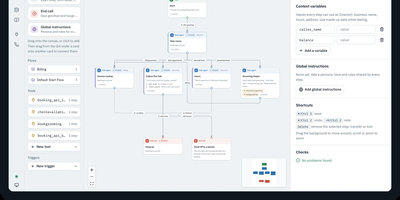
Once a voice agent is imported or built, Lampline connects it to a phone line, sends an AI caller to grade real calls, and keeps it all on your own server. Start by importing a Dialogflow CX or CX Agent Studio export along with a report of anything to check, or build fresh in a drag-and-drop builder that mixes LLM steps with scripted pages for exact lines and form fields. Next, pick one of 20 model providers, including Claude, OpenAI, Gemini, Bedrock, Groq, and DeepSeek, or run Ollama with local speech and no API keys. Test by chat or microphone while each step lights up, and let agents call HTTP and MCP tools and save records in collections of their own. Then connect callers through Twilio, Telnyx, or any SIP trunk, PBX, or session border controller via jambonz, with transfers to a person that carry the call's details as SIP headers. Finally, evals phone the agent over a real line, where an AI Test Caller brings background noise, accents, and interruptions, grades each transcript check by check, and reports typical and p95 response times as callers hear them. Each agent stays a folder of YAML and Markdown that you can review in git and lint or test with the vk CLI. Running on a dedicated VPS on RepoCloud with guaranteed CPU, RAM, and SSD, full root SSH access, and a browser serial console. Apache-2.0 licensed.
AstrBot
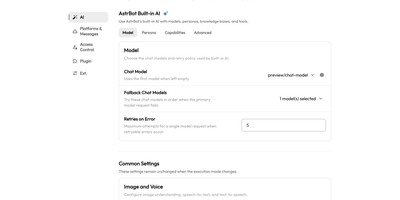
Getting a language model into the chat apps people already use takes a single self-hosted server running AstrBot, which answers in QQ, Telegram, Discord, Slack, Lark, DingTalk, LINE, and WeCom. The model itself is a setting. OpenAI-compatible endpoints, Anthropic, Google Gemini, DeepSeek, Ollama, and LM Studio all work, with fallback models and retry limits for failed requests, and Dify, Coze, or Alibaba Cloud Bailian can take over a conversation too. A bare model cannot act, so the built-in agent calls MCP servers and Skills, delegates to SubAgents, runs scheduled tasks, and executes code in an isolated sandbox. It cannot read your files either, so a knowledge base takes PDF, Word, Markdown, and EPUB uploads and searches them with hybrid dense and BM25 retrieval. Personas shape each bot's personality, and Whisper or Edge TTS adds speech. When an answer looks wrong, the ChatUI shows thinking, tool calls, token counts, and latency, and a per-message trace timeline shows how the bot got there. Because the panel steers the bot, administrator IDs, session whitelists, optional TOTP login, and HTTPS protect it. Backups live under System Settings, and the plugin market installs any of more than 1,000 extensions in one click. Running on a dedicated VPS on RepoCloud with guaranteed CPU, RAM, and SSD, full root SSH access, and a browser serial console. AGPL-3.0 licensed.