Onyx
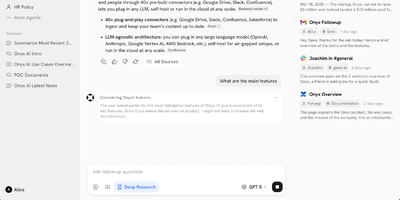
Formerly known as Danswer and now backed by over 31,000 GitHub stars with 253 releases, Onyx delivers a production-ready AI platform that turns any LLM into a context-aware enterprise assistant connected to your organization's actual knowledge. The agentic RAG pipeline combines BM-25 keyword search with prefix-aware embedding models in a hybrid index, then deploys AI agents to retrieve, verify, and synthesize answers with source citations from over 40 connected workplace tools including Google Drive, Confluence, Slack, Notion, Jira, SharePoint, GitHub, and Linear. Custom AI assistants with configurable prompts, backing knowledge sets, and document-level access control enable specialized agents for engineering, sales, support, and research workflows. The platform supports every major LLM provider — Anthropic Claude, OpenAI, Google Gemini, plus self-hosted options via Ollama, LiteLLM, and vLLM for fully air-gapped deployments. Beyond chat, Onyx provides web search with Serper, Google PSE, Brave, and SearXNG integration, an in-house web crawler, code execution, file creation, and multi-step deep research with report generation. Enterprise features include SSO via Google OAuth, OIDC, or SAML with SCIM provisioning, role-based access control, usage analytics by team and agent, query history auditing, PII removal through custom code hooks, and full whitelabeling. Deploy via Docker Compose on any infrastructure. Running on a dedicated VPS on RepoCloud with guaranteed CPU, RAM, and SSD, full root SSH access, and a browser serial console. MIT licensed (Community Edition).
AnythingLLM
Chat with your own documents: AnythingLLM, from Mintplex Labs, wraps retrieval-augmented generation (RAG) in an open-source application anyone can run. You organize content into workspaces, each an isolated namespace with its own documents, vector embeddings, chat history, and settings, so one instance can hold several separate knowledge bases. Upload PDFs, DOCX, TXT, and other formats, or scrape web pages; the built-in collector parses and chunks them into a vector database (LanceDB by default, with Pinecone, Chroma, Qdrant, and others supported). Answers cite their source documents. It works with both cloud LLMs (OpenAI, Anthropic, Gemini) and local ones via Ollama or LM Studio, and the embedding model is separately configurable. Beyond RAG chat, it includes AI agents that can browse the web and run tools, an embeddable chat widget for your website, a developer API, and multi-user mode with admin, manager, and default roles plus per-workspace access control. Context assembly is smarter than naive RAG: pinned documents, attached files, vector search hits, and recent chat history are combined under a token budget so the model's context window is filled efficiently, and each workspace supports multiple independent conversation threads against the same knowledge base. Because the embedding model, vector store, and chat LLM are all independently swappable, you can move between providers without re-ingesting a single document. The stack is Node.js with a React frontend, MIT-licensed.
QM
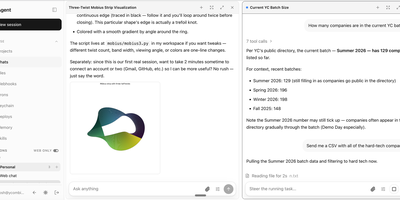
QM is Y Combinator's internal multiplayer agent infrastructure that shifts AI agents from personal assistants to shared company operating layer. The headless TypeScript core runs on Node.js with Fastify handling HTTP, Slack integration via Bolt, and a web UI built with Vite and Lit. PostgreSQL stores sessions, memory, queue state, and audit logs. Every person and every Slack channel gets an isolated sandbox with its own durable file system, installed tools that persist across runs, private memory, keychain view, permissions, and background crons. The harness-agnostic architecture routes agent tasks through Pi, OpenCode, Codex, or Claude Code without vendor lock-in, with production implementations swapping via a single wiring file. Three org-level security postures gate execution: Strict requires human approval for every tool call, Auto applies automated content screening, and Dangerous removes all pauses. Skills are scope-owned and shareable by grant, with admin-gated promotion to the entire organization and skill packs importable from Git repositories. The web apps feature lets agents spin up custom internal applications published to specific users. The qm CLI bootstraps operator-owned deployment directories with digest-pinned release images, infrastructure rendering, secret management, and live verification checks for Docker, Fly.io, or AWS ECS Fargate targets. On RepoCloud, deploy QM on a dedicated VPS with PostgreSQL persistence, Docker socket access, root SSH access, and complete control over your multiplayer agent infrastructure, all under the MIT license.
WeKnora
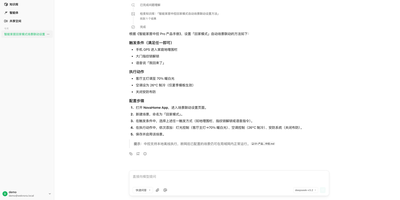
WeKnora turns scattered corporate documents into a searchable, reasoning-capable knowledge asset that your team can query in plain language and receive cited, sourced answers. Upload PDFs, Word files, web pages, Feishu wikis, Notion databases, Yuque docs, GitLab repositories, or RSS feeds into structured knowledge bases, and three distinct modes make the content actionable: RAG Quick Q&A retrieves relevant chunks and generates answers with source citations; the ReAct Agent autonomously orchestrates multi-step reasoning across knowledge retrieval, MCP tool calls, web search, and sandboxed code execution to produce comprehensive research reports; and Wiki Mode deploys LLM agents to distill raw documents into an interlinked markdown knowledge base with an interactive knowledge graph, revision history, and one-click rollback. Connect 20+ LLM providers including OpenAI, DeepSeek, Qwen, Claude, and local Ollama models without vendor lock-in, and choose from seven vector database backends (Qdrant, Milvus, Weaviate, and more) for embedding storage. Enterprise features include four-tier RBAC with per-resource ownership and per-workspace audit logs, AES-256-GCM credential encryption, scoped API keys, Langfuse observability tracing for every agent loop and tool call, and a runtime task-queue dashboard for worker-pool governance. Cross-session long-term memory preserves conversational context across interactions. The Agent Skills catalog lets teams install and share sandboxed scripts executed in Docker or E2B containers. A Chrome Extension captures web content directly into knowledge bases. Running on a dedicated VPS on RepoCloud with guaranteed CPU, RAM, and SSD, full root SSH access, and a browser serial console. MIT licensed.
Arkon
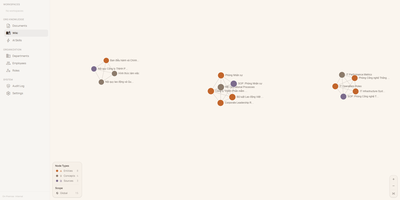
With 1,200+ GitHub stars since its April 2026 launch, Arkon provides an enterprise-grade knowledge management layer that turns scattered organizational documentation into AI-accessible structured context. The platform runs as a centralized MCP server, compiling your SOPs, policies, technical docs, and institutional knowledge into a versioned wiki with draft-approval workflows, then serving that wiki to Claude Desktop, Claude.ai, Cursor, and any MCP-compatible client through a single permission-scoped endpoint. OAuth 2.1 with PKCE authentication eliminates manual token management — employees authenticate through a browser login while the system discovers endpoints automatically via RFC 8414. The RBAC v2 system supports custom roles with granular permissions, department-scoped AI Skills, workspace isolation, and comprehensive audit logging so every query and access event is traceable. RAG retrieval powered by pgvector embeddings enables AI clients to search across all organizational documents with source attribution, while the AI Skills system lets teams define reusable instruction sets scoped to specific departments or roles. The architecture runs seven Docker containers coordinated by Compose: PostgreSQL with pgvector for embeddings and metadata, Redis for caching, MinIO for document storage, a FastAPI backend, two ARQ async workers for embedding generation and document processing, and a Next.js frontend portal accessible on port 3119. API keys are encrypted at rest with Fernet, and no telemetry leaves the deployment. Running on a dedicated VPS on RepoCloud with guaranteed CPU, RAM, and SSD, full root SSH access, and a browser serial console. PolyForm Internal Use licensed.
Utopia
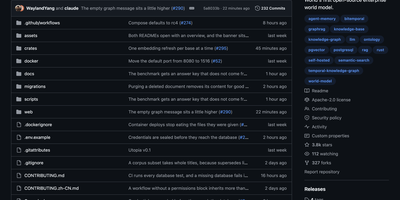
The first open-source substrate for enterprise knowledge engineering that learns passively and governs itself. The Rust-built backend paired with PostgreSQL and pgvector delivers a bitemporal knowledge graph where every fact carries two timelines: when it held in the real world and when the system came to believe it — enabling full audit trail replay of how understanding evolved. Document ingestion handles PDF, DOCX, PPTX, XLSX, CSV, Markdown, HTML, and plain text with legacy encoding detection, while scheduled syncing pulls from web pages, RSS feeds, GitHub, Jira, Notion, WebDAV, and S3-compatible buckets. Search fuses Tantivy full-text indexing with pgvector semantic vectors using Reciprocal Rank Fusion, streaming answers with inline citations that link directly to source passages. The built-in agent harness drives agentic RAG through conversation — searching documents, walking the knowledge graph at any historical date, and querying mounted databases via Ontology2SQL which achieves state-of-the-art results on BIRD Mini-Dev benchmarks. Five ontology packs ship inside the binary (schema.org, W3C Org, PROV-O, FOAF, IOF Core) with forward-chaining reasoning for transitivity, symmetry, inverses, and relation hierarchy. Entity resolution operates in three stages: exact name matching, embedding similarity, then model-based judgment with every merge reversible. Any OpenAI-compatible endpoint works including DeepSeek, Qwen, Ollama, and vLLM for fully air-gapped deployment. Running on a dedicated VPS on RepoCloud with guaranteed CPU, RAM, and SSD, full root SSH access, and a browser serial console. Apache-2.0 licensed.