Hermes Agent
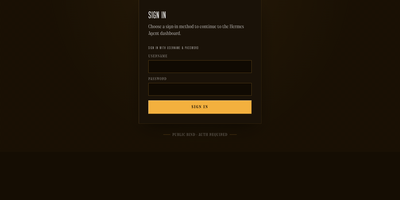
OpenRouter's most-used application by token volume — over 17 trillion tokens processed — Hermes Agent is an open-source autonomous agent built by Nous Research that lives on your server and gets more capable every day. Define a goal in natural language and Hermes plans sub-tasks, executes them through tool integrations, observes results, handles errors, and refines until the job is done or it genuinely needs your input. Persistent memory with full-text search and LLM summarization lets it recall context across sessions, and an agent-created skills system self-improves after complex tasks. A messaging gateway connects Telegram, Discord, Slack, WhatsApp, Signal, and 16 more platforms with cross-channel conversation continuity. A built-in cron scheduler runs daily reports, nightly backups, and weekly audits unattended. Subagent spawning parallelizes workstreams, and six terminal backends — local, Docker, SSH, Singularity, Modal, and Daytona — fit any infrastructure. Works with any LLM provider: Nous Portal, OpenRouter for 400+ models from 70+ providers, OpenAI, Anthropic, or your own endpoint. The API key you supply powers all LLM calls; billing goes through your own account. Running on a dedicated VPS with guaranteed CPU, RAM, and SSD, full root SSH access, and a browser serial console. MIT licensed.
OpenClaw VPS
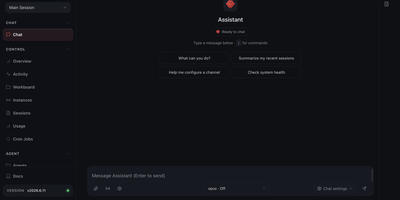
A personal AI assistant that remembers what it learns and reaches you wherever you are — OpenClaw is an open-source agent gateway built by the OpenClaw Foundation with 247,000+ GitHub stars. It connects to 200+ LLM models through providers like Anthropic, OpenRouter, and OpenAI, and meets you on 21+ messaging channels: Telegram, Slack, Discord, WhatsApp, Signal, iMessage, Matrix, and more. Persistent memory with full-text search lets the agent recall context across sessions, and a self-improving skills system means it gets more capable the longer it runs. Voice wake words and talk mode enable hands-free interaction on macOS, iOS, and Android. A live canvas provides an agent-driven visual workspace. Built-in browser automation, cron scheduling for unattended tasks, and subagent spawning for parallel workstreams round out the toolset. The gateway architecture keeps all sessions, credentials, and conversation history on your own server — nothing transits a third-party cloud unless you choose to connect one. The API key you provide for your chosen LLM provider powers the underlying calls; billing goes through your own account. Running on a dedicated VPS with guaranteed CPU, RAM, and SSD, full root SSH access, and a browser serial console. MIT licensed.
Xiryn
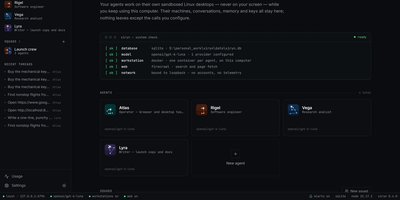
Picture a small staff of AI agents clocking in on your own server, each with a name, a specialty, its own model, and a private Linux desktop it can click around in. Every agent works inside a disposable Docker workstation with a shell, persistent files, and a Chromium browser, so it can research the web, write and run code, and finish multi-step tasks without touching your own files. You watch an agent click and type in real time, and when a login, payment, or one-time code needs a human, you take over the desktop, then hand it back with a note and let it continue. Pair a Telegram bot by scanning a QR code and you can assign work, answer questions, and receive results from your phone, with no public URL or port forwarding. Routines turn recurring requests into schedules, so a morning briefing, a price watch, or a weekly report runs by itself and reports back when it is done. Each agent can use a different model, from OpenAI, Anthropic, Google, xAI, Groq, Mistral, or DeepSeek to a local Ollama endpoint, and every reply shows its cost while a monthly budget pauses paid models automatically. Agents remember what matters about you across every thread, and logins or cards you save sit in an encrypted vault the agents themselves never see. Running on a dedicated VPS on RepoCloud with guaranteed CPU, RAM, and SSD, full root SSH access, and a browser serial console. MIT licensed.
Agenvoy
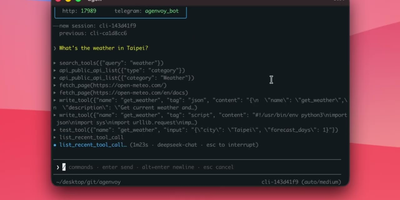
While ordinary chatbots sit idle between prompts, Agenvoy runs around the clock on your own machine, turning one-sentence requests into finished research, files, and reports. Say what you need once and it builds the missing tool itself, tests that tool inside a sandbox, saves it, and reaches for it again the next time a similar job appears. Recurring work becomes a schedule in plain words; a morning briefing, a watched folder, or a weekly report then runs unattended, and a long task interrupted mid-run resumes from its checkpoint instead of starting over. Ask questions about your own files and it searches them like a private archive, transcribing audio and video into text it can quote back to you. Each task is routed to the model tier that fits it, a light model for lookups and a heavy one for hard reasoning, across subscription logins, API keys from eleven providers, or a local Ollama that never phones home. Commands run in a sandbox with the network off until you approve a call, sensitive paths ask before they open, and credentials wait in the system keychain instead of the chat history. You drive it from the terminal, the browser dashboard, or Telegram and Discord when you are away from the desk, and it lends its sandboxed tools to Claude Code and Codex over MCP. Running on a dedicated VPS on RepoCloud with guaranteed CPU, RAM, and SSD, full root SSH access, and a browser serial console. AGPL-3.0 licensed.
II-Agent
II-Agent is an autonomous AI agent platform that ranked first on the GAIA benchmark by combining multi-step task planning with a full-stack execution environment spanning research, coding, browsing, and content creation. The platform runs a React frontend on port 1420 backed by FastAPI on port 8000, with PostgreSQL for persistence, Redis for task queuing, and MinIO for S3-compatible file storage, all deployable via Docker Compose. Users switch between Anthropic Claude, OpenAI GPT, and Google Gemini mid-conversation using bring-your-own-key authentication. Task domains include deep research with source triangulation, website and mobile app generation from prompts, storybook creation with illustrations, video and image generation via Google Veo and Imagen, presentation building with live collaborative editing, and document manipulation covering PDF extraction, Excel formulas, Word editing, and PowerPoint creation. Built-in connectors integrate Gmail, Slack, GitHub, Notion, Google Calendar, Discord, Dropbox, and Canva for workflow automation. A sandboxed code interpreter runs Python while browser automation with vision capabilities handles web interactions. Custom skills let teams package and reuse workflows. Context management handles up to 120,000 tokens with intelligent window sizing. 3,400+ GitHub stars. Apache-2.0 licensed.