Show Me The Story
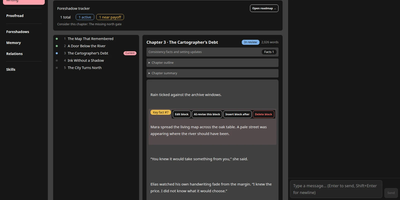
Somewhere between the brilliant novel idea you had in the shower and the finished manuscript sits a hundred hours of outlining, drafting, and continuity wrangling; Show Me The Story compresses that distance. Start with a synopsis and get a full chapter outline you can review, edit inline, or send back for revision before a single paragraph of prose exists. Once the outline is confirmed, the writing page drafts one chapter at a time with streaming output, then waits for your verdict: accept it, or highlight a passage and request a surgical revision that leaves the rest untouched. Characters, organizations, world rules, and relationships live in structured settings, complete with a relationship graph, and are woven into prompts automatically. A dedicated foreshadow system plans setups and payoffs chapters apart, tracks each thread from planted to resolved, and nudges you when one is overdue. After every chapter, extracted facts and a consistency check guard the story against contradictions, and an optional automatic mode keeps the chapters flowing while you supervise. Finished books can be diagnosed and polished in one pass, then exported as a single text file. Running on a dedicated VPS on RepoCloud with guaranteed CPU, RAM, and SSD, full root SSH access, and a browser serial console. MIT licensed.
TavernAI
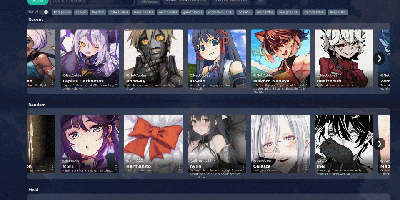
Character-based chat and storywriting with large language models: TavernAI is the open-source frontend that leaves model choice to you. It generates no text itself; it connects to the backend of your choice - OpenAI (including GPT-4), Anthropic Claude, KoboldAI and KoboldCpp, Oobabooga's Text Generation Web UI, NovelAI, Ollama, and the crowdsourced Horde - so cost, model quality, and content policy are decided by your backend, not the interface. Characters are defined by portable card files in PNG or JSON format with personality, scenario, and example dialogue, and tens of thousands of community-made cards from sites like Chub.ai import directly. Conversations support group chats with multiple characters, a story mode for long-form writing, message swiping to branch between alternative responses, and full editing of any message. World Info injects lore into context when keywords trigger, keeping long roleplays consistent. Themes, custom backgrounds, and configurable generation settings round out the interface. It runs on Node.js, and the SillyTavern project began as a fork of it.