Magento Open Source
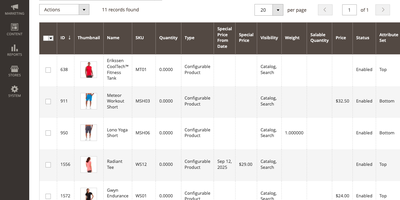
One admin panel, many storefronts: Magento Open Source is a free ecommerce platform for selling online under separate domains, category trees, languages, and currencies from a single install. Catalog managers create simple, configurable, grouped, virtual, bundle, and downloadable products and organize them with categories and attribute sets. Merchandisers assemble CMS pages, blocks, and product and category content in Page Builder by dragging rows, columns, tabs, banners, sliders, videos, and product lists onto a visual stage. Catalog price rules and cart price rules with coupon codes drive promotions, and customer groups such as Wholesale and Retailer can get targeted discounts and their own tax class. Shoppers browse the Luma storefront theme and check out as guests or with accounts. Staff then take each order through invoice, shipment, and credit memo, while Multi-Source Inventory tracks stock across warehouses, stores, and drop shippers. Built-in sales, customer, and product reports show what sells, and Login as Customer lets permitted staff view the storefront as an opted-in shopper sees it. Import and export tools move products and customers in bulk, and the REST and GraphQL APIs let ERPs, shipping tools, and headless front ends read and write store data. Running on a dedicated VPS on RepoCloud with guaranteed CPU, RAM, and SSD, full root SSH access, and a browser serial console. OSL-3.0 licensed.

GrandNode
GrandNode lets you run one shop, a dozen regional storefronts, or a full marketplace from a single installation, with a back office for every role involved. Each store gets its own domain, theme, currencies, languages, and settings, and a store manager panel limits staff to the catalog, orders, and customers of their own store. Outside sellers join through a vendor panel where they manage their own products and orders. The catalog handles attributes and combinations, bundles, grouped items, downloads, date-based reservations, and auctions. B2B selling adds customer groups, tier prices, sales employees, and approvals. Checkout accepts payments through plugins such as Stripe Checkout, Braintree, and cash on delivery, with shipping by fixed rate, weight, or pickup point and tax rules by country, state, or zip code. Marketing tools include coupon codes, discount rules, loyalty points, gift vouchers, customer segments, newsletter campaigns, and push notifications. Clean URLs, sitemaps, and structured data with price and availability help search engines read your products. Pages, blog posts, news, and sliders cover content, and a REST API serves headless storefronts and ERP or CRM integrations. Running on a dedicated VPS on RepoCloud with guaranteed CPU, RAM, and SSD, full root SSH access, and a browser serial console. GPL-3.0 licensed.
Smartstore
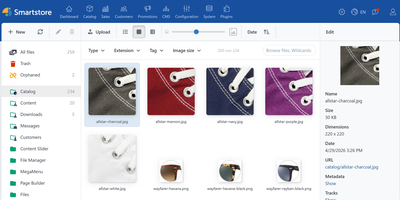
Smartstore is a self-hosted eCommerce platform that lets one install run several multilingual, multi-currency storefronts, with a drag-and-drop page builder and built-in AI writing tools. The catalog takes unlimited products and categories, with variants, bundles, grouped and downloadable products, tier pricing, and cross-selling, while faceted search keeps large assortments easy to filter. Shoppers get a responsive storefront with a streamlined checkout, reviews, wishlists, and wallet or gift-card payments; staff get order, shipment, and return handling plus a dashboard with sales statistics and bestseller lists. Marketing tools cover discounts, coupons, reward points, newsletters, affiliates, a blog, and forums, and the visual Rule Builder grants discounts, offers shipping and payment methods, and assigns customers to roles automatically. AI helpers draft product descriptions and meta tags with OpenAI, Gemini, Claude, DeepSeek, or a self-hosted Ollama model, and image tools create or edit pictures. A Media Manager organizes images and files in folders with filters and metadata. Import and export profiles move catalogs in and out on a schedule, a REST API connects other systems, and tree-based permissions decide which staff roles may do what. The Docker image starts a browser installer that connects to MySQL, PostgreSQL, or SQL Server. Running on a dedicated VPS on RepoCloud with guaranteed CPU, RAM, and SSD, full root SSH access, and a browser serial console. AGPL-3.0 licensed.