n8n
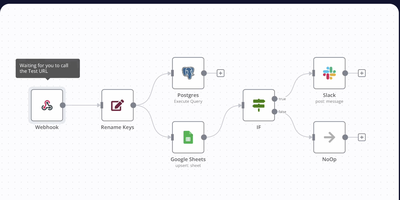
Webhooks, cron schedules, and app events trigger chains of nodes that fetch, transform, and route data: n8n is a workflow automation platform built around a visual, node-based editor. It ships with 400+ built-in integrations covering databases like Postgres, SaaS tools like Slack and HubSpot, and every major AI provider. When a pre-built node does not exist, the HTTP Request node calls any REST API, and the Code node runs JavaScript or Python inline, so you are never blocked by a missing connector. Workflows execute as directed graphs with branching, loops, error handling, and sub-workflows, and every run is logged for inspection and replay during debugging. It also includes LangChain-based nodes for building AI agents with tool calling and memory. Self-hosting on RepoCloud gives you unlimited workflow executions with no per-task pricing, and all data stays on your instance. Runs on Node.js with SQLite by default; add Postgres and Redis queue mode when you need to scale workers horizontally.
Activepieces
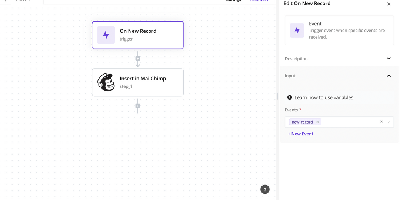
Zapier's job, on your own server: Activepieces is an open-source workflow automation platform built to be exactly that replacement. Flows are built in a visual no-code editor with triggers, actions, loops, conditional branches, auto-retries, raw HTTP steps, and code steps that run JavaScript or TypeScript with full npm package support. Integrations are "pieces" - type-safe TypeScript npm packages with hot reloading for local development - and the catalog spans 600+ services, with the large majority contributed by the community. The platform is AI-first in two directions: native AI pieces call OpenAI, Anthropic, Google, and Azure models inside flows, and every piece automatically doubles as an MCP server, so assistants like Claude Desktop and Cursor can invoke your integrations and workflows through natural language. A built-in MCP server also exposes 30 tools for building flows, managing tables, and running tests agentically. Flows are fully versioned with draft and locked states. The core is MIT-licensed and runs on TypeScript with PostgreSQL and Redis.
Open Connector
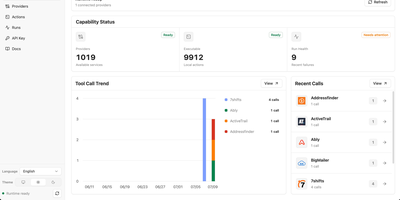
With over 5,000 GitHub stars since its June 2026 launch, OOMOL OpenConnector bridges the gap between AI agents and the real world by handling the authentication nightmare that stops LLMs from calling external APIs safely. The runtime connects to more than 1,000 SaaS providers — GitHub, Gmail, Notion, Slack, Microsoft, HubSpot, Google Workspace, and hundreds more — through 10,000+ prebuilt typed Actions that agents can discover and execute without ever touching raw credentials. OAuth2 flows, API key rotation, custom credentials, and no-auth providers are all managed centrally with AES-encrypted storage, scoped runtime tokens, and configurable action allowlists and blocklists that enforce least-privilege access. Agents interact through five access surfaces: the Model Context Protocol endpoint at /mcp for Claude and other MCP-capable hosts, a full REST API at /v1 for programmatic control, an auto-generated OpenAPI specification for code generation, a TypeScript SDK for application integration, and the oo CLI for local agent relay. The built-in Web Console provides browser-based administration for configuring OAuth apps, managing connections, inspecting action schemas, and reviewing execution logs with redacted inputs. Deploy via Docker Compose with SQLite for single-server setups, run from source on Node.js 22+, or push to Cloudflare Workers with D1 and R2 for edge deployment. Running on a dedicated VPS on RepoCloud with guaranteed CPU, RAM, and SSD, full root SSH access, and a browser serial console. Apache 2.0 licensed.
Automatisch
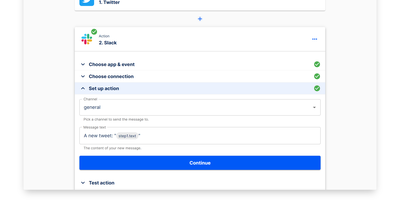
Automatisch runs your Zapier workflows on your own hardware - an open-source, self-hosted automation platform built as a direct alternative. Flows are chains of steps: one trigger (a polling or webhook event such as a new GitHub issue, a Stripe payment, or a form submission) followed by action steps that pass data downstream (post to Slack, append a Google Sheets row, update Notion). The visual builder deliberately mirrors Zapier's trigger-action model, so migrating existing Zaps requires no retraining and no programming knowledge. Roughly 60 integrations cover common business services - Slack, GitHub, Google Sheets, Notion, Stripe, Discord - and connections store credentials per service, with multiple accounts per app supported. Every execution runs on your own server: execution history, logs, and payload data never touch a third-party processor, which matters for GDPR, healthcare, and finance workloads. Error handling with retry logic, a REST API for programmatic flow management, and Docker Compose deployment round out the platform. The AGPL-3.0 Community Edition has no feature limits or per-task billing; an Enterprise Edition adds SSO, roles, and audit logs.