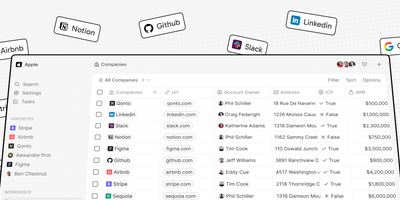
Twenty
Salesforce's core workflow, open-source and on your own server: Twenty is a modern CRM built as exactly that alternative. It ships the standard CRM objects out of the box: people, companies, opportunities, notes, and tasks, displayed in table and kanban views with drag-and-drop and real-time updates. Its defining technical feature is a metadata-driven data model: you define custom objects and fields in the UI, and the backend regenerates its GraphQL schema at runtime, so a new object gets working queries, mutations, filters, and sorting within seconds, with no migrations to run - adapting the CRM to your sales process never requires code changes. A REST API is auto-generated from the same schema, GraphQL subscriptions push real-time updates, and webhooks fire on record changes for external integration. A visual workflow builder automates actions like notifications and field updates, TypeScript-based apps extend the platform with custom logic and frontend components, and email and calendar sync pulls Gmail messages and meetings onto contact timelines so communication history sits next to the record. The stack is NestJS with TypeORM, PostgreSQL, Redis, and BullMQ on the backend, React with Jotai on the frontend. Self-hosting on RepoCloud means unlimited users with no per-seat licensing - the pricing model that penalizes growing teams on commercial CRMs - and your pipeline, contacts, and deal history live in your own PostgreSQL database rather than a vendor's.
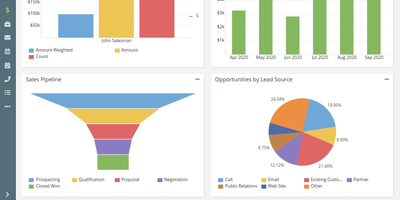
EspoCRM
Teams tired of paying Salesforce or HubSpot per seat run EspoCRM: an AGPL-licensed PHP application with a fast single-page frontend over a REST API, covering sales, support, and marketing in one uncluttered interface. The sales core is complete - leads, contacts, accounts, opportunities with customizable pipeline stages, kanban views, calendars, meetings, and calls. Email is deeply integrated rather than bolted on: IMAP sync links messages to CRM records automatically, and mass email campaigns run with reusable templates, tracking, and Web-to-Lead forms feeding the funnel. Support teams get case management and a customer portal where clients track their own tickets and access a knowledge base. The real differentiator is the Entity Manager: create custom entities, fields, relationships, and layouts from the admin UI without code, with dynamic logic showing or hiding fields conditionally - EspoCRM is as much a business-application platform as a CRM. Formula scripting handles calculated fields and record automation in the free core; the optional Advanced Pack adds visual BPM process design and workflow rules. Role-based permissions with team and territory scoping, full-text search, reports, and a straightforward REST API for n8n or custom integrations round it out. Runs on PHP 8.3+ with MySQL, MariaDB, or PostgreSQL - unlimited users, zero per-seat fees.
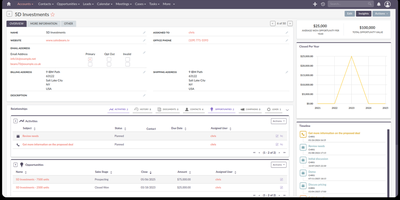
SuiteCRM
Your customer relationships deserve better than a spreadsheet and a prayer: SuiteCRM gives sales, support, and marketing teams one shared system for every account, contact, lead, and deal. Track opportunities through your pipeline with stages, amounts, and close dates, then quote and invoice directly from the won deal without retyping a single line item. Support agents work cases with queues, assignments, and email threading, while marketers build target lists, run email campaigns, and measure opens and clicks against the same records sales uses. Reports query across any modules with grouping, aggregation, and charts, export to CSV or PDF, land on dashboards as dashlets, and arrive by scheduled email so Monday's pipeline review writes itself. Workflow rules react to record changes by sending notifications, creating tasks, updating fields, or calling webhooks, quietly handling the follow-up work humans forget. Roles and security groups decide exactly which teams see which records, down to individual fields, and the audit log remembers every change. Administrators reshape the system without code in Studio, adding fields (including image and file fields), rearranging layouts, and building whole custom modules, while the REST API connects SuiteCRM to your website forms, telephony, and accounting tools. Running on a dedicated VPS on RepoCloud with guaranteed CPU, RAM, and SSD, full root SSH access, and a browser serial console. AGPL-3.0 licensed.
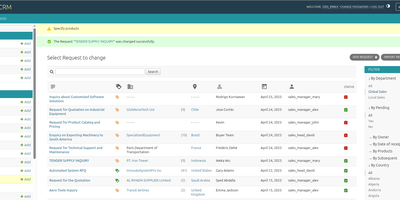
Django-CRM
Small teams that have outgrown spreadsheets but balk at per-seat CRM pricing can run Django-CRM on their own server, with leads, deals, tasks, and email campaigns in one self-hosted system. Requests from website contact forms arrive automatically, email requests are imported from the company mailbox, and each gets a unique ticket and is matched against existing companies, contacts, and leads. When nothing matches, a new lead is created and later converted into a company and contact person. Deals carry products, payments, currencies, and price tiers, and the price list exports to Excel. Tasks can be individual or team-based with subtasks, memos can spawn tasks or projects, and participants chat and share files inside each one. Eight analytics reports cover the sales funnel, income forecasts, lead sources, conversions, and closing reasons. The built-in email client works over SMTP and IMAP, supports Gmail through OAuth 2.0, and links each message to its request, lead, or deal. Mass mailings are spread through the workday and can use additional mailboxes to protect managers' main accounts from spam filters. Web forms are protected by reCAPTCHA v3, IP geolocation fills in each requester's country and city, and VoIP callbacks and WhatsApp or Viber messages are supported. Object-level permissions control who can view, add, change, or delete each record, and the interface offers 22 languages. Running on a dedicated VPS on RepoCloud with guaranteed CPU, RAM, and SSD, full root SSH access, and a browser serial console. AGPL-3.0 licensed.
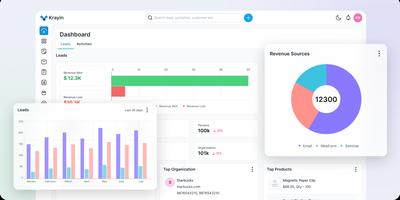
Krayin CRM
Krayin CRM gives sales teams a visual Kanban pipeline where leads flow through configurable stages — new, contacted, qualified, proposal, won, lost — with deal values tracked per stage, drag-and-drop transitions, and AI-powered document import that extracts contact details from uploaded PDFs, DOCs, and images without manual data entry. Built on Laravel 12 with a Vue.js frontend and MySQL database, the platform delivers complete customer lifecycle management through a two-stage contact model separating unqualified Leads from qualified Persons linked to Organizations, with a unified timeline displaying associated activities, notes, emails, and deals. The activity module schedules calls, meetings, and tasks on a drag-and-drop calendar with reminders and team assignment. A built-in product catalog supports line-item quoting with pricing and quantities. Email integration connects via SMTP, IMAP, and SendGrid parsing, linked to leads and contacts automatically. Workflow automation triggers actions on conditions and pushes events to external systems via webhooks. The dashboard visualizes pipeline performance, top customers, top products, and email engagement with pie charts and trend widgets. Custom attributes add text, number, date, boolean, and dropdown fields to any entity. Role-based ACLs manage team permissions per module. Extensions add multi-tenant SaaS, WhatsApp lead generation, and VoIP calling. Deploy via Docker Compose. Running on a dedicated VPS on RepoCloud with guaranteed CPU, RAM, and SSD, full root SSH access, and a browser serial console. MIT licensed.
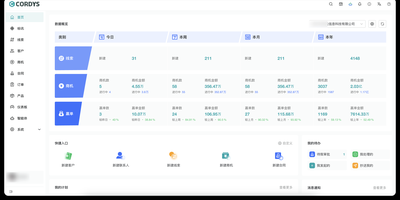
Cordys CRM
Follow every sale from first inquiry to final payment inside one self-hosted CRM. Cordys CRM splits the lead-to-cash cycle into connected modules: leads with custom forms and one-click conversion, customers with contact records and shared follow-up among team members, and opportunities that advance through configurable stages from needs confirmation to won or lost. Quotations and contracts come next, with contracts carrying payment plans, payment records, business titles, and invoice records so every collection stays traceable. Orders link to contracts and move through a customizable status flow covering shipment requests, partial and full shipment, inspection, and completion. Approval workflows route requests to reviewers and keep an approval history, and real-time notifications reach users while they work. Administrators draw the organization chart, assign role-based permissions, configure modules and form fields without code, and review system logs. An MCP server secured with per-user API keys lets MaxKB agents search records, create leads, customers, opportunities, and contacts, log follow-ups, and update accounts, while an Agents module embeds those assistants in the CRM and CRM Skills connect OpenClaw and WorkBuddy to the sales process. Sales data can feed DataEase dashboards, WeCom, DingTalk, and Lark integrations link departments and messages to the office platforms teams already use, and the interface ships in English and Chinese. Running on a dedicated VPS on RepoCloud with guaranteed CPU, RAM, and SSD, full root SSH access, and a browser serial console. GPL-3.0 licensed with FIT2CLOUD branding terms.
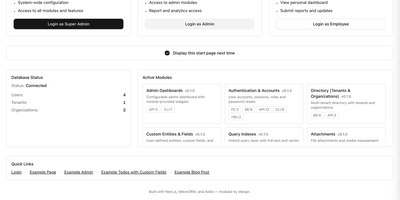
Open Mercato
Your next business system does not need a year of scaffolding: Open Mercato hands you a running CRM, ERP, and commerce back office, and your team builds only the logic that makes your company different. Deals and pipelines live next to the product catalog, so a quote pulls real variants, price lists, and stock without swivel-chair exports. Orders flow into invoices, shipments, and payments in one motion, while warehouse lots and stock movements keep fulfillment honest about what can actually ship today. Customers and partners stop emailing your team for status: the self-service portal takes B2B orders, shows tracking, and files warranty claims directly. When a record needs a field nobody planned for, an administrator adds the custom entity from the panel, no migration deploy, and shapes its lifecycle with per-tenant workflows and business rules. Every change lands as an auditable command with an author attached, so mistakes get undone, sensitive columns get encrypted per tenant, and several companies share one install without seeing each other's data. Storefronts and mobile apps plug into generated REST APIs with OpenAPI documentation, attachments turn searchable through OCR, and AI coding agents extend the system because the architecture conventions are written down for them. Running on a dedicated VPS on RepoCloud with guaranteed CPU, RAM, and SSD, full root SSH access, and a browser serial console. MIT licensed.
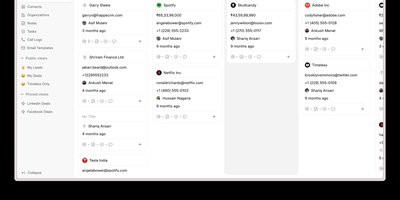
Frappe CRM
With 3,300+ GitHub stars, 200+ releases, and v1.77 shipping in July 2026, Frappe CRM delivers enterprise CRM capabilities without per-seat licensing costs that plague Salesforce and HubSpot deployments. The Python backend running on Frappe Framework v15/v16 with MariaDB and Redis pairs with a Vue 3 frontend using Pinia state management, Vue Router, and the Frappe UI component library styled with Tailwind CSS v3. All-in-one lead and deal pages consolidate activities, comments, notes, tasks, call logs, and email history into a single scrollable view while the drag-and-drop Kanban board provides visual pipeline tracking across configurable stages. Built-in Twilio integration enables click-to-call with recording directly from deal pages, Exotel routes calls through agent mobile phones, and WhatsApp messaging connects via the Frappe WhatsApp module for conversational sales. A visual field layout editor lets non-technical users customize CRM forms, sidepanels, and grid views with real-time drag-and-drop without writing code. The Service Level Agreement engine tracks first-response and rolling-response times against configurable policies with automatic escalation. Meta integration captures leads from Facebook and Instagram ad campaigns directly into the pipeline. ERPNext connectivity extends CRM into invoicing, accounting, inventory, and purchasing with native data flow. Docker Compose deployment with a single command provisions a production-ready instance. Running on a dedicated VPS on RepoCloud with guaranteed CPU, RAM, and SSD, full root SSH access, and a browser serial console. AGPL-3.0 licensed.