AnythingMCP
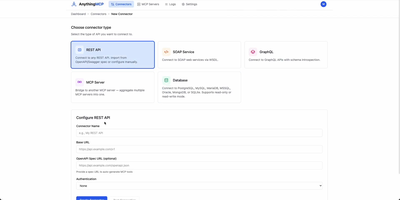
Connecting autonomous AI assistants to internal enterprise databases and legacy systems is streamlined by AnythingMCP, a visual Model Context Protocol gateway with automated knowledge graph generation and granular access controls. Engineers can import OpenAPI specifications, Postman collections, SOAP WSDL files, or raw database credentials to generate standardized Model Context Protocol tools in minutes without writing custom code. The built-in knowledge graph automatically maps entity relationships across disparate databases and software platforms, teaching agents how to correlate customer records in CRM tools with live order histories in enterprise resource planning software. System administrators can enforce fine-grained access policies by restricting tool execution permissions to specific roles and scoping database operations to read-only queries with strict row limits. An interactive web console provides real-time tool inspection, payload testing, request tracing, and comprehensive audit logs that capture every upstream invocation with full parameter visibility. Enterprise teams can integrate identity providers through OAuth2, SAML single sign-on, and SCIM automated user provisioning while protecting sensitive credentials using AES-256-GCM encryption at rest. Running on a dedicated VPS on RepoCloud with guaranteed CPU, RAM, and SSD, full root SSH access, and a browser serial console. GNU AGPLv3 licensed.
OpenRun
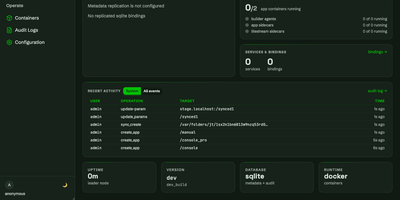
OpenRun replaces the patchwork of CI/CD pipelines, reverse proxies, and identity providers that teams typically assemble when deploying internal tools, offering declarative GitOps-based deployment of web applications to Docker, Podman, or Kubernetes from a single self-hosted Go binary. Point it at a Git repository and it builds containers from AppSpec templates, routes requests by domain or URL path, provisions TLS certificates automatically, and scales idle applications to zero when unused. Blue-green staged deployments promote new versions through development, staging, and production environments with atomic rollback across multiple apps simultaneously. Every deployed application inherits SSO authentication through OAuth, OpenID Connect, or SAML providers alongside role-based access control, all configured once at the platform level rather than per app. Service bindings provision isolated PostgreSQL, MySQL, SQLite, or Redis credentials for each application, while Litestream integration replicates SQLite databases to S3 for automatic disaster recovery. The management console provides a web interface for monitoring containers, reviewing audit logs, configuring syncs, and managing server operations. AppSpec templates handle Streamlit, Gradio, FastAPI, Flask, and FastHTML projects out of the box, deploying existing Python applications without requiring custom Dockerfiles. Running on a dedicated VPS on RepoCloud with guaranteed CPU, RAM, and SSD, full root SSH access, and a browser serial console. Apache-2.0 licensed.
QuickStack
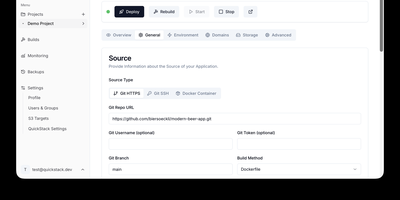
QuickStack transforms your standalone Linux server or cluster into a self-hosted platform-as-a-service that automatically compiles, deploys, and monitors full-stack applications and relational databases without vendor lock-in. Developers can trigger instant deployments directly from public or private Git repositories, upload custom Dockerfiles, or pull container images straight from private registries with automated webhook synchronization. The built-in application catalog enables one-click provisioning of production databases including PostgreSQL, MySQL, MariaDB, MongoDB, and Redis with preconfigured internal network isolation. Administrators can route traffic across custom domains with automated Let's Encrypt SSL certificate issuance, inspect real-time CPU and memory telemetry, stream container runtime logs, and launch in-browser web terminals. Teams can configure granular role-based access controls with single sign-on authentication, establish zero-trust ingress and egress network security policies, and orchestrate automated volume snapshots directly to S3 object storage. When infrastructure requirements expand, operators can attach additional worker nodes using lightweight join tokens to distribute workloads seamlessly across high-availability compute pools. Running on a dedicated VPS on RepoCloud with guaranteed CPU, RAM, and SSD, full root SSH access, and a browser serial console. GNU GPL v3.0 licensed.
Fynt
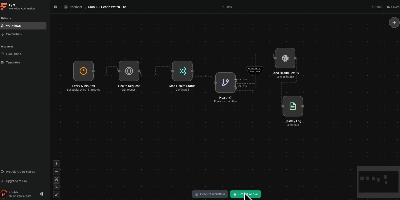
A clean alternative to n8n and Zapier that puts AI-native workflows front and center, Fynt is the MIT-licensed workflow automation platform where you drag nodes onto a React Flow canvas, wire them together with typed connections, and let a distributed BullMQ engine execute them — with every step streamed live to your browser over WebSockets so you never wonder what happened inside a run. The node library spans triggers (manual, webhook, cron scheduling), AI providers (OpenAI, Anthropic, and Gemini with structured output parsing), service integrations (GitHub webhooks, Notion databases, Slack channels, Discord bots, arbitrary HTTP endpoints), logic gates (conditional branching, filtering, data transformation), and utility nodes (delay, logging, payload mapping). The execution architecture separates concerns across three services: a Next.js 16 web application serving the React 19 workflow builder and tRPC API, a BullMQ worker processing jobs with node-level retries and checkpointing for crash-safe execution, and a dedicated WebSocket relay server broadcasting real-time run events via Redis Pub/Sub. All stored credentials are encrypted at rest using AES-256-GCM with per-credential initialization vectors. The full-stack deploys as a single Docker Compose stack (web, worker, realtime, PostgreSQL, Redis) or individually via pnpm workspaces in a Turborepo monorepo. Authentication is handled through better-auth with configurable OAuth providers. Running on a dedicated VPS on RepoCloud with guaranteed CPU, RAM, and SSD, full root SSH access, and a browser serial console. MIT licensed.
JobSpy API
JobSpy API turns seven major job boards into a single REST endpoint, aggregating listings from LinkedIn, Indeed, Glassdoor, Google Jobs, ZipRecruiter, Bayt, and Naukri through one GET request. Built on FastAPI with the Python JobSpy scraping library, the API returns structured JSON or downloadable CSV containing job titles, companies, locations, salaries, descriptions, posting dates, and direct application URLs. Filters cover search terms, location, distance radius, job type (full-time, part-time, contract, internship), remote status, hours since posting, country, and salary range. Interactive Swagger UI and ReDoc interfaces provide try-it-now functionality for testing queries directly in the browser. Security includes x-api-key header authentication with configurable rotation, per-endpoint rate limiting with adjustable thresholds, and response caching with configurable TTL to reduce redundant scraping. Global proxy support routes outbound requests through HTTP/HTTPS proxies to avoid IP-based rate limiting from job boards. Environment variables control everything from default search parameters and logging levels to CORS origins and documentation paths. Health check and ping endpoints integrate with uptime monitoring services. Docker Compose exposes the API on a configurable port. MIT licensed.
DumbBudget
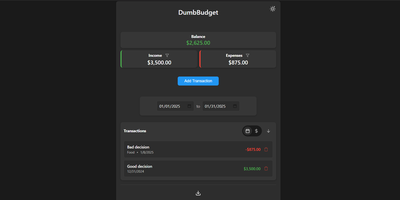
"Stupid simple software" is the entire philosophy at DumbWare.io, and DumbBudget delivers it: no over-engineering, no complexity, no accounts, no bank connections - just a clean, modern ledger for money in and money out. Log income and expenses, assign categories, and watch real-time balance calculations update as you type. Finding transactions is quick: filter by type, narrow by date range, sort by date or amount. When tax season or spreadsheet analysis calls, everything exports to CSV. Access control matches the philosophy - a single PIN (set via one environment variable) gates the app, backed by real security engineering: rate limiting on PIN attempts, temporary lockout after failures, secure session handling, and no sensitive data in browser storage. Multi-currency support covers the ISO codes, and a SITE_TITLE variable names each instance - deliberately useful, because running separate instances per account or family member is the intended pattern for multi-user needs. The responsive UI ships light and dark themes and installs as a PWA on phones, where expense logging actually happens. Configuration is five environment variables; data persists in one folder. If Actual Budget and Firefly III feel like accounting software, this is the notepad that gets used. GPL-licensed.
Lyftr
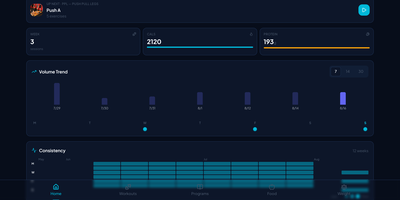
Lyftr delivers a self-hosted workout and nutrition tracker that runs on a small VPS — no subscriptions, no vendor lock-in, no "export is a Pro feature" paywalls. The Go backend with Gin framework provides JWT authentication and a REST API while storing everything in a single SQLite database file you can back up with one copy command. The exercise library ships with 800+ movements auto-seeded on first run, letting you build reusable workout programs with target sets, reps, and weights from day one. Active workout mode provides a guided set-by-set flow through your session while Gym Mode offers a full-screen card layout showing one exercise at a time with an integrated rest timer for focused training. The React frontend built with TypeScript and Tailwind delivers a mobile-first interface featuring a dashboard with weekly session KPIs, daily calorie and protein tracking, 12-week consistency heatmap, volume trend charts, and muscle balance visualization with sparklines. Nutrition tracking connects to Open Food Facts for food search with camera-based barcode scanning, logging calories and macros across customizable meal sections. Bodyweight logging with trend graphs supports both lbs and kg units across all data. An Android APK connects to your self-hosted instance for native mobile access. Running on a dedicated VPS on RepoCloud with guaranteed CPU, RAM, and SSD, full root SSH access, and a browser serial console. MIT licensed.
Freshrss
Where Miniflux strips reading down, FreshRSS gives you knobs - the feature-rich pole of self-hosted RSS, comfortable with thousands of feeds. It's a multi-user PHP aggregator (host family and friends on one instance, with an anonymous reading mode) with the reading workflow refined over a decade: favorites, custom tags, powerful filter and search queries, three reading views, and statistics that reveal each site's publishing frequency - useful for pruning subscriptions. Two properties make it the standard choice. First, the Google Reader-compatible API (plus a Fever API) syncs with virtually every serious RSS client - Reeder, NetNewsWire, ReadYou, FeedMe, Fluent Reader - so your phone reads from your server. Second, native WebSub support means compatible sources (WordPress, Blogger, Medium, Friendica) push new articles instantly instead of waiting for polling. A 50+ extension ecosystem adds what truncated feeds omit - full-text content fetching, reading-time estimates, trending views, auto-unsubscribe for dead feeds - alongside community themes and custom CSS. OPML import/export keeps subscriptions portable, a CLI handles administration, and article sharing posts to many services. AGPL-licensed, running on SQLite, MySQL, or PostgreSQL. Feedly Pro's feature set, minus Feedly's subscription and its algorithms.
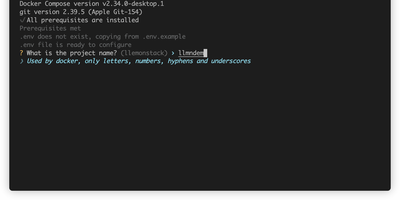
LLemonStack
One CLI command deploys a complete AI development environment: n8n, Flowise, Supabase, Ollama, Qdrant, LiteLLM, Langfuse, Open WebUI, LightRAG, Browser-Use, Firecrawl, Crawl4AI, and more, all pre-wired with networking, credentials, and database connections. LLemonStack eliminates the hours of Docker Compose configuration that typically precede any local AI agent project. The llmn CLI initializes isolated project environments with auto-generated secure credentials, starts services in dependency order (databases first, then middleware, then apps), and displays a dashboard showing every service URL and access token. n8n brings 400+ workflow integrations, Flowise provides visual agent building, Ollama runs local LLMs like Llama and Mistral, Qdrant stores vectors at high performance, Open WebUI offers ChatGPT-style model interaction, and LiteLLM proxies requests to any provider with cost tracking. Langfuse automatically logs traces for every LiteLLM query, providing full observability. Each project maintains isolated Postgres schemas preventing data collision across parallel stacks. Firecrawl and Crawl4AI extract web content into LLM-ready formats for RAG pipelines feeding LightRAG or Qdrant. Dozzle streams live container logs for debugging. Import/export tooling migrates workflows between projects with automatic credential reconfiguration. Running on a dedicated VPS on RepoCloud with guaranteed CPU, RAM, and SSD, full root SSH access, and a browser serial console. AGPL-3.0 licensed.
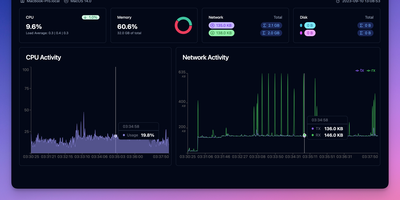
ServerBee
ServerBee delivers complete fleet monitoring from a single Rust binary that embeds both the server and web UI, requiring no external database or heavy runtime. Lightweight agents installed on each node stream CPU, memory, disk, network, load, temperature, GPU, and disk I/O metrics over persistent WebSocket connections to a central server backed by embedded SQLite. The real-time React dashboard presents 17 drag-and-drop widget types across custom layouts, with historical charts spanning one hour to 30 days and monthly traffic statistics with billing-cycle prediction and cost insights including burn rate and per-resource unit cost scoring. Network monitoring covers ICMP, TCP, and HTTP ping probes, service monitors for SSL certificates, DNS records, HTTP keyword matching, TCP ports, and WHOIS expiration, plus network-quality probing across 96 China 3-ISP and international presets with IP-quality and streaming-unlock detection. Remote management features include a web terminal with sandboxed file manager, Docker container stats with logs and events, firewall configuration, and agent auto-update capabilities. Public status pages display 90-day uptime timelines, while alerting supports email and webhook notifications with flexible trigger expressions. A native iOS companion app provides mobile monitoring access. Deploy via Docker or download the single binary for Linux, macOS, or Windows, running on a dedicated VPS on RepoCloud with guaranteed CPU, RAM, and SSD, full root SSH access, and a browser serial console. AGPL-3.0 licensed.
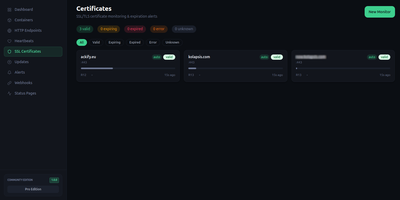
Maintenant
Maintenant replaces three to five separate monitoring tools with a single Go binary that consolidates container discovery, endpoint monitoring, SSL tracking, resource metrics, and public status pages without requiring any external database. The embedded Vue 3 frontend serves on port 8080 immediately after deployment, auto-discovering Docker containers and Kubernetes pods through direct socket and API access without configuration. HTTP and TCP endpoint monitoring validates availability with configurable intervals, while TLS certificate tracking alerts before expiration across all monitored domains. Resource metrics collect CPU, RAM, network throughput, and disk usage per container with real-time Server-Sent Events streaming to the dashboard. Heartbeat and cron monitoring accepts pings from external scheduled jobs, triggering alerts on missed check-ins via webhook callbacks and Discord notifications. The built-in alert engine supports escalation rules and notification batching. Public status pages expose component health to end users without authentication, customizable per monitored service. Network security insights analyze exposed ports, container privilege levels, and host configuration to produce a posture score. Update intelligence scans OCI registries to detect available container image updates with digest comparison. The REST API with SSE broker enables automation, and the integrated MCP server provides tooling for AI assistant integration. SQLite in WAL mode stores all data with zero operational overhead. Running on a dedicated VPS on RepoCloud with guaranteed CPU, RAM, and SSD, full root SSH access, and a browser serial console. AGPL-3.0 licensed.

DumbPad
With a deliberately minimalist design philosophy and zero database dependencies, DumbPad delivers a self-hosted notepad that stores notes as plain text files with real-time auto-saving every 10 seconds and keyboard-shortcut manual saves. The Node.js Express backend serves a vanilla JavaScript frontend that supports multiple named notepads with direct URL linking and shareable links for instant access to specific notes. The split-view editor displays markdown source on the left and rendered preview on the right with a draggable resize handle, while the full preview mode renders complete markdown with GitHub-style alert blocks for Note, Tip, Important, Warning, and Caution callouts, extended table formatting, fenced code blocks with syntax highlighting via highlight.js covering approximately 180 programming languages, collapsible details sections, and checklist support. Fuzzy search matches across both filenames and file contents for fast navigation across large collections. Optional PIN protection secures access with configurable 4 to 10 digit codes, constant-time comparison to prevent timing attacks, brute force lockout after 5 failed attempts with 15-minute cooldown, and IP-based tracking. The Docker container runs as non-root UID 1000 by default with multi-architecture support, CORS origin restrictions for reverse proxy deployments, and persistent data volumes. Notes can be downloaded as text or markdown files, printed with auto-expanded collapsible sections, and imported by placing text files directly into the data directory. On RepoCloud, deploy DumbPad on a dedicated VPS with Docker, root SSH access, and complete control over your note-taking infrastructure, all under the GPL-3.0 license.
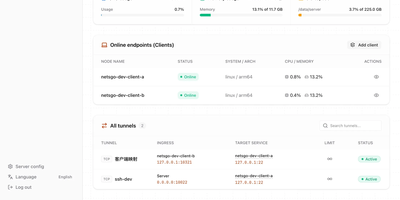
NetsGo
Created to eliminate the configuration fragmentation plaguing multi-device Homelab setups and small-team infrastructures, NetsGo merges what typically requires three separate tools — a tunnel daemon, a management panel, and a monitoring stack — into a single Go binary that starts with one command and listens on one port. The server exposes HTTP, TCP, and UDP tunnels, a built-in Web console for node management, a REST API for automation, and real-time traffic statistics with per-client bandwidth limiting, all sharing default port 9527 so firewalls and reverse proxies need only a single rule. Version 0.1.11 introduced Client-to-Client P2P tunnels via WebRTC DataChannel with three selectable transport strategies — Server relay, Prefer P2P with automatic fallback, and P2P only — reducing latency for direct connections while maintaining the centralized control plane. The management console displays every connected client's online status, authentication tokens, tunnel configuration, active transport mode, P2P candidate gathering progress, and cumulative byte-level traffic counters updated every second. Unlike frp or rathole which delegate management to external plugins or configuration files, NetsGo provides built-in client key generation, tunnel target migration between nodes, SOCKS5 proxying, IP-whitelist console access, and one-command server upgrades. Running on a dedicated VPS on RepoCloud with guaranteed CPU, RAM, and SSD, full root SSH access, and a browser serial console. Apache 2.0 licensed.
Orbit
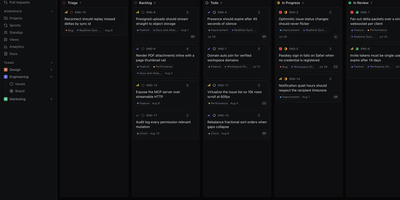
Orbit is a free, realtime project management platform that unifies issue tracking, kanban boards, sprint cycles, and collaborative documents into a keyboard-driven workspace with native AI agent integration. Engineers can manage backlog items across customizable kanban boards, execute timeboxed sprint cycles with automated burndown charts, and link pull requests directly to the tasks they resolve. Team members compose specifications and meeting notes in rich-text documents with nested collections, inline comment threads, public sharing links, and self-contained interactive web pages that render alongside active project milestones. The built-in standup board aggregates workspace activity into an interactive kanban filtered to individual assignees, while comprehensive analytics dashboards report issue throughput, scope modifications, churn rates, and team distributions. Autonomous coding assistants connect directly through the integrated Model Context Protocol server to inspect project status, triage incoming tickets, file detailed bug reports, and trigger automated notifications across workspace channels. Custom views allow teams to filter issues by priority, estimate, or assignee and save shared workspace perspectives for recurring planning sessions. Running on a dedicated VPS on RepoCloud with guaranteed CPU, RAM, and SSD, full root SSH access, and a browser serial console. Apache-2.0 licensed.

GoRaven
GoRaven transforms AI chat from a question-answer window into a full engineering workstation where agents read files, write code, run shell commands, query databases via MCP tools, and deliver structured results — orchestrating across OpenAI, Claude, DeepSeek, Gemini, Qwen, GLM, and Ollama with task-based routing that allocates the right model for each job based on cost and capability. Built on a Go backend using the Freedom framework with Iris HTTP and a React/TypeScript frontend powered by Vite and Tailwind CSS, each user operates in an isolated workspace with team-shared project areas and centrally managed model quotas. The skill marketplace packages prompts, scripts, and workflows as reusable installable units with automatic dependency resolution and centralized versioning. MCP toolchain integration connects agents to internal APIs, databases, private services, and CLI tools so they query data, invoke services, and trigger actions directly. RAG-powered knowledge bases ingest policies, documentation, and business data for real-time retrieval during planning, coding, and Q&A with source attribution. Long-running task support decomposes complex work through a main agent coordinating sub-agents that execute in parallel across sessions. Plugin hooks inject custom logic at conversation start and end, tool calls, and SSE event streams without forking core code. The operations dashboard tracks usage metrics, model consumption, and team activity. Supports SQLite, MySQL, or PostgreSQL with Redis or local memory caching. Deploy with a single Docker command. Running on a dedicated VPS on RepoCloud with guaranteed CPU, RAM, and SSD, full root SSH access, and a browser serial console. Apache 2.0 licensed.

Hiccup
"Get to your most important links, FAST" - Hiccup's README states its whole mission in that one line, and the static start page delivers it. It is a client-side React single-page app - no backend, no database, no accounts - driven entirely by a config.json that defines featured link cards, categorized sections, and search providers. The search bar is the power feature: it queries your own links by name, URL, and tag while simultaneously offering external providers like Google, DuckDuckGo, and Amazon (plus custom URL-template providers you define), with arrow-key navigation and Enter to launch, so muscle memory replaces mousing. Editing happens in the browser - drag and drop links and background images, tweak cards in edit mode - with changes persisting to localStorage; a built-in config manager exports the JSON for hosting, and remote profile loading pulls a shared config across every browser and device you use. Multiple profiles keep home-server, work, and dev-tool link sets separate. PWA support installs it on a phone home screen, caching strategies keep it fast offline, read-only mode suits kiosk displays, and Cmd/Ctrl+/ reveals the full hotkey reference. Serve it from any static host and point your new tab at it.
LogTide
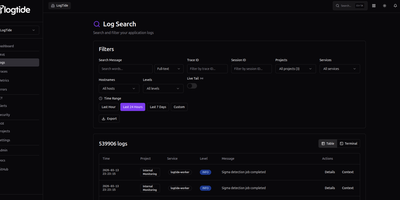
Every production incident starts the same way: someone asks "what do the logs say?" and the answer takes 45 minutes to find. LogTide collapses that search into seconds with a unified observability platform that indexes logs, traces, and metrics into a single queryable interface, backed by your choice of TimescaleDB, ClickHouse, or MongoDB. The log search interface supports full-text queries across millions of entries with filters for trace ID, session ID, project, service, hostname, and severity level, plus a live tail mode that streams new log lines as they arrive. Distributed traces render as waterfall timelines showing every span, its duration, and cross-service dependencies, while correlated logs for each trace are one click away. The metrics explorer visualizes OTLP gauge and counter data from your applications with system CPU, memory, disk, and network panels that update in near real-time. Where LogTide diverges from standard observability is its built-in SIEM engine: Sigma-compatible detection rules scan incoming logs for security threats like SQL injection, privilege escalation, lateral movement, and C2 communication, surfacing findings on a dedicated security dashboard with severity distribution, detection timelines, and affected service breakdowns. Alerting pushes notifications to Email, Slack, or Discord webhooks when thresholds trip or security rules fire. Native SDKs for Node.js, Python, Go, PHP, Kotlin, and Ruby ship logs with retry logic and circuit breakers, and the platform accepts OpenTelemetry data natively. Running on a dedicated VPS on RepoCloud with guaranteed CPU, RAM, and SSD, full root SSH access, and a browser serial console. AGPL-3.0 licensed.
PayMe
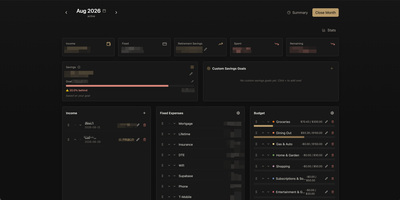
PayMe is a privacy-first personal finance dashboard that runs entirely on your own hardware with zero third-party service dependencies. The Rust backend compiled to a single binary serves a React 19 frontend built with Vite, TypeScript, and Tailwind CSS 4, storing all financial data in a local SQLite database that auto-migrates on startup. Monthly dashboards track income entries, fixed expenses like mortgage and utilities, and budget categories with real-time progress bars showing spending against configurable limits. The savings module includes goal tracking with percentage-based progress indicators, custom savings goals for targeted objectives, retirement savings projections with breakdown analysis, and projected savings calculations. Variance analysis compares actual spending against budgets across categories. Drag-and-drop reordering powered by dnd-kit lets you arrange income sources, expenses, and budget items to match your workflow. The interactive charts rendered by Recharts visualize spending trends, income patterns, and savings trajectories. Month-by-month navigation tracks financial history over time, while the Summary and Stats views aggregate data across periods. JWT-based authentication secures access, and the full OpenAPI Swagger documentation at the /swagger-ui endpoint exposes every API route for automation and integration. Docker Compose deployment creates a minimal image with the compiled Rust binary and static frontend assets, running on port 3001 behind nginx, Caddy, or Traefik reverse proxy with HTTPS. On RepoCloud, deploy PayMe on a dedicated VPS with persistent SQLite storage, root SSH access, and complete privacy over your household financial data, all under the MIT license.