Whisper Money
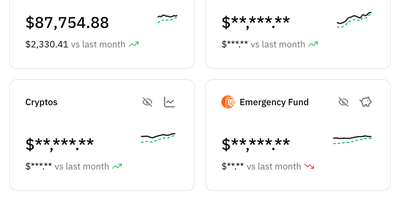
Ditch the spreadsheet for good: Whisper Money is a privacy-first personal finance app you host yourself to see exactly where your money goes, without your data being sold or profiled for ads. Connect multiple bank accounts in one place, fill them by hand or CSV import, and watch transactions categorize themselves automatically. Automation rules handle the repetitive sorting: rent, subscriptions, and transfers land in the right buckets every time. Brokers and exchanges including Indexa Capital, Coinbase, Binance, Bitpanda, Wise, and Interactive Brokers connect with your own API keys, so investments sit beside everyday spending. Optional open banking through EnableBanking can pull a year of movements and keep them current, and it stays switched off until you configure it. AI features suggest categories and rules and summarize your stats reports, and you choose the provider: Gemini by default, or OpenAI, Anthropic, Groq, DeepSeek, Mistral, any OpenAI-compatible endpoint, or a local Ollama server so nothing leaves your infrastructure. Spending pattern insights turn raw transactions into an honest picture of your habits, month after month. Running on a dedicated VPS on RepoCloud with guaranteed CPU, RAM, and SSD, full root SSH access, and a browser serial console. CC BY-NC 4.0 licensed.

OpenPost
OpenPost is an open-source content creation and publishing suite that unifies multi-platform social scheduling, graphic design, and video editing into a single self-hosted control center. Creators can compose one primary announcement and tailor bespoke copy, media attachments, and thread structures across sixteen distinct networks including Bluesky, Mastodon, X, Threads, LinkedIn, YouTube, and Discord. The integrated browser canvas lets you design multi-slide carousels with custom typography, layer ordering, and automated background removal without juggling external design software. A built-in multitrack video suite allows you to trim footage, render subtitle captions, insert transitions, and slice clips directly by highlighting spoken words in generated transcripts. Social managers can organize campaigns through an interactive visual calendar, stagger deliveries across automated queues, and monitor unified comment streams to answer incoming audience inquiries directly from a single inbox. Teams can organize multiple independent client brands into partitioned workspaces with role-based permissions, automated repost policies, and programmable scheduling webhooks via native REST and Model Context Protocol endpoints. Running on a dedicated VPS on RepoCloud with guaranteed CPU, RAM, and SSD, full root SSH access, and a browser serial console. AGPL-3.0 licensed.
AliasVault
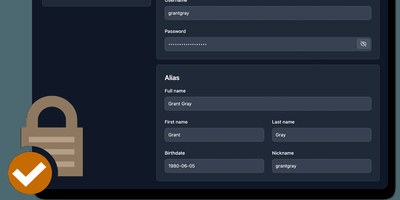
Sign up for a new service and you face a familiar choice: hand over your real email and get spam-listed forever, or generate a throwaway alias that dies when you close the tab. AliasVault eliminates that trade-off by combining a password manager with a built-in email server, so every website gets a unique identity (random email, generated name, strong password) and incoming emails land directly in your encrypted vault rather than your primary inbox. Creating a new alias takes one click: the system generates a random address on your configured domain, a fake identity with name and birthdate, and a cryptographically strong password, all stored in a zero-knowledge encrypted vault that even the server administrator cannot read. Browser extensions for Chrome, Firefox, Edge, Safari, and Brave detect login forms and autofill credentials or prompt you to create a new alias on the spot. Native iOS and Android apps with biometric unlock provide mobile access to your vault and integrate with the operating system's autofill framework. The built-in TOTP authenticator generates time-based one-time codes without needing a separate app. Import existing credentials from other password managers through standard export formats, and export your vault data at any time for full portability. Self-hosting via Docker with your own email domain gives you complete control over where alias mail is received and stored, with no third-party dependencies. Running on a dedicated VPS on RepoCloud with guaranteed CPU, RAM, and SSD, full root SSH access, and a browser serial console. AGPL-3.0 licensed.
AnythingMCP
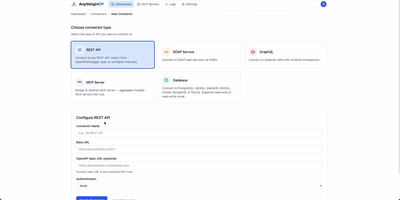
Connecting autonomous AI assistants to internal enterprise databases and legacy systems is streamlined by AnythingMCP, a visual Model Context Protocol gateway with automated knowledge graph generation and granular access controls. Engineers can import OpenAPI specifications, Postman collections, SOAP WSDL files, or raw database credentials to generate standardized Model Context Protocol tools in minutes without writing custom code. The built-in knowledge graph automatically maps entity relationships across disparate databases and software platforms, teaching agents how to correlate customer records in CRM tools with live order histories in enterprise resource planning software. System administrators can enforce fine-grained access policies by restricting tool execution permissions to specific roles and scoping database operations to read-only queries with strict row limits. An interactive web console provides real-time tool inspection, payload testing, request tracing, and comprehensive audit logs that capture every upstream invocation with full parameter visibility. Enterprise teams can integrate identity providers through OAuth2, SAML single sign-on, and SCIM automated user provisioning while protecting sensitive credentials using AES-256-GCM encryption at rest. Running on a dedicated VPS on RepoCloud with guaranteed CPU, RAM, and SSD, full root SSH access, and a browser serial console. GNU AGPLv3 licensed.
Tiledesk
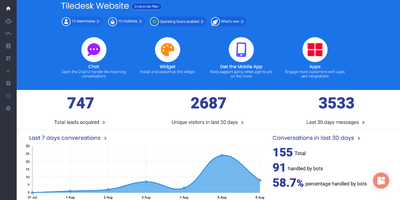
Tiledesk lets you build AI-powered conversational agents with a visual drag-and-drop designer, then deploy them simultaneously across web chat, WhatsApp, Telegram, Facebook Messenger, Instagram, email, and Slack without rebuilding per channel. The no-code Design Studio combines LLM-powered conversations with conditional logic, external API calls, and branching dialogue trees that work identically everywhere. Multi-RAG knowledge management separates content into isolated repositories with hybrid search combining traditional full-text retrieval and semantic understanding via Qdrant vector embeddings, enabling accurate answers even when users phrase queries in unexpected ways. LLM integration supports GPT-4, GPT-4o, Anthropic Claude, and any model exposing an OpenAI-compatible API including locally hosted models via Ollama for complete data sovereignty. The human-in-the-loop system provides seamless escalation from AI agents to live support staff with full conversation context preserved, while multi-agent workflows enable complex orchestration where specialized bots collaborate on different aspects of a customer interaction. REST and MQTT APIs power integration with external systems and webhook-triggered automations, and pre-designed templates accelerate common scenarios. Docker Compose deployment starts the full stack including server, dashboard, messaging engine, and widget. Running on a dedicated VPS on RepoCloud with guaranteed CPU, RAM, and SSD, full root SSH access, and a browser serial console. MIT licensed.

MyTube
For video enthusiasts and media archivers who want complete ownership over their online video subscriptions, MyTube provides a self-hosted video downloader, library organizer, and streaming portal. Paste a single link or queue a batch of URLs from YouTube, Bilibili, Twitch, MissAV, and over one thousand yt-dlp compatible sites to archive videos directly to your disk. Subscribe to your favorite creators so new uploads download automatically in the background alongside their default language subtitles. Local video uploads automatically generate thumbnails and pull movie or television posters, cast details, release years, and ratings from TMDB. Curate custom collections, filter your catalog by tags or authors, and generate private RSS feed links for external podcast and feed readers. Built-in playback tools include keyboard shortcuts, cinema mode, Canvas-based in-car playback, and optional real-time audio translation with live subtitles via Google Gemini. You can sync finished recordings to Alist or OpenList cloud storage, trigger custom shell scripts on task completion, and receive instant Telegram bot alerts when downloads finish or fail. Share your library safely using read-only visitor accounts while protecting admin controls with WebAuthn passkeys or a 3x3 gesture lock. Running on a dedicated VPS on RepoCloud with guaranteed CPU, RAM, and SSD, full root SSH access, and a browser serial console. MIT licensed.

Quackback
Quackback unifies customer feedback boards, feature voting, public roadmaps, release changelogs, help centers, status pages, and a multi-channel support inbox into a single self-hosted workspace that replaces Canny, Productboard, and Intercom. Product teams use its branded boards to collect feature requests and bug reports, merge duplicate submissions, and rank demand by user votes or customer segments. When a request moves into development, two-way integrations with Linear, GitHub, and Jira automatically update the card across customizable Kanban status columns or quarterly timeline views on your public roadmap. Support agents work out of a shared inbox that brings real-time Messenger web chat, inbound email threads, and durable support tickets together under one roof, complete with SLA timers, office hours, saved macros, and CSAT surveys. Conversations that uncover a feature gap convert directly into votes on existing feedback posts without losing thread context. Quinn, the built-in AI assistant, answers common questions from your Help Center articles, drafts agent replies, and exposes a Model Context Protocol server so external AI tools can triage posts or manage tickets. Once features ship, publishing a scheduled changelog entry automatically notifies every voter via email and in-app alerts. Running on a dedicated VPS on RepoCloud with guaranteed CPU, RAM, and SSD, full root SSH access, and a browser serial console. AGPL-3.0 licensed.
Ever Teams
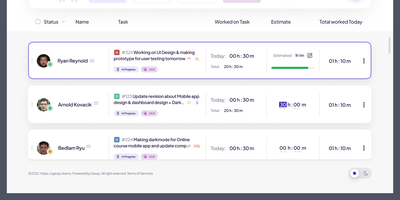
Powering distributed teams seeking full visibility into work patterns and productivity, Ever Teams is an open-source platform unifying time tracking, task management, project coordination, and team collaboration in a single self-hosted application. The real-time timer tracks work against tasks and projects with one-click start/stop, while the Electron desktop app captures periodic screenshots at configurable intervals, monitors keyboard and mouse activity levels, detects idle periods, and syncs offline sessions automatically. Kanban boards with drag-and-drop, calendar views, and daily planning tools organize work across custom statuses, priorities, and sizes. Built-in video conferencing powered by Jitsi or LiveKit enables meetings without leaving the platform. Timesheet management supports submission, review, and approval workflows with configurable time limits and budgets. The backend runs on the Ever Gauzy NestJS platform providing REST and GraphQL APIs, multi-tenant architecture with organization and team scoping, role-based access control, and an integration framework connecting GitHub issues and pull requests bidirectionally plus JIRA import and sync. Infrastructure includes PostgreSQL, Redis for caching and pub/sub, MinIO for S3-compatible storage, Elasticsearch for full-text search, and Cube.js for OLAP analytics. Built with Next.js 16, React 19, Tailwind CSS, and Recoil, with native iOS and Android clients via Expo, Electron desktop apps for Windows, macOS, and Linux, and Plasmo browser extensions for Chrome and Firefox. Internationalization spans 13-plus locales with dark, light, and system themes. Running on a dedicated VPS on RepoCloud with guaranteed CPU, RAM, and SSD, full root SSH access, and a browser serial console. AGPL v3.0 licensed.
ScribeWizard
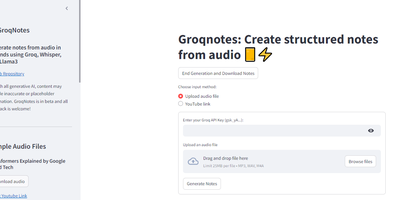
Audio lectures become structured, Markdown-formatted notes in about a minute with ScribeWizard (also known as GroqNotes). Upload an MP3, WAV, or M4A file - or paste a YouTube link - and the app runs a three-stage pipeline on Groq's LPU inference hardware: Whisper Large v3 transcribes the audio, a larger Llama model drafts a comprehensive outline of the material, and a faster Llama model fills each section with detailed content. This scaffolded prompting strategy is the core idea: the strong model handles structure where quality matters most, the fast model handles volume, and Groq's 1200+ tokens-per-second inference keeps the whole process near real time. Output renders as clean Markdown with support for tables and code blocks, and finished notes download as text or PDF. Model selection is configurable - swap in other Groq-hosted open models like Mixtral or Gemma to trade speed against quality or work around rate limits. Built as a single Streamlit app by Benjamin Klieger at Groq, it needs only a Groq API key to run, making it one of the simplest self-hosted AI tools to operate.
Dockpeek
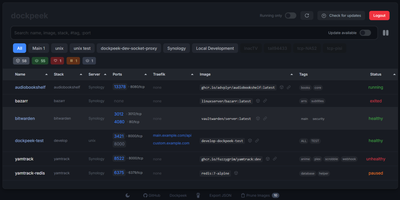
Fleet-wide container discovery, live log streaming, and Traefik reverse-proxy routing converge into Dockpeek, a lightweight Docker dashboard built for multi-host server environments. System administrators can launch web applications with one click through automatic port binding detection and integrated Traefik label parsing that extracts public routing hostnames directly from container configurations. The platform monitors multi-host environments through encrypted Docker socket proxies, letting operators inspect running containers, query published network ports, and trigger image updates from a unified control panel. Native Docker Swarm integration auto-detects active cluster managers, mapping swarm services and replicated tasks alongside standalone workloads while flagging degraded service replicas. Built-in log inspectors stream stdout and stderr outputs in real time with line-filtering controls to diagnose crashed services without opening remote SSH terminals. Operators can track image registries for newer digest tags, review pending updates across container fleets, and trigger graceful rolling container recreations directly from the dashboard. Running on a dedicated VPS on RepoCloud with guaranteed CPU, RAM, and SSD, full root SSH access, and a browser serial console. MIT licensed.
Pipelock
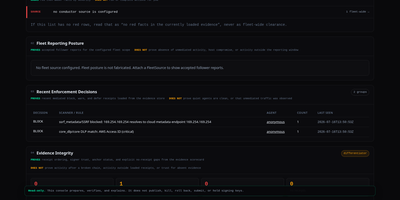
Your AI coding agent has your API keys in its environment and unrestricted network access, which means one prompt injection away from sending those secrets anywhere. Pipelock closes that gap by sitting as a proxy between your agents and every outbound connection, scanning the actual content of HTTP, WebSocket, MCP, and Agent-to-Agent traffic before it leaves your server. An 11-layer scanner pipeline checks every request against 62 credential patterns covering AWS, GCP, Azure, GitHub, OpenAI, Anthropic, SSH keys, and database URLs, then inspects every response for prompt injection using 29 detection patterns with six-pass normalization that catches base64-encoded, leetspeak, and whitespace-obfuscated payloads. The MCP proxy wraps any Model Context Protocol server (stdio, HTTP, or WebSocket) with bidirectional scanning that detects tool description poisoning and mid-session rug-pull changes via SHA-256 fingerprinting. Every scanning decision produces a cryptographically signed action receipt that third parties can verify offline without trusting the agent or the vendor. The Operator Console provides a web dashboard for reviewing evidence scorecards, receipt timelines, agent sessions, enforcement decisions, and fleet posture at a glance. Cross-request taint tracking catches slow-drip exfiltration attempts that spread a secret across multiple calls. Canary tokens plant synthetic secrets that trip alerts the moment an agent tries to exfiltrate them. Pre-built Prometheus metrics and a Grafana dashboard provide real-time visibility into traffic volumes and block rates. Deploy on a dedicated VPS on RepoCloud with guaranteed CPU, RAM, and SSD, full root SSH access, and a browser serial console. Apache 2.0 licensed.

Easy Invoice PDF
Freelancers, contractors, and small shops can turn a short form into a client-ready PDF invoice, with a live preview that redraws on every keystroke and no account to create. Fill in seller and buyer details, then add line items with quantity, unit, net price, and tax rate; net amounts, tax, totals, and the amount in words are calculated automatically. Item discounts take a percentage or fixed amount off any line under a custom label, and tax applies to the discounted figure. Pick a classic layout or a Stripe-style template, and add your logo as a JPEG, PNG, or WebP file. Invoices can be written in 13 languages, including Brazilian Portuguese, with 122 currencies, 18 date formats, and a number format setting that survives a language switch. Tax labels can read VAT, GST, Sales Tax, or anything else, or the tax columns can be dropped entirely. Bank account, SWIFT/BIC, payment method, due date, and notes sit alongside an optional QR code that can carry a payment link, UPI details, or contact information. Long invoices flow onto extra pages automatically. Saved seller and buyer profiles fill in the next invoice for you, and the data stays in the browser. Download the PDF or copy a shareable link that opens the same invoice for your client. Running on a dedicated VPS on RepoCloud with guaranteed CPU, RAM, and SSD, full root SSH access, and a browser serial console. AGPL-3.0 licensed.
AirTrail
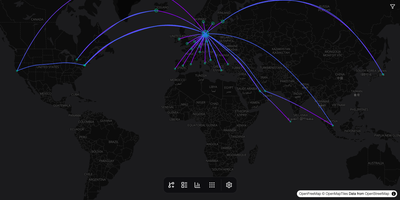
Commercial flight logbooks frequently lock historical travel records behind annual subscriptions or shut down unexpectedly, whereas AirTrail preserves your complete aviation history on an interactive world map under your own control. Enter a flight number to look up routes automatically or log departures manually with seat numbers, cabin classes, aircraft registrations, timestamps, notes, and custom metadata fields. Switching from another tracker takes seconds: the built-in importer ingests CSV, ICS, and JSON exports from MyFlightradar24, Flighty, App in the Air, OpenFlights, TripIt, JetLog, byAir, and JetLovers. The vector map renders geodesic flight paths, recorded GPS tracks, and airport runway details across customizable basemaps. Detailed statistics dashboards break down total distance flown, time in the air, top airlines, aircraft models, and visited countries. Families and travel groups can share a single instance with role-based permissions, OAuth single sign-on, and read-only public links, while developers automate entries through the versioned REST API or Model Context Protocol server. Running on a dedicated VPS on RepoCloud with guaranteed CPU, RAM, and SSD, full root SSH access, and a browser serial console. GPL-3.0 licensed.
Mission Control
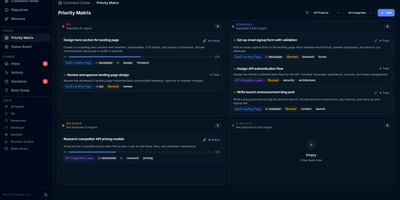
With over 600 GitHub stars and a featured Show HN launch, Mission Control is the agent-first command center that replaces the chaos of manually shepherding AI agents with structured delegation, approval workflows, and autonomous execution. The Next.js 15 web UI delivers an Eisenhower priority matrix with drag-and-drop quadrants, a Kanban board tracking tasks through Not Started, In Progress, and Done columns, and a goal hierarchy with milestone progress bars — powered by shadcn/ui, Radix UI, and @dnd-kit. Six built-in agent roles — Researcher, Developer, Marketer, Business Analyst, Tester, and You — receive tasks through a token-optimized API compressing context by 92 percent to approximately 50 tokens versus 5,400 unfiltered. The autonomous daemon polls task queues on cron schedules, spawns Claude Code sessions via the official CLI, enforces concurrency limits, and auto-retries with loop detection that escalates to human decisions after three failures. Field Ops extends execution to 64 external services across 16 categories with working X, Ethereum with MetaMask signing, and Reddit adapters, protected by AES-256-GCM encrypted vault with scrypt key derivation, per-service and global spend limits, a circuit breaker, and three autonomy levels. All data lives in local JSON files with Zod validation and async-mutex locking ensuring safe concurrent writes, backed by 193 automated Vitest tests. Running on a dedicated VPS on RepoCloud with guaranteed CPU, RAM, and SSD, full root SSH access, and a browser serial console. AGPL-3.0 licensed.
degoog
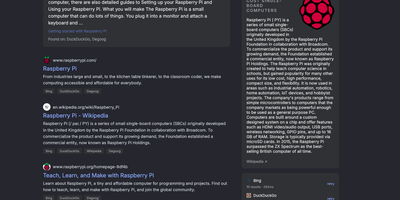
Instead of trusting one search company with every query, degoog is a self-hosted search aggregator that fans each one out to the engines you choose, from your own server, and merges the answers into one deduplicated, ranked list. It installs with no engines at all; a first-run tour then walks you through picking Google, Bing, DuckDuckGo, Brave, Startpage, Reddit, or Wikipedia from the built-in Store. Pages found by several engines collapse into a single row that lists every source, while a sidebar times each engine, explains failures like rate limits or CAPTCHAs, and retries only the one that failed. Tabs appear for each search type your engines serve, and the Images tab adds size, color, layout, and safe-mode filters beside a zoomable preview panel. Bangs target one engine or run commands (!w for Wikipedia, !ip, !speedtest, !uuid), and Store plugins add weather, definitions, QR codes, and search across your own Jellyfin or Meilisearch libraries. Owners can block, rewrite, or score domains, serve a script-free page to text browsers, and turn on an indexer that remembers seen results for later recall. A JSON search API, a SearXNG-compatible response mode for Open WebUI, and an MCP companion feed the same results to scripts and LLM clients. Running on a dedicated VPS on RepoCloud with guaranteed CPU, RAM, and SSD, full root SSH access, and a browser serial console. AGPL-3.0 licensed.
Zeabur
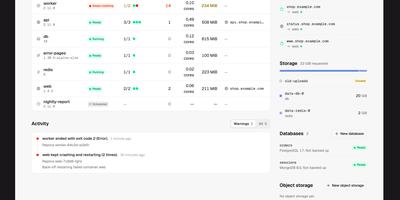
Zeabur is a self-hosted web platform that deploys and runs your services on your own Kubernetes cluster, presenting the cluster as simple projects and services instead of raw manifests. Every change starts as a readable plan listing the exact fields it will write and who owns them today, and nothing is applied until you confirm it. When something breaks, Zeabur says so in plain words and points at the fix: a worker that restarted fourteen times gets a button straight to the logs from the run before the restart. You deploy from Git repositories, from an uploaded folder or ZIP archive, or directly in the dashboard, then follow live logs, open a terminal inside a container, and watch CPU and memory move over time. Projects are namespaces and all state lives in Kubernetes objects, so there is no Zeabur database to back up, and uninstalling the platform leaves your Deployments, Services, and Ingresses running untouched. Companion pieces add passkey sign-in for kubectl with tokens that expire in minutes, image builds from Git through a BuildKit operator, and a catalog of cluster components and app templates. Running on a dedicated VPS on RepoCloud with guaranteed CPU, RAM, and SSD, full root SSH access, and a browser serial console. Apache-2.0 licensed.
UseAgent
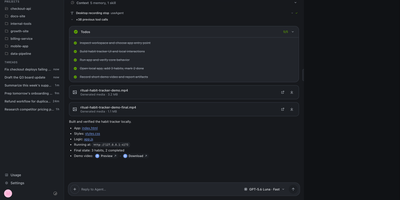
Hand a task to an AI teammate the way you would hand it to a person: describe the work, then follow along and step in when it matters. UseAgent runs Claude Code, Codex, OpenCode, and Pi inside isolated Linux workspaces, each with your repositories, a terminal, a real browser, and a desktop you can open and take over. Start work from the web app, by mentioning an agent in Slack, or through the API, and get pull requests, documents, spreadsheets, presentations, and research back as usable files. Four engines share one thread and one event format, so you can compare how Claude Code and Codex each handled the same bug, then switch engines on the next reply without losing history, files, or memory. Risky operations pause at approval gates, and a decision resumes the run with a one-shot, argument-bound capability instead of blanket trust. Every step, tool call, and approval is stored as an append-only event log in your Postgres, replayable after the fact and durable across restarts mid-task. Teach the workspace your procedures by importing versioned skills from GitHub and pinning playbooks to tasks, while knowledge pages and optional team memory stay beside the work, inspectable and correctable. Recurring tasks run on schedules with full history. Provider keys stay on your server and never enter an agent sandbox. Running on a dedicated VPS on RepoCloud with guaranteed CPU, RAM, and SSD, full root SSH access, and a browser serial console. AGPL-3.0 licensed.

HomeGallery
HomeGallery turns the photo and video folders on your server into a mobile-friendly web gallery. Your files and folder structure stay exactly as they are. Point it at camera files, phone files, or offline drives, and previews and metadata are extracted once. Scroll one endless stream, newest first. Open any image for its file name, dimensions, capture date, source paths, camera settings, street address, tags, and detected objects. Swipe between photos, then pinch or double-tap to zoom. The Map view clusters photos by place, with counts. The plant button lists similar images, so one sunset finds every other sunset. Face search finds the same person in other photos. A search box accepts expressions like tags in (vacation, family), type:video year in [2015:2020] order by duration, or not exists(geo). In Edit mode, select many photos at once and type comma-separated tags; a minus prefix removes one. Videos are transcoded for playback. Renamed or moved files keep their previews. An archive disk can stay unplugged once indexing is done. Optional logins limit each user to a query filter. Install it as a PWA for a lightweight mobile app. Running on a dedicated VPS on RepoCloud with guaranteed CPU, RAM, and SSD, full root SSH access, and a browser serial console. MIT licensed.